English
Last updated: September 2026
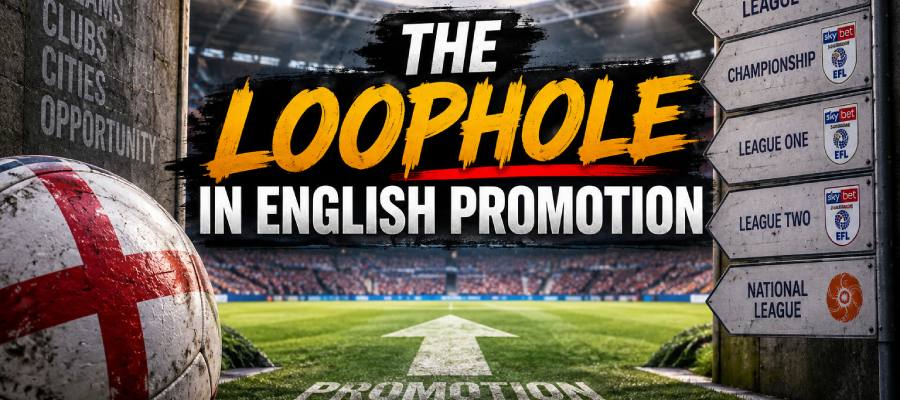
The English soccer system works as an open pyramid of connected leagues. The Premier League is tier one, followed by the EFL Championship, League One, League Two, and the National League. Clubs move between levels through promotion and relegation, with playoffs deciding some of the final promotion places.
Below the National League, the English football pyramid divides into regional competitions, including National League North and National League South. The system continues through additional semi-professional and local divisions.
Unlike a closed American sports league, membership at each level can change every season. Final standings, automatic promotion places, promotion playoffs, relegation positions, and club eligibility determine where a team competes next.
For bettors, this structure creates individual match markets and season-long futures. English football betting can include league winners, automatic promotion, promotion through any route, playoff qualification, relegation, survival, and top goalscorer odds. Understanding the structure helps bettors identify what a club is competing for before evaluating whether the available price offers value.
This guide separates the official English football league structure from the betting markets built around it. Competition formats and sportsbook settlement conditions can change, so bettors should confirm the current league format, market wording, and applicable rules before placing a wager. Betting information is educational and does not guarantee an outcome.
Table of Contents
- What Is the English Football Pyramid?
- What Is the Difference Between a Tier and a Step?
- How Many Clubs and Matches Are in Each Division?
- How Do Promotion and Relegation Work in English Football?
- How Do the English Football Promotion Playoffs Work?
- How Does Non-League Football Differ From the Professional Tiers?
- How Do the FA Cup and EFL Cup Fit Into the System?
- Navigating the English Football Structure: Tiers, Teams, and Betting Markets
- How Does the English Football Pyramid Affect Betting Markets?
- How Are Promotion, Relegation, and Premier League Futures Priced?
- Why Do English Football Betting Odds Move?
- How Can Bettors Find Value Across the English Soccer Tiers?
- Do Extra Time and Penalties Count in English Soccer Bets?
- What Mistakes Should Bettors Avoid in English Football Futures?
- FAQ
- Final Thoughts on the English Soccer System
What Is the English Football Pyramid?
The English football pyramid is a hierarchy of connected leagues. Clubs can move between those leagues based primarily on where they finish in the table at the end of the season.
The Premier League sits at the top. The Championship, League One, and League Two occupy the next three levels and collectively form the English Football League, commonly known as the EFL.
Below League Two sits the National League. That is the highest level normally described as non-league football. The system then divides geographically into National League North and National League South before expanding into additional regional competitions.
You may see this structure described as the English soccer league system, English football hierarchy, football pyramid, English soccer divisions, or English football tiers. These terms describe the same central idea: clubs are connected from the Premier League down through national, regional, semi-professional, and local competitions.
English Soccer Tiers From the Premier League to Non-League
The standard structure at the top of the men’s English football pyramid can be summarized as follows:
| Overall Tier | Competition | Standard Promotion | Standard Relegation |
|---|---|---|---|
| 1 | Premier League | Top division | Bottom three |
| 2 | EFL Championship | Top two plus playoff winner | Bottom three |
| 3 | EFL League One | Top two plus playoff winner | Bottom four |
| 4 | EFL League Two | Top three plus playoff winner | Bottom two |
| 5 | National League | Champion plus playoff winner | Clubs drop into the regional tier |
| 6 | National League North and South | Champion and playoff winner from each division | Clubs move into regional leagues below |
This is the standard movement between the main divisions, but lower-league allocations can change because of club eligibility, resignations, financial problems, league restructuring, or geographic considerations.
If you need a wider introduction to the wagering side of the sport, the soccer betting guide explains the main odds and markets used across domestic and international competitions.
What Is the Difference Between a Tier and a Step?
A tier describes a league’s position within the entire English football pyramid. A Step describes its position within the FA’s National League System.
For example, the National League is tier five of the complete English soccer system. However, it is also Step 1 of the National League System. National League North and National League South are tier six overall but Step 2 within the non-league structure.
This difference explains why official documents and league guides may appear to give a competition two different numbers. One number counts from the Premier League. The other starts with the National League System below the EFL.
How Many Clubs and Matches Are in Each Division?
The Premier League normally contains 20 clubs. Each team plays every other club once at home and once away, creating a 38-match league schedule.
The Championship, League One, and League Two normally contain 24 clubs each. That creates a 46-match league schedule before any promotion playoffs, EFL Cup, FA Cup, or other cup matches are added.
The National League also typically contains 24 clubs, while National League North and National League South operate as separate regional divisions. The exact composition can change when clubs move between regions or when administrative decisions affect league membership.
The longer EFL schedule matters to bettors. A club can play eight more regular-season league matches than a Premier League team while also competing in cup tournaments. That increases the importance of squad depth, rotation, recovery time, postponed fixtures, and travel.
How Do Promotion and Relegation Work in English Football?
Promotion and relegation connect each division. Clubs near the top compete to move up, while clubs near the bottom try to avoid dropping into the league below.
Premier League and Championship
The three clubs finishing 18th, 19th, and 20th in the Premier League are relegated to the Championship.
The top two Championship clubs earn automatic promotion to the Premier League. Teams finishing third through sixth enter the Championship playoffs for the final promotion place.
Championship and League One
The bottom three Championship clubs are relegated to League One. League One promotes its top two clubs automatically, while teams finishing third through sixth contest the playoffs for the third promotion place.
League One and League Two
The bottom four League One clubs are relegated to League Two. League Two promotes its top three clubs automatically, while teams placed fourth through seventh enter the playoffs for the fourth promotion place.
League Two and the National League
The bottom two League Two clubs can be relegated to the National League. The National League champion earns the automatic promotion position, while another club can go up through the National League playoffs.
A National League club may also need to satisfy admission, stadium, financial, and administrative requirements. Winning on the field and being eligible to enter the EFL are connected but separate considerations.
How Do the English Football Promotion Playoffs Work?
The EFL promotion playoffs give clubs that missed automatic promotion another opportunity to move up. The semifinal format depends on the division.
In the Championship and League One, third place faces sixth place while fourth faces fifth. The semifinals are played over two legs, with each club hosting one match. The two aggregate winners advance to the playoff final.
In League Two, fourth place faces seventh while fifth faces sixth. Those semifinals are also played over two legs before the winners meet in the final.
The playoff final determines the last promotion place from that division. One result can therefore change a club’s competitive level, future revenue, transfer plans, and betting expectations for the following season.
National League playoffs use a different format and may involve more participants. Bettors should confirm the current bracket, home-field rules, and qualification conditions rather than assuming every English playoff works like the EFL version.
How Does Non-League Football Differ From the Professional Tiers?
The term “non-league” can sound strange to American readers because the clubs still compete in organized leagues. In England, it traditionally means football played outside the Premier League and EFL.
Some National League clubs operate as full-time professional organizations. Farther down the pyramid, semi-professional and amateur structures become more common. Clubs may have smaller squads, different training schedules, tighter budgets, and more limited access to performance data.
Geography also becomes increasingly important. Regional divisions reduce travel costs and help make the system sustainable for smaller clubs. Promotion or relegation can therefore include geographic reassignment when a club moves into a regional level.
A non-league club can reach League Two through promotion and, in theory, continue climbing toward the Premier League. That structural continuity is one of the defining features of the English soccer pyramid.

How Do the FA Cup and EFL Cup Fit Into the System?
The FA Cup and EFL Cup are knockout competitions, not additional levels of the football pyramid. A club does not earn league promotion by winning a cup match, and losing a cup tie does not cause relegation.
The FA Cup includes eligible clubs from multiple levels, which creates the possibility of a lower-league team facing a Premier League opponent. These matches are often described as potential giant killings.
The EFL Cup is primarily contested by Premier League and EFL clubs. Cup schedules can still affect league betting because additional matches may create travel, rotation, injuries, and shorter recovery periods.
For that reason, cup participation can be an important variable when evaluating a club’s promotion campaign, relegation battle, or upcoming league match.
Understanding the English soccer system is essential whether you are breaking down long-term futures or hunting value in weekly match odds. From the global spotlight of the top division to the grueling 46-match schedules further down, every tier presents unique challenges for bettors. Use the complete structural breakdown below to see how clubs move through the divisions and access current betting markets for each competition.
| Tier | Competition Hub | Teams | Promotion Mechanics | Relegation Mechanics |
|---|---|---|---|---|
| 1 | Premier League | 20 | Top division (None) | Bottom three teams relegated to the Championship |
| 2 | EFL Championship | 24 | Top two plus playoff winner (3rd–6th) | Bottom three teams relegated to League One |
| 3 | EFL League One | 24 | Top two plus playoff winner (3rd–6th) | Bottom four teams relegated to League Two |
| 4 | EFL League Two | 24 | Top three plus playoff winner (4th–7th) | Bottom two teams relegated to the National League |
| 5 | National League | 24 | Champion plus playoff winner | Clubs drop into regional tiers |
English Cup Competitions & Additional Markets
Knockout tournaments add an entirely different layer of betting strategy, featuring sudden-death drama, potential giant-killings, and heavily rotated squads. Explore the dedicated hubs for domestic cups and international representation below:
- FA Cup: The historic knockout tournament open to clubs across multiple levels of the pyramid.
- EFL Cup (Carabao Cup): Primarily contested strictly by Premier League and EFL clubs.
- EFL Trophy: Featuring League One, League Two, and select academy U21 sides.
- FA Trophy: Showcasing clubs competing in non-league tiers.
- FA Community Shield: The traditional season-opener curtain-raiser.
- England National Team: International markets and tournament futures.
- Women’s Super League (WSL) & FA Women’s League Cup: Top-flight domestic women’s football markets.
- Professional Development League: Under-23 academy competition tracking.
- England Amateur League: Grassroots and amateur tier wagering.
Final Betting Takeaway: Whether you are tracking a multi-week relegation battle in the Championship or evaluating early cup fixtures, always review market settlement rules and squad rotations carefully before locking in your bets.
How Does the English Football Pyramid Affect Betting Markets?
The pyramid creates season-long betting markets that are uncommon in closed American leagues. In addition to individual matches, sportsbooks may price league winners, automatic promotion, promotion through any route, playoff qualification, relegation, survival, and top goalscorer futures.
The exact wording matters. A wager on a club to finish in the Championship’s top two is different from a wager on that club to earn promotion through any route. The second market may still win if the club finishes between third and sixth and then wins the playoffs.
Relegation markets can have similar distinctions. A sportsbook may offer a standard relegation price, a bottom-three finish, or a club to finish last. Those outcomes are related, but they are not interchangeable.
Match Betting Versus Season-Long Futures
A match market covers a specific fixture. Common options include the three-way moneyline, draw no bet, goal totals, both teams to score, handicaps, team totals, and player props.
A futures market remains open for a longer period and concerns a season-level outcome. English football futures can include the Premier League champion, Championship promotion, League One promotion, League Two top goalscorer, National League promotion, or relegation from a specific division.
The complete guide to betting on soccer explains moneylines, draws, totals, handicaps, props, and other common markets in greater detail.
For current prices across the available competitions, review the current soccer odds and betting lines. Bettors concentrating on England’s top division can compare the available English Premier League odds and betting markets.
How Are Promotion, Relegation, and Premier League Futures Priced?
Premier League relegation odds estimate the probability that a club will finish in one of the bottom three positions. Promotion odds perform a similar function farther down the pyramid, although the market may cover automatic promotion, promotion through any route, or a specific playoff outcome.
Sportsbooks can adjust English football futures using results, points, underlying performance, remaining schedule, injuries, transfers, squad depth, managerial changes, financial developments, and betting activity.
The price can also change as the number of realistic contenders becomes smaller. A club may begin the season as one of ten plausible promotion candidates but become one of only three serious contenders during the closing weeks.
How a Futures Market Narrows
Convert the Odds Into Implied Probability
Odds are prices, not predictions that must come true. Convert the available odds into an implied probability and compare that number with your estimate of the club’s actual chance.
If MyBookie displays American odds, this explanation of what -110 means in sports betting covers the basic profit, return, implied probability, and break-even calculations.
A club can be the most likely champion, promotion candidate, or relegation candidate and still be a poor wager when the offered price is too short. The objective is not simply to identify the most likely result. It is to decide whether the odds compensate you for the risk.
Why Do English Football Betting Odds Move?
English football odds can move because of injuries, confirmed lineups, transfers, suspensions, coaching changes, weather, market action, or new information about a club’s finances.
Futures prices also react to points gained or dropped by competing clubs. A promotion candidate can shorten without playing if its closest rivals lose. A relegation price can move when another club receives a points deduction or faces a more difficult remaining schedule.
Market liquidity matters as well. Premier League markets generally attract more betting volume and information than lower-league futures. A smaller amount of action may therefore produce a more noticeable change in a League Two or National League price.
Movement alone does not prove that a wager offers value. A shorter price means the market now assigns the outcome a higher implied probability, but the new number may already account for the information that caused the adjustment. This guide to sportsbook line movements explains how to evaluate a change without automatically following it.
How Can Bettors Find Value Across the English Soccer Tiers?
A lower division is not automatically easier to beat. League One, League Two, and National League markets may receive less public attention, but they can also offer less complete information, lower liquidity, fewer betting options, and greater pricing uncertainty.
Separate Automatic Promotion From Promotion Through Any Route
“To finish in the top two,” “to win the playoffs,” and “to be promoted” are different wagers. Compare the settlement condition, not only the listed price.
Measure Schedule and Squad Pressure
EFL clubs play 46 regular-season league matches and may also participate in several cup competitions. Fixture congestion can expose clubs with limited squad depth or create rotation before an important league or playoff match.
Check the number of remaining fixtures, days of rest, travel demands, postponed matches, and strength of the upcoming opponents. Games in hand are opportunities, not guaranteed points.
Compare Home and Away Performance
Some clubs build promotion campaigns around strong home form but become less effective away. Others may be better suited to counterattacking on the road. Overall league position can hide those differences.
Compare home and away results, goals, expected goals, shots, set-piece production, and quality of opposition. A split becomes more useful when you can explain why it exists rather than treating it as a permanent trend.
Use Expected Goals Carefully
Expected goals can help measure the quality of chances a club creates and concedes. It may reveal that a winning run depends on unusually efficient finishing or that poor results are hiding stronger underlying performances.
However, data coverage and model quality may vary outside the major leagues. Lower-league expected-goals figures should be considered alongside match footage, lineup information, set pieces, injuries, and schedule context.
Watch for Managerial and Transfer Changes
A managerial change can alter formation, pressing, playing time, and player roles. The immediate results are sometimes described as a managerial bounce, but a short winning streak does not automatically prove that the improvement is sustainable.
Transfers can have a greater effect on clubs with smaller squads. Losing one reliable scorer, goalkeeper, or central defender may change both match-level performance and a season-long promotion or relegation projection.
Account for Points Deductions and Eligibility Risk
Financial or administrative penalties can change the official table without changing a club’s performances on the field. Promotion eligibility can also affect movement between the National League and League Two.
Check the market terms to understand how a points deduction, disqualification, abandoned competition, or eligibility decision would affect settlement.
Choose a League You Can Price Consistently
The best competition to bet is the one you understand well enough to estimate probabilities more accurately than the available line. Our analysis of which soccer league is best to bet on explains how familiarity, market depth, data quality, and available bet types affect that decision.
New bettors can also use the Sports Betting Academy to review implied probability, bankroll decisions, market types, and other fundamentals before moving into season-long futures.

Do Extra Time and Penalties Count in English Soccer Bets?
Most standard soccer match markets are settled using 90 minutes plus stoppage time unless the market states otherwise. Extra time and penalty shootouts normally matter only for markets such as “to qualify,” “to advance,” or “to lift the trophy,” subject to the posted terms.
This distinction becomes especially important during EFL playoffs and FA Cup knockout matches. A club can draw the 90-minute match but still advance after extra time or penalties. That can produce different results for a three-way moneyline and a qualification wager.
Postponed, abandoned, or rescheduled fixtures may also be subject to time limits or market-specific settlement conditions. Always review the applicable sportsbook rules and soccer settlement terms before placing a wager.
What Mistakes Should Bettors Avoid in English Football Futures?
Betting the Club Instead of the Price
A recognizable club is not automatically a valuable selection. Its reputation may already be reflected in a shorter price.
Confusing Promotion Markets
Automatic promotion, playoff qualification, playoff winner, and promotion through any route have different settlement conditions. Read the full market name before placing the bet.
Ignoring the Remaining Schedule
Two clubs with the same number of points may have very different paths remaining. Opponent strength, home and away balance, rest, and games in hand can change their actual probabilities.
Overreacting to One Match
A large win or bad defeat can influence public perception more than it changes a club’s season-long outlook. Evaluate whether the performance revealed new information before adjusting your projection.
Assuming Every Division Has the Same Rules
The number of automatic promotion, playoff, and relegation places changes by level. National League playoff rules also differ from the standard EFL format.
Ignoring Market Settlement
A correct opinion can still lead to the wrong wager when the selected market answers a different question. Confirm whether the bet concerns 90 minutes, qualification, an exact finishing range, or promotion through any route.
FAQ
What is the difference between the Premier League and the English Football League?
The Premier League is England’s top division, while the English Football League administers the Championship, League One, and League Two.
How many tiers are in the English football pyramid?
The pyramid reaches from the Premier League at tier one through National League North and South at tier six, then continues into increasingly regional divisions.
How many teams are relegated from the Premier League?
Three teams are relegated each season. The clubs finishing 18th, 19th, and 20th drop to the Championship.
How many clubs are promoted from the Championship?
Three clubs are promoted: the top two automatically, with the third promotion place decided through the playoffs involving teams finishing third through sixth.
How many clubs are promoted from League One?
Three clubs are promoted from League One. The top two earn automatic promotion, while teams finishing third through sixth compete in the playoffs for the final place.
How many clubs are promoted from League Two?
Four clubs are promoted from League Two. The top three go up automatically, while teams finishing fourth through seventh compete in the playoffs for the fourth promotion place.
How do the Championship and League One playoffs work?
Third faces sixth and fourth faces fifth in two-legged semifinals. The aggregate winners meet in the final, with the winner earning promotion.
Can a non-league club reach the Premier League?
Yes. A club can climb from the National League system into League Two and continue earning promotion through the English football pyramid.
Why is the National League called tier five and Step 1?
Tier five describes its position in the complete English football pyramid, while Step 1 describes its position within the FA National League System below the EFL.
Is the FA Cup part of the English football pyramid?
No. The FA Cup is a separate knockout competition involving eligible clubs from multiple levels, and its results do not directly cause promotion or relegation.
Do EFL playoff bets include extra time and penalties?
It depends on the market. Standard match-result markets commonly use 90 minutes plus stoppage time, while qualification markets may include extra time and penalties.
Can a points deduction affect promotion or relegation bets?
Yes. A points deduction can change a club’s official league position and affect promotion, playoff, or relegation outcomes, subject to the applicable settlement rules.
Are lower English leagues easier to bet than the Premier League?
Not automatically. Lower divisions may have less public attention but can also feature thinner markets, less complete data, and greater uncertainty around teams and players.
What data matters when betting on promotion or relegation?
Useful factors include points, goal difference, expected goals, home and away performance, remaining schedule, injuries, squad depth, transfers, fixture congestion, and available prices.
What are Premier League relegation odds?
Premier League relegation odds are sportsbook prices on whether a club will finish in the relegation places. They represent an implied probability but do not guarantee the outcome.
Final Thoughts on the English Soccer System
The English football pyramid connects the Premier League, EFL, National League, and regional competitions through promotion and relegation. That movement gives clubs a path upward while ensuring that poor results can carry consequences beyond a single season.
For bettors, understanding the structure is only the first step. You also need to distinguish automatic promotion from promotion through the playoffs, match odds from futures, 90-minute markets from qualification markets, and a likely outcome from a valuable price.
Review the competition format, remaining schedule, squad strength, available data, settlement rules, and current sportsbook price. The pyramid tells you what can happen. The odds determine whether the potential return is worth the risk.
Summary
- The English football pyramid connects the Premier League, EFL, National League, and regional divisions through promotion and relegation.
- English soccer betting includes match markets and season-long futures such as promotion, relegation, league winners, and top goalscorer markets.
- Evaluating these markets requires more than identifying likely outcomes. Compare the available price with your probability estimate while accounting for schedules, squad strength, injuries, fixture congestion, and settlement rules.
NEXT STEP
Build Your Soccer Betting Knowledge
Now that you understand how the English football pyramid works, explore the main markets, odds, and strategies used when betting on soccer with our soccer betting guide.
Explore Soccer BettingMyBookie: Bet On Anything. Anywhere. Anytime.

About the Author

Since 2008, D.S. Williamson has written about sports and sports handicapping. His philosophy is value-based, meaning statistics and other handicapping factors are only useful when compared with the available wagering odds. He believes bankroll management and consistently making value-based wagers are the most important factors separating successful sports bettors from unsuccessful bettors.
Sportsbook Bonuses
Read requirements in the Bonus page. However, if you want to take a deep knowledge, go to MyBookie Bonus Rules and How to