English


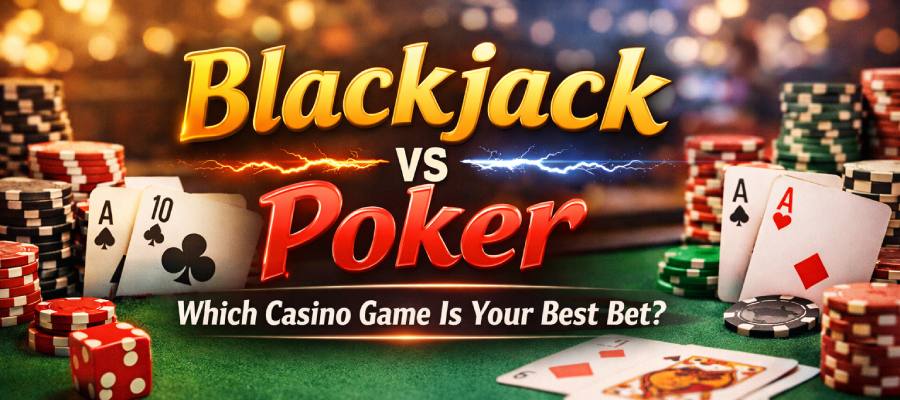
Choosing between blackjack and poker is not just about preference. It is about how you interact with risk, skill, variance, and the casino itself. One game puts you directly against the house and its built-in edge. The other puts you against other players, where your results depend more on decision-making, discipline, and long-term execution.
Blackjack and poker are two of the most popular card games in any casino, but they work in fundamentally different ways. Blackjack is structured, fast, and math-driven. Poker is competitive, dynamic, and shaped by psychology, position, and player behavior.
This guide breaks down blackjack vs poker through a casino lens, including house edge, rake, skill impact, variance, and player fit, so you can choose the game that actually matches your style. If you are new to table games, start with this beginner’s guide to casino games to understand the basics before going deeper.
Table of Contents
- Blackjack vs Poker Quick Comparison
- Playing Online Blackjack or Poker Games
- Is Blackjack a Poker Game?
- What Is Poker?
- Why People Confuse Blackjack and Poker
- House Edge vs Rake
- How Blackjack and Poker Work in an Online Casino
- Difference Between Poker and Blackjack
- Poker Skills vs Blackjack Discipline
- Which Game Matches Your Playing Style?
- Common Mistakes Players Make
- Which Game Is Best for You?
- FAQ
- Final Thoughts
Blackjack vs Poker Quick Comparison
At a high level, the biggest difference is simple: blackjack is a player vs dealer game, while poker is a player vs player game. That changes everything from where your edge comes from to how much control you have over long-term results.
| Factor | Blackjack | Poker |
|---|---|---|
| Opponent | Dealer and house | Other players |
| Casino Advantage | House edge | Rake or tournament fees |
| Skill Impact | Moderate | High |
| Variance | Low to medium | High |
| Decision Style | Rule-based and mechanical | Strategic and adaptive |
| Best For | Structured, fast play | Competitive, long-term play |
Key Insight
Blackjack:
You are trying to minimize losses against a fixed mathematical edge.
Poker:
You are trying to outperform other players while overcoming rake.
Playing Online Blackjack or Poker Games
Two of the most recognizable card games in the casino world, blackjack and poker have become synonymous with Vegas-style table action. They are both accessible online, but they deliver very different experiences.
One game revolves around beating the dealer without going over 21. The other revolves around building better hands, managing betting rounds, and making stronger decisions than the people at your table. Many players are drawn to both because of the convenience and flexibility explained in the benefits of playing in an online casino.
Visual Model

Is Blackjack a Poker Game?
Blackjack is not a type of poker. It is a different casino game with a different objective, structure, and source of edge.
Both games use cards, but blackjack is a player vs dealer game, while poker is a player vs player game. In blackjack, the goal is to get as close to 21 as possible without going over. Card values are fixed: face cards count as 10, number cards count as face value, and aces count as 1 or 11 depending on the hand.
You receive two cards, the dealer receives two cards with one hidden, and then every decision follows a defined action set. You can hit, stand, and in broader blackjack rules also split or double depending on the hand and table rules. Unlike poker, there is no bluffing battle between players and no table-wide psychological contest. The game is driven by probabilities, house rules, and decision optimization.
Blackjack Basics
Objective:
Reach a stronger total than the dealer without busting.
Information gap:
The dealer has one hidden card, which helps preserve the house edge over time.
Decision style:
Optimal play is largely mechanical and based on math, not psychology.
What Is Poker?
Poker includes multiple formats such as Texas Hold’em, Omaha, and Five-Card Draw. In the U.S., Texas Hold’em is the most recognized and widely played version.
In Texas Hold’em, players compete for the pot. The game begins with forced bets from the small blind and big blind, then each player receives two private cards. Betting decisions happen across multiple stages as community cards are revealed. After the first three community cards, then the fourth, then the fifth, players keep betting, calling, raising, or folding based on hand strength, position, and opponent behavior.
At showdown, the remaining players build the best possible hand using their two hole cards and the community cards. The best hand wins the pot. Unlike blackjack, poker is not about beating a dealer. It is about beating the other people at the table. Casinos simply facilitate the action and make money through rake or tournament entry fees.
Poker Basics
Opponent:
Other players, not the house.
Profit source:
Your edge comes from making better decisions than your opponents.
Core skills:
Hand selection, position, pressure, and discipline.
Why People Confuse Blackjack and Poker
Some players loosely group blackjack and poker together because both are card games played at casino tables. That overlap can make blackjack seem like a type of poker, especially to new players.
But the comparison breaks down quickly. Poker depends on bluffing, hidden information between players, and psychological pressure. Blackjack does not. The only hidden information in blackjack is the dealer’s down card, and that does not create the same strategic environment as a poker hand.
| Shared Surface Feature | What Actually Changes |
|---|---|
| Both use cards | The objectives and decision models are completely different |
| Both are table games | Blackjack is against the house, poker is against players |
| Both involve hidden cards | Poker uses hidden information for strategy and bluffing, blackjack does not |
House Edge vs Rake
This is the most important structural difference between blackjack and poker.
Blackjack is a negative expectation game because the casino holds a house edge. Even if you use perfect basic strategy, the house usually retains a small long-term advantage. Poker works differently. Poker itself is a competitive game between players, but the casino takes a fee through rake or tournament entry costs, which means every player must overcome those costs to stay profitable.
The Real Difference
Blackjack:
You are fighting math and fixed rules.
Poker:
You are fighting other players and the fee structure.
Visual Model
How Blackjack and Poker Work in an Online Casino
Online blackjack is usually played against software or a live dealer with fixed rules, fast pacing, and a predictable house edge. Rule variations matter. Whether the dealer hits on soft 17, how many decks are in play, and what payouts are offered all affect your expected return.
Online poker works as a player-vs-player ecosystem. The casino earns money from rake or tournament fees rather than a direct house edge, so your profitability depends on how your skill compares to the field. Applying fundamentals from this online casino success guide can help you avoid common early mistakes.
| Category | Blackjack | Poker |
|---|---|---|
| Game flow | Fast and repetitive | Slower and multi-street |
| Rule impact | High impact on expected return | High impact on format and table dynamics |
| Profitability driver | Minimizing mistakes | Outplaying the pool |
| Casino revenue | House edge | Rake and fees |
Difference Between Poker and Blackjack
The core difference is who you are playing against and where your edge comes from.
In blackjack, you are playing directly against the dealer, which means you are effectively playing against the house. The casino builds in a mathematical edge, often around 0.5% when you use basic strategy. If you make poor decisions, that edge grows. Over time, the house expects to keep a portion of every dollar wagered.
In poker, you are not playing against the house. You are competing against other players, and the casino takes rake or tournament fees. That changes the skill equation. Winning at poker is more dependent on long-term decision quality, discipline, and the ability to identify and exploit mistakes.
Where the Edge Comes From
Blackjack edge management:
Use basic strategy to keep the house edge as low as possible.
Poker edge creation:
Create a skill advantage through hand selection, position, pressure, and discipline.
Poker Skills vs Blackjack Discipline
Blackjack rewards precision and consistency. Poker rewards adaptation and judgment. That is why the skill ceiling in poker is much higher, even though blackjack still punishes sloppy play.
Poker Skills That Matter Most
Hand selection:
Know what to play and what to fold before trouble starts.
Position awareness:
Acting later gives you more information and more control.
Bluffing and pressure:
Strong players force errors instead of waiting passively.
Discipline:
Folding bad or marginal spots is one of the biggest long-term edges.
Blackjack Discipline That Matters Most
Basic strategy:
Correct hit, stand, split, and double decisions reduce the house edge.
Emotional control:
Betting emotionally increases losses faster than most players realize.
Which Game Matches Your Playing Style?
Your best game depends less on hype and more on temperament. Some players want structure and speed. Others want a competitive environment where skill can create a real edge over time.
| If You Prefer | Better Fit |
|---|---|
| Structured decisions and fixed rules | Blackjack |
| Fast-paced sessions | Blackjack |
| System-based play like basic strategy | Blackjack |
| Reading opponents and long-term strategy | Poker |
| Competing directly against other players | Poker |
| Accepting higher variance for greater skill expression | Poker |
Start with the game that matches your edge
If you want structure and lower complexity, begin with blackjack fundamentals. If you want competitive depth, study poker decision-making first. This casino games guide is a strong starting point before moving into either path.
Read the beginner casino guideCommon Mistakes Players Make
Both games punish undisciplined bankroll management, but the actual leaks are different.
Common Player Errors
Blackjack mistake:
Ignoring basic strategy and increasing bet size emotionally.
Poker mistake:
Playing too many hands and underestimating the skill of the table.
Shared mistake:
Chasing losses and mismanaging bankroll, issues also covered in this guide to crushing the odds at the online casino.
Which Game Is Best for You?
The best game depends on your gambling style. If you like relaxed, faster sessions and prefer a game where the decision tree is clear, blackjack is often the better fit. With strong basic strategy, the house edge can stay relatively low, giving you a more controlled experience.
If you prefer competition, table dynamics, and long-term skill development, poker is the better choice. Texas Hold’em is the most popular version, but tournament fields are full of serious players. Entering before you develop your game can get expensive quickly.
Important Note on Card Counting
What it is:
Card counting is an advantage-play method used in specific land-based blackjack conditions.
Why it is limited online:
Continuous shuffling and multi-deck systems make it largely ineffective in online blackjack.
Learn more:
See how card counting in blackjack works and where it actually applies.
FAQ
Is blackjack a type of poker?
No. Blackjack and poker are separate games with different objectives, structures, and sources of edge. Blackjack is played against the dealer, while poker is played against other players.
Which game has the lower house edge?
Blackjack usually has the clearer and lower built-in casino edge when played with strong basic strategy. Poker does not use a house edge in the same way, but rake and tournament fees still create long-term pressure.
Is poker more skill-based than blackjack?
Yes. Blackjack rewards correct decision execution, but poker has a much higher skill ceiling because your edge depends on reading situations, exploiting opponents, and making better decisions across many variables.
Which game is better for beginners?
Blackjack is usually easier for beginners because the decisions are more structured and easier to learn. Poker takes longer to understand because it involves betting dynamics, position, and opponent tendencies.
Does card counting work online?
In most online blackjack environments, no. Continuous shuffle mechanics and multi-deck conditions reduce or eliminate the situations where card counting can create a practical edge.
Summary
- Blackjack is a structured player vs dealer game with a built-in house edge.
- Poker is a player vs player game where your edge comes from outperforming opponents.
- Blackjack rewards discipline and correct execution, while poker rewards adaptability and long-term strategic skill.
- The better game is the one that matches your risk tolerance, pace, and style of decision-making.
Final Thoughts
Blackjack is about discipline against the house. Poker is about skill against players.
If you want controlled risk, faster sessions, and a mathematically structured experience, blackjack gives you a cleaner entry point. If you want a deeper strategic path with more room to build an edge over time, poker is the stronger long-term challenge.
The right choice is not which game sounds better. It is which one aligns with how you think, manage risk, and want to experience the casino environment.
MyBookie: Bet On Anything. Anywhere. Anytime.

About the Author

Since 2008, D.S. Williamson has written about sports and sports handicapping. His philosophy is value-based, meaning stats and other handicapping factors are only worth something in comparison to wagering odds. He believes money management and making value-based wagers is the single more important factor that distinguishes successful sports bettors from non-successful sports bettors.
Sportsbook Bonuses