English
Last updated: August 2026
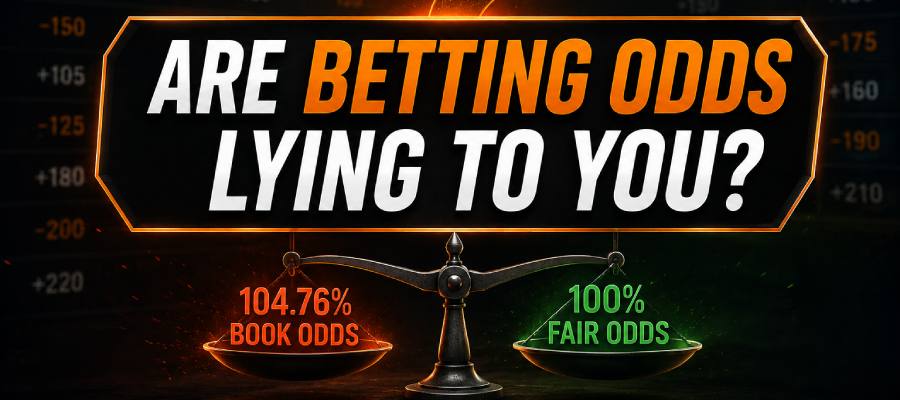
To convert soccer betting odds into what is commonly called “true probability,” convert the home, draw, and away prices into implied probabilities, add the three percentages, and divide each outcome by that total. This removes the sportsbook’s proportional vig and makes the complete 1X2 market equal 100%.
More precisely, the result is a no-vig fair probability—not the objectively true probability of the match outcome.
How Do You Convert Soccer Odds Into Fair Probability?
Use this formula:
Fair probability = outcome implied probability ÷ total market implied probability
For decimal odds, first calculate each outcome using implied probability = 1 ÷ decimal odds. Include the home win, draw, and away win before removing the vig.
Table of Contents
- What Does “True Probability” Mean in Soccer Betting?
- How Do You Convert Soccer Odds Into Implied Probability?
- How Does the Vig or Overround Work in a 1X2 Soccer Market?
- How Do You Remove the Vig and Calculate Fair Probability?
- How Do You Convert Fair Probability Back Into Fair Odds?
- Can You Calculate No-Vig Soccer Odds Automatically?
- How Can Fair Odds Help You Evaluate Soccer Betting Value?
- What Information Should You Check Beyond No-Vig Probability?
- Does Removing the Vig Predict Which Soccer Team Will Win?
- Can You Use No-Vig Calculations for BTTS, Totals, and Handicap Markets?
- How Should You Read MyBookie Soccer Lines After Removing the Vig?
- Frequently Asked Questions
- What Is the Most Important Lesson About Soccer Fair Odds?
The Soccer Fair-Odds Process in One Minute
- Convert: Turn every posted price into implied probability.
- Add: Calculate the total probability for the complete market.
- Normalize: Divide each outcome by the market total.
- Convert back: Turn each no-vig probability into fair odds.
- Compare: Evaluate the fair-market baseline against your independent estimate.
Quick Answer: How Do You Calculate Fair Soccer Probability?
Convert every outcome into implied probability, add the complete market probabilities, divide each outcome by that total, and then convert the normalized probabilities back into fair decimal odds.
| Step | Formula |
|---|---|
| 1. Implied probability | 1 ÷ decimal odds |
| 2. Market total | Home + Draw + Away implied probabilities |
| 3. No-vig probability | Outcome probability ÷ market total |
| 4. Fair decimal odds | 1 ÷ no-vig probability |
Example: If a 1X2 market totals 107.12%, the overround is 7.12%. Normalize each outcome against 107.12% to estimate the margin-removed market probability.
How to Convert Soccer Betting Odds Into Fair Probability
The complete process is: betting odds give you implied probability, the full market reveals the overround, normalization removes the proportional margin, and the resulting no-vig probability converts into fair odds. You can then compare those fair-market probabilities with an independent estimate to determine whether the available price appears to offer value.
To convert soccer betting odds into fair probability, follow four steps: convert each price into implied probability, add the probabilities for every possible outcome, divide each outcome by the total probability, and multiply by 100. In a 1X2 soccer market, this means calculating the home win, draw, and away win probabilities before removing the proportional overround.
What Are You Actually Trying to Find?
① What does the price imply?
Calculate the raw implied probability from the posted odds.
② What does the market imply without its margin?
Normalize the complete market to calculate the no-vig probability.
③ Is the price potentially valuable?
Compare the available break-even probability with your independent estimate.
These are three different questions. Keeping them separate prevents one of the most common mistakes in soccer betting: treating an implied probability as if it were an objective prediction.
What Does “True Probability” Mean in Soccer Betting?
The betting odds displayed by a sportsbook represent prices. Those prices can be converted into implied probabilities, but there is normally a margin—called the vig, juice, or overround—built into the complete set of odds.
In a standard soccer 1X2 market, the three possible results are a home win, a draw, and an away win. You can calculate no-vig probabilities for all three outcomes, but you must include the entire market. Leaving out the draw produces an incomplete and misleading result.
No-vig probability is the implied probability after the sportsbook’s proportional margin has been removed from the complete market. It is calculated by dividing each outcome’s raw implied probability by the sum of all implied probabilities. The resulting probabilities add up to 100% and provide a margin-adjusted market baseline.
Three Probability Layers
① Implied probability
The percentage contained in an individual posted price before the margin is removed.
② Fair market probability
The normalized percentage after the complete market’s proportional overround is removed.
③ Independent probability
Your own estimate based on team strength, expected goals, injuries, tactics, and other verified information.
Important Distinction
Is no-vig probability the actual chance of winning? No. It is the market’s margin-removed baseline. Injuries, expected goals, lineup changes, match context, model error, and new information can all affect whether that baseline is accurate.

How Do You Convert Soccer Odds Into Implied Probability?
Implied probability is the break-even percentage encoded in a betting price before the vig is removed. The formula depends on whether the sportsbook displays decimal, American, or fractional odds.
The key difference is simple: implied probability comes directly from one posted betting price and still contains the sportsbook’s margin, while fair probability is the normalized probability after the margin is removed from the complete market.
For decimal soccer odds, use:
Implied probability = 1 ÷ decimal odds
Decimal odds of 2.50 therefore equal:
1 ÷ 2.50 = 0.40, or 40.00%
American soccer moneyline odds require two formulas. For positive odds:
Probability = 100 ÷ (positive odds + 100)
At +150:
100 ÷ 250 = 0.40, or 40.00%
For negative odds:
Probability = absolute odds ÷ (absolute odds + 100)
At -150:
150 ÷ 250 = 0.60, or 60.00%
| Odds format | Formula | Example | Implied probability |
|---|---|---|---|
| Decimal | 1 ÷ decimal odds | 2.50 | 40.00% |
| Positive American | 100 ÷ (odds + 100) | +150 | 40.00% |
| Negative American | |odds| ÷ (|odds| + 100) | -150 | 60.00% |
| Fractional | Denominator ÷ (numerator + denominator) | 3/2 | 40.00% |
Once you understand these calculations, the numbers become easier to interpret when you read soccer win, lose, and tie odds. If you want to build a stronger foundation in betting terminology and probability concepts, the MyBookie Betting Academy provides additional educational resources. However, the percentages for a complete market usually add up to more than 100% because the sportsbook margin is still present.
Soccer Betting Probability Formula Cheat Sheet
Decimal odds: Implied probability = 1 ÷ decimal odds.
Positive American odds: Implied probability = 100 ÷ (odds + 100).
Negative American odds: Implied probability = |odds| ÷ (|odds| + 100).
1X2 overround: Overround = home implied probability + draw implied probability + away implied probability − 100%.
No-vig probability: Fair probability = individual implied probability ÷ total implied probability.
Fair decimal odds: Fair odds = 1 ÷ fair probability expressed as a decimal.
How Does the Vig or Overround Work in a 1X2 Soccer Market?
The overround is the amount by which the combined implied probabilities exceed 100%. To see how it works, consider these fictional three-way soccer betting odds:
The vig in soccer betting is the pricing margin reflected in the complete set of sportsbook odds. In a 1X2 market, calculate it by adding the home, draw, and away implied probabilities and subtracting 100%. For the fictional example below, 107.12% − 100% = 7.12% overround.
| Outcome | Decimal odds | Calculation | Raw implied probability |
|---|---|---|---|
| Home | 2.20 | 1 ÷ 2.20 | 45.45% |
| Draw | 3.40 | 1 ÷ 3.40 | 29.41% |
| Away | 3.10 | 1 ÷ 3.10 | 32.26% |
| Complete market | — | 45.45% + 29.41% + 32.26% | 107.12% |
Visual Model: Raw 1X2 Implied Probabilities
Common mistake: Do not calculate the soccer betting vig from only one price. A sportsbook’s margin belongs to the complete market, so a 1X2 calculation must include the home win, draw, and away win prices from the same market.
Overround, vig, juice, and hold are related terms, but they are not always interchangeable. Overround describes the amount above 100% in the posted probability book. Vig or juice commonly refers to the embedded charge, while hold may refer to expected or realized sportsbook revenue as a percentage of wagers.
If you’re wondering why this matters, it’s because an individual price does not reveal the full cost of a market. You need every possible outcome to measure the complete sportsbook margin.
How Do You Remove the Vig and Calculate Fair Probability?
To remove bookmaker margin with the proportional normalization method, divide each outcome’s implied probability by the total implied probability of the complete market:
Fair probability = outcome implied probability ÷ total implied probability
In other words: No-vig probability = individual implied probability ÷ total market implied probability. The calculation redistributes the complete sportsbook probability book so that all mutually exclusive outcomes sum to exactly 100%.
Four-Step No-Vig Soccer Framework
① Record
Collect the home, draw, and away prices from the same 1X2 market.
② Convert
Turn each price into raw implied probability using the correct odds formula.
③ Add
Sum all three implied probabilities to calculate the complete book percentage.
④ Normalize
Divide each raw probability by the market total so the fair set equals 100%.
Example: If a soccer 1X2 market has a total implied probability of 107.12%, divide each outcome’s raw implied probability by 107.12% to remove the proportional overround. The normalized results are the no-vig fair probabilities for the home win, draw, and away win.
Using the same example:
Home: 45.45 ÷ 107.12 = 42.43%
Draw: 29.41 ÷ 107.12 = 27.46%
Away: 32.26 ÷ 107.12 = 30.11%
| Outcome | Raw implied probability | Fair probability | Margin adjustment |
|---|---|---|---|
| Home | 45.45% | 42.43% | -3.02 points |
| Draw | 29.41% | 27.46% | -1.95 points |
| Away | 32.26% | 30.11% | -2.15 points |
| Total | 107.12% | 100.00% | -7.12 points |
In simple terms, normalization removes the proportional markup from the complete set of sportsbook lines. The market becomes mathematically cleaner, but there is no guarantee that it has assessed each team correctly.
Normalization does not mean every outcome is equally well priced. The draw deserves particular attention in 1X2 markets because public expectations can influence how prices are set, making it useful to understand why soccer draw odds can be mispriced when evaluating the no-vig baseline.
How Do You Convert Fair Probability Back Into Fair Odds?
Once the fair probability has been calculated, convert it back into decimal odds by dividing one by the probability written as a decimal:
Fair odds are the decimal prices implied by no-vig probabilities. Once the margin-adjusted probability is known, divide 1 by that probability expressed as a decimal. For example, a 42.43% fair probability corresponds to fair decimal odds of approximately 2.36.
Fair decimal odds = 1 ÷ fair probability
A 42.43% fair probability becomes:
1 ÷ 0.4243 = 2.36
| Outcome | Posted odds | Fair probability | Normalized fair odds |
|---|---|---|---|
| Home | 2.20 | 42.43% | 2.36 |
| Draw | 3.40 | 27.46% | 3.64 |
| Away | 3.10 | 30.11% | 3.32 |
Fair Odds Are a Benchmark, Not a Betting Signal
📊 Posted odds
The actual price available in the sportsbook.
⚖ Fair odds
The proportional no-vig price derived from the complete market.
★ Your estimate
Your independent probability based on the information and model you trust.
A difference between posted odds and fair odds is not automatically an edge. The important comparison is between the available price and a defensible independent probability estimate.
What the Difference Means
Posted home price: 2.20
This is the fictional price available to the bettor and includes margin.
Fair home price: 2.36
This is the proportional no-vig market baseline, not a price the sportsbook is required to offer.
A fair odds calculator can complete the arithmetic quickly, but it does not change the sportsbook’s posted odds. It gives you a consistent reference point for comparing prices.
Can You Calculate No-Vig Soccer Odds Automatically?
Yes. Enter all three decimal prices from the same home-draw-away market into the calculator below. It will show the raw implied probabilities, the total book percentage, the overround, the normalized fair probabilities, and the fair decimal odds.
If you only need to translate one betting price, use the MyBookie betting odds calculator to compare decimal, American, and fractional formats.
Ready to Test a 1X2 Market?
Enter the home, draw, and away prices below. The calculator will show you the complete book percentage, overround, no-vig probability, and corresponding fair decimal odds.
Use prices from the same market, same match, same line, and same settlement period so the comparison remains mathematically valid.
Soccer 1X2 Fair Odds Calculator
Enter decimal odds for the home win, draw, and away win from one complete market.
What Should You Do With the Result?
| Result | What It Means | Next Step |
|---|---|---|
| Posted odds are shorter than fair odds | The sportsbook price implies a higher probability than the no-vig baseline. | Compare the price with your own probability estimate. |
| Posted odds are close to fair odds | The proportional market adjustment is relatively small. | Look for an independent edge before considering a wager. |
| Your probability exceeds the posted break-even probability | The price may offer positive expected value if your estimate is reliable. | Check assumptions, current price, rules, and bankroll limits. |
The calculator does not tell you which team to bet. It gives you the mathematical baseline needed to ask the more important question: Is the available price better than the probability I can reasonably defend?
Calculator Limits
The tool uses proportional normalization. It does not account for unequal margin distribution, market bias, lineup news, limits, liquidity, or whether your independent probability model is accurate.
COMPARE PRICE WITH PROBABILITY
Don't Judge the Bet Until You Check the Price
Convert the complete 1X2 market, remove the proportional margin, and compare the resulting fair probability with your independent estimate.
A team can be the most likely winner and still be a bad bet at the wrong price.
How Can Fair Odds Help You Evaluate Soccer Betting Value?
Fair odds become useful when they help answer a specific betting question: does the available price require a lower probability than the outcome's probability that you can reasonably defend? Start with the posted price, calculate its break-even probability, compare it with your independent estimate, and then determine whether the difference is large enough to matter.
Use no-vig probability when you want to separate the market's estimated probabilities from the sportsbook's embedded margin. Use your independent probability estimate when you want to determine whether the available betting price appears to offer value. The two numbers answer different questions and should not be treated as interchangeable.
The 3 Numbers to Compare Before Betting
| Number | Question It Answers |
|---|---|
| Posted-price probability | What probability does the sportsbook price require to break even? |
| No-vig probability | What does the complete market imply after proportional margin is removed? |
| Independent probability | What probability can your own analysis reasonably defend? |
The betting decision comes from the relationship between these numbers—not from any one number by itself.
A disagreement between your model and the market is not automatically soccer betting value. It is a starting point for finding expected value in soccer betting, and the quality of the conclusion depends on the quality of your inputs. If you are building your own probability estimate, a simple soccer betting model can provide a structured starting point for turning team and match information into probabilities.
| Comparison | Possible interpretation | Practical response |
|---|---|---|
| Your estimate is below the posted break-even probability | The price may not compensate for the estimated risk. | Pass or look for a better price. |
| Your estimate is close to the no-vig market baseline | You have little evidence of a meaningful edge. | Review assumptions and avoid forcing a bet. |
| Your estimate is above the posted break-even probability | There may be positive expected value. | Check model quality, market rules, price availability, and risk. |
Value Check
⚙ Price test
What win rate does the available betting price require to break even?
⚙ Model test
Does your independent estimate exceed that threshold for defensible reasons?
⚙ Execution test
Is the price still available, and does the market settle under the rules you analyzed?
From a betting perspective, the important question is not simply which team is more likely to win. It is whether the available price is better than the probability estimate you can reasonably defend. Before applying that comparison to an actual wager, review the applicable MyBookie betting rules so you understand how the market is settled.
What Information Should You Check Beyond No-Vig Probability?
Once you have a no-vig baseline, the next question is why your independent probability should differ from it. Removing the vig cleans up the market price, but it does not create an independent prediction. Team performance, expected goals, injuries, lineups, incentives, timing, and market behavior can all affect your estimate. Because player availability can materially change a team's expected performance, understanding how injuries and starting lineups affect soccer betting odds can help put a changing market price into context.
League-specific conditions can also affect an independent probability estimate. In Major League Soccer, long-distance travel, schedule congestion, lineup rotation, and home-field conditions may influence how a match should be evaluated. Our guide to betting on MLS explains how to assess those factors alongside the available betting odds.
Soccer Probability Review Model
① Team performance
Review opponent-adjusted results, home and away splits, shot quality, and expected goals rather than relying on the final score alone. A deeper approach to evaluating team form beyond wins and losses can help separate sustainable performance from short-term results.
② Availability
Confirm injuries, suspensions, rotation risk, travel, rest, and likely starting lineups.
③ Match incentives
Consider tournament format, aggregate score, relegation pressure, qualification needs, and whether a draw changes either team's approach.
④ Market behavior
Track line movement, compare sportsbook lines, and separate confirmed information from public sentiment or unsupported assumptions.
What Should Carry the Most Weight?
- Confirmed information: Starting lineups, injuries, suspensions, and verified team news.
- Underlying performance: Expected goals, shot quality, opponent strength, and repeatable team metrics.
- Match context: Qualification requirements, aggregate score, relegation pressure, rest, and rotation.
- Market information: Opening price, current price, line movement, and differences between sportsbooks.
- Public sentiment: Useful for understanding market behavior, but not proof that an outcome is correctly priced.
The further down this list you rely, the more carefully you should question the assumption. A popular team or heavily discussed storyline is not automatically a reason to change a probability estimate.
What Can Change Your Independent Probability Estimate?
No-vig probability gives you a cleaner market baseline, but your independent estimate should account for information that can change the underlying probability. The most useful checks are:
- Market timing: Opening odds can move as injuries, lineups, betting activity, and other information enter the market. Understanding the best time to bet soccer matches can help put price movement into context.
- Expected scoring: Expected-goals data can improve the assessment of chance creation and prevention, while soccer totals modeling shows how expected scoring can be translated into probability estimates. These remain model outputs, not guarantees.
- Match incentives: Qualification pressure, relegation battles, or a must-win soccer match can change how teams approach a game. The opposite can also matter when teams have nothing to play for, because motivation, rotation, and tactical priorities may differ from a basic form-based model.
- Goal probability: For a more mathematical approach, the Poisson distribution in soccer betting can estimate goal probabilities and construct scoreline probabilities before those estimates are compared with sportsbook prices.
Independent Probability Checklist
⏱ Timing
Check whether new information has moved the opening price.
⚖ Scoring Model
Use xG and scoring models to test whether the market baseline fits the underlying numbers.
★ Incentives
Account for motivation, rotation, qualification pressure, and match context.
① Probability
Translate your assumptions into a defensible probability rather than relying on confidence alone.
Finally, sports betting sentiment analysis may help explain why a price moved, but popularity does not establish that the new price is fair. The objective is to identify whether the information supports a different probability estimate—not simply whether other bettors appear to agree.
Key Insight
Market probability answers, “What does the price imply?” Independent analysis asks, “What do I believe the outcome is worth?” Value can exist only when the offered price and a defensible estimate differ enough to matter.
Does Removing the Vig Predict Which Soccer Team Will Win?
No. Removing the vig cleans up pricing information; it does not predict the match winner. Even an outcome assigned a 60% fair probability still has a 40% probability of not occurring.
Visual Model: Probability Is Not Certainty
This limitation is especially important across small samples, where variance can be substantial. Whether you use traditional online betting, Bitcoin betting, or crypto betting, the probability calculation remains the same. Payment method does not improve the quality of the estimate.
It’s important to note: probability should never be confused with certainty. Strong bankroll management and a predetermined budget should remain part of any plan to bet on sports.
Can You Use No-Vig Calculations for BTTS, Totals, and Handicap Markets?
Yes. The same core process works for two-way soccer markets such as Both Teams To Score and game totals: convert both outcomes into implied probabilities, add them, and normalize each result by the total. Handicap markets require careful attention to the exact line and settlement conditions.
| Market | Complete outcome set | Key check |
|---|---|---|
| 1X2 match result | Home, draw, away | Include all three regulation-time outcomes. |
| BTTS | Yes, no | Use both prices from the same Both Teams To Score market. |
| Over/Under 2.5 | Over, under | Match the same goals total and settlement period. |
| Asian handicap | Both sides of the same handicap | Confirm push, split-line, and partial-win rules. |
| Draw no bet | Home, away | Confirm that a draw returns the stake. |
For market-specific context, review how Both Teams To Score betting works before normalizing BTTS prices. If you are evaluating a spread-style market, first understand the settlement mechanics in the soccer handicap betting guide.
Quick Answer
Can one listed price reveal the vig? No. To calculate the overround accurately, you need the prices for every mutually exclusive outcome in the same market.
Can you mix prices from different totals or handicaps? No. The outcomes must belong to the same line, period, and settlement conditions.
Before You Compare a Live Soccer Price
① Same market
Make sure the prices represent the same market and settlement period.
② Current price
Confirm the odds are still available before relying on your calculation.
③ Current information
Check lineups, injuries, rotation, and other material news.
④ Independent estimate
Know what probability you believe before deciding whether the price is attractive.
Only after these checks should a fair-odds comparison become part of the betting decision.
How Should You Read MyBookie Soccer Lines After Removing the Vig?
Now take the process from theory to an actual sportsbook market. When looking at MyBookie soccer odds, start with the complete market: record every price, convert the odds into probability, calculate the full book percentage, remove the proportional margin, and compare the resulting baseline with your independent assessment.
Rules matter just as much as the arithmetic. Confirm whether a 1X2 market covers regulation time only, whether overtime or penalties are included, and how voids or pushes are handled. It is also important to understand what happens if a soccer match is abandoned, because settlement rules can determine whether a calculated price comparison remains relevant to the wager.
MyBookie Soccer Line Checklist
① Match the market
Use prices from the same event, market type, line, and settlement period.
② Record every outcome
For 1X2 soccer betting lines, include home, draw, and away.
③ Calculate the baseline
Convert, total, normalize, and return each fair percentage to fair odds.
④ Make the decision
Compare the available price with your independent estimate and predetermined risk limit.
A fictional MyBookie soccer betting line of 2.20/3.40/3.10 produces the calculations shown in this guide. It is only an illustration, not a current line or recommendation. Knowing how to read MyBookie odds is ultimately about sportsbook-line literacy: understand the price, the complete market, and the settlement rules before acting. When you're ready to compare those principles with available markets, review the MyBookie soccer sportsbook for current soccer betting markets and odds.
Frequently Asked Questions
These concise answers cover the most common questions about soccer implied probability, bookmaker margin, and fair odds.
What is the difference between implied probability and true probability in soccer betting?
Implied probability comes directly from posted betting odds and includes sportsbook pricing. True or fair probability commonly refers to a margin-removed market estimate, although it should not be treated as the guaranteed real-world chance of an outcome.
How do you calculate implied probability from decimal soccer odds?
Divide one by the decimal price and multiply by 100. Odds of 2.00 produce 1 ÷ 2.00 = 0.50, or 50%, before bookmaker margin is removed.
How do you convert American betting odds into probability?
For positive odds, calculate 100 ÷ (odds + 100); for negative odds, calculate the absolute odds ÷ (absolute odds + 100). Multiply the result by 100 to express it as a percentage.
How do you remove the vig from 1X2 soccer odds?
Convert the home, draw, and away prices into implied probabilities, add the three percentages, and divide each individual probability by that total. The normalized home-draw-away probabilities will equal 100%.
Why do soccer implied probabilities add up to more than 100%?
The excess above 100% is the market's overround. It reflects the margin embedded in the complete set of sportsbook prices.
What is the difference between vig, juice, hold, and overround?
Overround measures how far a probability book exceeds 100%, while vig or juice commonly describes the embedded sportsbook charge. Hold may describe expected or realized sportsbook revenue and is not always identical to overround.
Why must the draw be included when calculating soccer 1X2 probability?
A draw is one of the three possible winning outcomes in a regulation-time 1X2 market. Omitting it leaves the probability set incomplete and distorts the margin calculation.
What are no-vig or fair odds?
No-vig odds are sportsbook prices converted into probabilities and normalized so the complete market equals 100%. They represent a margin-removed market baseline rather than an outcome guarantee.
Do fair odds guarantee a winning soccer bet?
No. Fair odds express probability, not certainty, and even a high-probability outcome can lose because individual matches contain variance.
Can you use a no-vig calculation for BTTS, totals, and handicap markets?
Yes. Convert every possible outcome from the same market into probability and normalize the complete set, while accounting for the exact line and settlement rules.
How do fair odds connect to expected value in soccer betting?
Fair odds provide a comparison point. Positive expected value may exist when a defensible independent probability is higher than the break-even probability required by the available price.
Soccer Fair Odds Summary
- Convert each posted price into raw implied probability.
- Include every possible outcome: home, draw, and away in a 1X2 market.
- Add the probabilities to measure the complete book and its overround.
- Normalize each outcome by the market total to calculate no-vig probability.
- Convert the fair percentages back into fair decimal odds.
- Compare the available betting odds with an independent estimate before evaluating value.
- Check the exact market and settlement rules before placing a wager.
READY TO COMPARE THE PRICE?
Turn Soccer Odds Into a Probability-Based Decision
Check the complete market, remove the overround, compare fair probability with your own estimate, and verify the current price and settlement rules before betting.
The objective is not to find certainty. It is to find a price that makes sense relative to a probability you can defend.
Ready to apply the process? Review the current MyBookie soccer odds and available betting markets, compare the complete price structure with your probability estimate, check the relevant settlement rules, and decide whether the available price fits your betting plan.
Risk Reminder
Sports betting involves financial risk. No formula, fair odds calculation, model, or betting strategy guarantees a profit. Bettors should be of legal age in their jurisdiction and wager only within a predetermined budget they can afford to lose.
What Is the Most Important Lesson About Soccer Fair Odds?
The process for converting soccer betting lines is straightforward: convert the odds into implied probabilities, add those probabilities, remove the overround, and convert the resulting fair probabilities back into fair odds. The quality of the betting decision, however, depends on what happens after the arithmetic.
Final Takeaway
Fair odds separate the market's price from its embedded margin. They do not tell you what will happen; they tell you what probability the margin-removed market is pricing and what threshold your independent analysis must beat.
The strongest approach is to compare that no-vig baseline with an independent estimate grounded in team news, expected goals, opponent strength, match incentives, and settlement rules. Include the entire 1X2 market, question every assumption, and pass when the difference is too small or uncertain to justify the risk.
The Price-First Rule
Don't start with “Who will win?” Start with “What probability does this price require, and is my estimate meaningfully higher?”
That simple change keeps the focus on probability, price, and expected value rather than prediction confidence.
The key takeaway is that better soccer betting decisions come from price discipline, not prediction confidence. Converting odds into fair probability gives you a clearer way to evaluate sportsbook lines, compare odds for sports, and recognize when an apparent opportunity is only the bookmaker margin in disguise. For a broader look at available sports betting markets and odds, explore the MyBookie sportsbook.
MyBookie: Bet On Anything. Anywhere. Anytime.
Important: Sports betting involves risk. No strategy guarantees results, and managing exposure is essential.

About the Author

Henry Watkins is a Sports Writer at MyBookie. Originally from Scotland and currently residing in Metro Atlanta with his wife, Penny, Henry covers competitive and professional sports as well as the business of sports. In addition to his sports writing, he is an author of horror fiction, including Karaoke Night, Crueller, and Off The Grid.
Sportsbook Bonuses
Read requirements in the Bonus page. However, if you want to take a deep knowledge, go to MyBookie Bonus Rules and How to


🔍 Explore Everything you Need to Know aboout your Licensed, Trusted Home For Casino and Sports Since 2014
👉 Gamble responsibly—must be 21+ and in a Legal Jurisdiction | Get Help at 1-800-Gambler