English


Last updated: October 2026
Read line movements in sports betting by comparing the same selection and market at two different times. Check what changed in the spread or total, whether the odds changed, and when the adjustment happened. Then review relevant news and evaluate the current price. A line move shows how a sportsbook’s offer changed; it does not tell you which team will win.
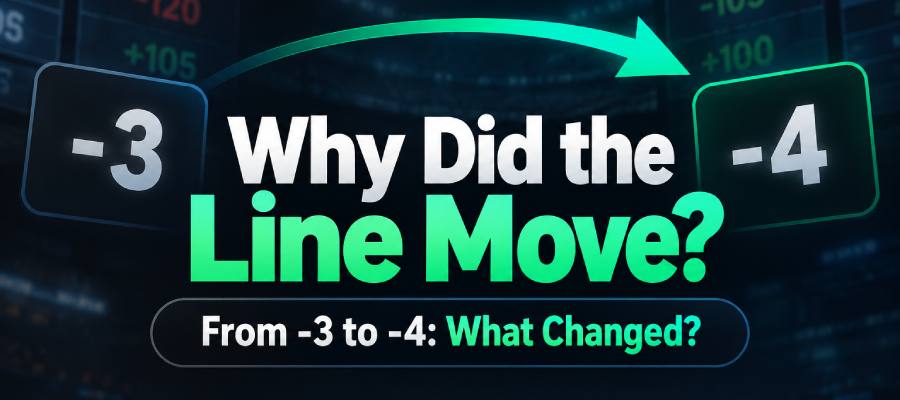
Start with this distinction: the line sets the result you need; the odds set the price you pay. A favorite moving from -3 to -4 must win by a larger margin to cover. The same favorite staying at -3 while its odds move from -110 to -120 has the same winning condition, but a higher cost.
How to Read a Line Move: Three Examples
| Earlier offer | Current offer | How to read the move |
|---|---|---|
| Team A -3 (-110) | Team A -4 (-110) | Harder spread, same price. A four-point win wins at -3 but pushes at -4 on a standard straight spread bet. |
| Team A -3 (-110) | Team A -3 (-120) | Same spread, higher cost. To profit $100, the required risk increases from $110 to $120. |
| Team B +150 | Team B +130 | Same outright-win condition, smaller profit. A winning $100 stake profits $130 instead of $150, plus the returned stake. |
The crucial distinction: when Team A moves from -3 to -4, the market has moved toward Team A, but the available spread has become less favorable for a new Team A bettor at the same odds. A stronger market assessment of a team does not automatically make its current price a better bet.
Ask These Four Questions Before Following a Move
- Am I comparing the same bet? Match the event, selection, market, and period. A full-game spread and a first-half spread are different wagers.
- Did the threshold, price, or both change? Record the complete quote, such as -3 (-110), rather than the spread alone.
- What happened between the timestamps? Check injuries, lineups, weather, and movement at other sportsbooks. These can suggest explanations without proving who caused the change.
- Would I accept the current offer without seeing the movement? Compare it with your own assessment. If your only reason is “the line moved,” you have not established value.
This guide shows you how to distinguish ordinary repricing, reverse line movement, and steam moves; why NFL key numbers matter; and how to compare your accepted ticket with the closing line. The MyBookie Line Movement Evidence Check also walks through a timestamped example so you can separate what the market shows from what you are assuming.
Your goal is to understand the offer—not chase the arrow. A useful line read can lead to a wager, more research, or a decision to pass.
How Do You Read a Betting Line Move Quickly?
Compare the same selection and market at two different times. Check whether the spread or total changed, whether the odds changed, and what relevant news appeared between the two timestamps.
- Match the market: confirm the event, selection, betting period, and market type.
- Compare the full quote: record both the line and odds, such as Team A -3 (-110) changing to -4 (-110).
- Check the evidence: review injury news, lineups, weather, and comparable sportsbook prices.
- Evaluate the current offer: compare the available line and odds with your own probability assessment instead of following the direction of the move.
Line movement shows how a sportsbook’s offer changes. It does not prove why the adjustment happened or establish that the current price offers value.

What Does Line Movement Mean in Sports Betting?
Line movement is a change in a sportsbook’s offered threshold, price, or both. The threshold defines the result needed for a spread, total, or many player props. The price determines potential profit relative to the amount risked.
| Market | Earlier offer | Later offer | What changed? |
|---|---|---|---|
| Point spread | Team A -3 (-110) | Team A -4 (-110) | A harder threshold for Team A at the same price. |
| Game total | Over 44.5 (-110) | Over 46.5 (-110) | The over now needs at least 47 points instead of 45. |
| Moneyline | Team B +150 | Team B +130 | A winning $100 stake profits $130 instead of $150; stake return is additional. |
| Price-only spread move | Team A -3 (-110) | Team A -3 (-120) | The spread stays at -3, but risking $120 instead of $110 is required to profit $100. |
Reading odds for sports correctly requires both parts of the quote. A better spread with a worse price is a tradeoff, not automatically a better wager.
For a broader look at how betting markets adjust and what those changes can mean for your decisions, read our guide to line movements and how to read into them. Use that additional context alongside the actual spread, odds, and timestamp rather than treating movement alone as a betting signal.
What Does a Minus or Plus Sign Change Mean?
A negative spread means the selection gives points; a positive spread means it receives points. Team A moving from -3 to -4 means the market has moved toward Team A, but a new Team A spread bet has a harder condition. The opposite side typically moves from +3 to +4, giving that underdog an extra point.
If Team A moves from -1.5 to +1.5, it has changed from favorite to underdog in that spread market. Do not confuse spread signs with moneyline signs: a moneyline quote describes the price of winning outright, rather than a point handicap.
Keep the selection fixed when comparing snapshots. Switching from Team A’s row to Team B’s row can make an ordinary mirrored spread look like a reversal.
When comparing changes in a spread, it also helps to understand how bettors evaluate a move that shifts the available handicap. Our guide to reversal trading spread strategies provides additional context for evaluating changes in market direction. As with any line movement, assess the actual spread, price, and available evidence before deciding whether a wager makes sense.
| Initial Line | Updated Line | What Happened to the Favorite (Team A)? | What Happened to the Underdog (Team B)? |
|---|---|---|---|
| Team A -3 vs Team B +3 | Team A -4 vs Team B +4 | Harder condition: Must win by 5+ instead of 4 to cover. | Easier condition: Can now lose by up to 4 points and still win the bet. |
| Team A -1.5 vs Team B +1.5 | Team A +1.5 vs Team B -1.5 | Role reversal: Team A is no longer the favorite; they now receive 1.5 points. | Role reversal: Team B shifts to the favorite and must now lay 1.5 points. |
Why Do Sportsbook Lines Move Before a Game?
Sportsbook lines can move because of new information, respected wagers, liability management, changing limits, or competing prices. Several causes may operate together.
- Injuries and lineups: a player’s availability or replacement can change the assessment of an event.
- Weather: updated conditions may affect expected scoring or team performance.
- Information in wagers: a sportsbook may react differently to bets it regards as informative.
- Risk exposure: adjustments can reflect existing liabilities and correlated outcomes.
- Limits and market competition: available stakes and prices elsewhere can influence repricing.
Sportsbooks do not necessarily seek equal dollars on both sides of every game. Their opening lines are informed offers based on models and judgment, and those offers can change as the market develops. See how sportsbooks set betting lines for the opening-price process.
Suppose an NFL favorite moves from -4 to -2 shortly after its starting quarterback is ruled out. That sequence supports an injury-related explanation, but it does not reveal which accounts wagered. Review how injured players affect betting odds before attributing every adjustment to betting volume.
How Can You Tell Sharp Money From Public Betting?
A public line chart does not identify individual bettors or prove that professional bettors caused a move. Betting splits can provide context, but they describe the provider’s reported sample.
- Ticket percentage: the selection’s share of reported bets.
- Money percentage: the selection’s share of reported dollars wagered.
Check the participating sportsbooks, market, period, sample size, and timestamp. A provider’s spread tickets cannot be treated as moneyline tickets, and its sample is not a census of all sports betting.
What Does 75% of Tickets but 40% of Money Actually Show?
Consider a hypothetical two-sided sample of 100 tickets and $10,000 wagered. Team A has 75 tickets totaling $4,000; Team B has 25 tickets totaling $6,000.
- Team A’s average ticket: $4,000 ÷ 75 = $53.33.
- Team B’s average ticket: $6,000 ÷ 25 = $240.
- Team B’s average ticket is 4.5 times larger.
That calculation establishes a difference in average stakes within this sample. It does not establish expertise, profitability, or whether those bets caused the observed move. Wealthier recreational bettors can also place large wagers.
What Is Reverse Line Movement, and How Do You Spot It?
Reverse line movement, or RLM, describes a move toward the side receiving the minority of reported tickets. For example, Team A has 75% of reported spread tickets, but its spread moves from -3 to -2. The adjustment is toward Team B despite the ticket majority on Team A.
Possible explanations include respected bets, new information, or a sportsbook following another market. RLM describes the relationship between a quote and a ticket sample; it does not explain the cause by itself.
| Matchup | Public Ticket Split | Opening Line | Current Line | What RLM Shows |
|---|---|---|---|---|
| Team A vs Team B | Team A: 75% Team B: 25% |
Team A -3 | Team A -2 | The line moved toward Team B (making Team A a cheaper favorite), defying the public ticket majority on Team A. |
Why Can a Line Move Toward a Team With 80% of Tickets Against It?
The number of bets is not the only input into pricing. The minority may account for larger stakes, the sportsbook may regard certain bets as more informative, or new information may favor that side. The displayed percentages may also cover different sportsbooks or a different time window from the line you are examining.
Can Mismatched Timestamps Create a Misleading RLM Signal?
Yes. Suppose a line changes at 10:05 a.m. after injury news, but the ticket split you read is a cumulative snapshot updated at 11 a.m. That later split does not show the ticket distribution when the move happened. Record both timestamps and label the relationship unconfirmed when comparable earlier splits are unavailable.
Example of the Timestamp Trap:
- 10:05 AM: Key player is ruled out; sportsbook shifts line from -3 to -2. (At this exact moment, 80% of bets were actually coming in on the underdog).
- 11:00 AM: Public betting tracker updates its cumulative daily display, showing 80% on the favorite.
- The Error: Reading the 11 a.m. split and assuming the line moved *because* of the public, missing the 10:05 a.m. news trigger entirely.
Betting against the public is not automatically value betting. Popularity alone gives you no reliable estimate of the selection’s chance of covering.
What Is a Steam Move, and Should You Follow It?
A steam move is a rapid adjustment in the same direction across multiple sportsbooks. Team A changing from -2.5 to -3.5 at several books within minutes is a hypothetical example. Coordinated wagering, breaking news, or books reacting to a leading price can produce similar charts.
Key Insight: The Steam Move Trap
⚙ Market Reality:
Books moving together may just be copying a leading price or reacting to the same news, not offering independent confirmations of value.
Why Late Chasing Fails:
By the time a steam move is noticed, the available price is often heavily inflated, erasing any mathematical value for the late bettor.
Several books moving together are not necessarily several independent confirmations of value. They may be responding to the same information or copying the same price. Also, the quote available after a move can be substantially worse for the side that attracted interest.
MyBookie-specific rule: MyBookie’s published rules prohibit deliberate steam chasing before its line adjusts and describe potential account restrictions. This guide explains market behavior; it does not recommend that activity. Review the current MyBookie rules, including the provisions on steam and obvious line errors, before wagering.
What Is a Stale Line, and How Is It Different From Line Shopping?
A stale line is a quote believed to lag a relevant market update. A different quote is not automatically stale: it could reflect different rules, a different period, local pricing, or a delayed data feed.
Line shopping compares equivalent offers available at approximately the same time. Historical tracking compares an offer with its earlier versions. To assess a suspected discrepancy, confirm the event, market, threshold, timestamp, and settlement terms before drawing a conclusion.
A price shown on an odds-comparison page may no longer be available for acceptance. Read our line shopping guide for comparable-price checks. Do not treat an apparent delay or obvious error as permission to exploit it; sportsbook rules apply.
Why Do NFL Key Numbers 3 and 7 Matter?
Three and seven are important NFL spread margins because of football’s scoring structure and their historical frequency as winning margins. The consequence of a half-point move depends on which result it changes.
| Accepted spread | Result at a three-point winning margin |
|---|---|
| -2.5 | Win |
| -3 | Push on a standard straight spread wager |
| -3.5 | Loss |
The same win/push/loss distinction applies around seven when the favorite wins by exactly seven. However, a favorable half-point comes with a price: -2.5 (-140) cannot be declared better value than -3 (-110) without considering the relevant outcome probabilities.
Read about key numbers in wagering for more context. Do not transfer NFL margin assumptions directly to NBA, MLB, or soccer markets.
Is It Better to Bet Early or Wait Until Game Day?
There is no universally best time to bet. An early offer may be attractive but depend on uncertain availability. A later offer may incorporate confirmed information but have a less favorable price.
- Early: assess the opening number and identify what unresolved news could change your estimate.
- Later: update your assessment after relevant announcements and compare the new quote with that estimate.
- Either time: pass if you cannot justify the current price or verify the market.
Write down your minimum acceptable odds or maximum acceptable spread before deciding. Do not change that boundary solely because the line is moving. A useful explanation might be: “I would consider Team A at -2.5 (-110), but I have not established value at -3.5 (-110).” That is a research condition, not a prediction.
How Can You Track Opening and Closing Lines for Free?
A manual spreadsheet can record line movement without a paid tracker. Log the sportsbook, event, market, period, selection, threshold, odds, timestamp with time zone, and source. Record your accepted ticket separately from quotes you only observed.
- Define the opening: the sportsbook’s documented first offer, or your first observed quote if the actual opening is unavailable.
- Collect comparable snapshots: keep the same event, selection, market, and period.
- Record news independently: note the source and publication time.
- Define the closing benchmark: identify the sportsbook or comparison method and the last available pregame quote before start or suspension.
- Preserve gaps: mark missing data rather than inventing the path between snapshots.
An opening and a closing quote do not show every move in between. A line may move, reverse, and return to its opening number. Likewise, your first observation may be hours after the actual opening.
Which Tools Help You Read Line Movement Charts?
Choose tools by market coverage, timestamps, and available history. A chart is useful only if you can identify which offer each point represents.
- Action Network: its public-betting tools distinguish tickets from money percentages. Select the relevant wager type and check which features require paid access.
- OddsPortal: its results archive provides historical-odds research. Find the event, choose the market, and inspect the bookmaker-specific information available rather than treating an aggregate price as one book’s history.
- Your own log: records the exact quotes and accepted tickets you observed, including time-zone and news notes.
Before relying on any tracker, check whether it includes the sportsbook and market you need, distinguishes price from threshold changes, and displays collection times. Free access, historical depth, and refresh frequency can differ by feature and change over time. No tool can guarantee that a displayed offer will be accepted.
What Does Closing Line Value Tell You About a Bet?
Closing line value, or CLV, compares your accepted wager with a defined closing benchmark for the same selection, market, and betting period. It shows whether you secured a more favorable threshold or price than that benchmark offered before the event began. It does not tell you whether your ticket will win or prove that your betting strategy is profitable.
Keep three records separate: the opening offer, your accepted ticket, and the closing offer. Opening-to-closing movement describes what happened in the market. Your accepted ticket compared with the close describes your CLV.
What Does Positive, Negative, or Neutral CLV Look Like?
The following examples are hypothetical. Each comparison assumes the same selection, market, period, and settlement rules. Spread and total examples hold the odds constant so the threshold difference is clear.
| Market | Your accepted bet | Closing benchmark | What the comparison shows |
|---|---|---|---|
| Favorite spread | Team A -3 (-110) | Team A -4 (-110) | Positive threshold CLV. You gave one fewer point at the same price. |
| Underdog spread | Team B +6.5 (-110) | Team B +5.5 (-110) | Positive threshold CLV. You received one extra point at the same price. |
| Over | Over 44.5 (-110) | Over 46.5 (-110) | Positive threshold CLV. Your bet needs fewer points to win. |
| Under | Under 46.5 (-110) | Under 44.5 (-110) | Positive threshold CLV. Your bet allows a higher final total while still winning. |
| Moneyline | Team A +150 | Team A +130 | Positive price CLV. A winning $100 stake earns $150 profit on your ticket instead of $130. |
| Price-only spread comparison | Team A -3 (-110) | Team A -3 (-120) | Positive price CLV. You risked less per $100 of potential profit for the same spread. |
| Moneyline | Team A +130 | Team A +150 | Negative price CLV. The closing benchmark offered a higher profit for the same stake. |
| Unchanged offer | Team A -3 (-110) | Team A -3 (-110) | Neutral CLV. Your accepted threshold and price match the benchmark. |
Can You Beat the Closing Line and Still Lose?
Yes. CLV and settlement answer different questions. Suppose you accepted Team A -3 (-110), and the benchmark closed at -4 (-110):
- Team A wins by two: both spreads lose. You obtained the better threshold, but your ticket still loses.
- Team A wins by three: your -3 ticket pushes on a standard straight spread wager; the closing -4 wager loses.
- Team A wins by four: your -3 ticket wins; the closing -4 wager pushes.
- Team A wins by five: both spreads win.
The better threshold changes settlement for specific outcomes; it does not control which outcome occurs. Likewise, a wager with negative CLV can still win.
Which Sports Can You Track Closing Line Value In?
CLV can be tracked in any sport where you have an accepted wager and a reliable, comparable closing quote. The market and its settlement conditions matter more than the sport’s name.
- NFL and college football: spreads, totals, moneylines, and comparable player props. Pay attention to threshold changes around important scoring margins.
- NBA and college basketball: spreads, totals, moneylines, and props. Match the betting period and any player-participation requirements.
- MLB: moneylines, run lines, totals, and first-five-innings markets. Confirm that the period and pitcher-related settlement conditions match.
- NHL: moneylines, puck lines, and totals. A regulation-only market and a market including overtime are different comparisons.
- Soccer: 1X2, Asian handicaps, and totals. Keep regulation-time, draw-no-bet, and qualification markets separate.
- Tennis, MMA, and boxing: match or fight winner prices and other comparable markets. Check retirement, withdrawal, or cancellation conditions.
- Golf and other futures markets: comparisons are possible when the selection and terms remain equivalent. Record the changing field, withdrawal rules, and your chosen closing time.
CLV does not change a sport’s results or reprice your accepted ticket. It helps you review the terms you secured. Its usefulness depends on the quality of the closing benchmark; a thinly traded or unreliable market may provide a weaker reference.
What Should You Record Before Calling It Positive CLV?
- Your ticket: accepted selection, threshold, odds, period, and timestamp.
- Your benchmark: the named sportsbook or clearly defined comparison method.
- The closing snapshot: the last relevant pre-event quote before the market starts or suspends, with its timestamp.
- Comparable terms: matching settlement conditions and separate records of threshold and price changes.
If your spread improves but your price gets worse, record both changes. You cannot quantify the overall advantage without assessing the probabilities of the outcomes whose settlement changes. Missing closing data should be marked unavailable rather than estimated without explanation.
For a deeper explanation, read our closing line value guide. Review CLV alongside stakes, realized profit or loss, and sample size—not as a substitute for those records.
How Do You Calculate Price-Based CLV?
For identical selections and settlement conditions, one clearly labeled convention is:
Decimal-odds price comparison = (accepted decimal odds ÷ closing decimal odds – 1) × 100.
For a hypothetical moneyline bet accepted at +150 (2.50 decimal) and closing at +130 (2.30 decimal), the calculation is (2.50 ÷ 2.30 – 1) × 100 = +8.70%. This is a quoted-price comparison, not an 8.70% proven edge or guaranteed return.
Do not use that ratio to compare -3 (-110) with -4 (-110): the decimal prices match, but the winning conditions differ. Record threshold CLV separately unless you have a justified method for valuing the changed outcomes.
You can also check conversion metrics using our betting odds calculator tool before tracking your benchmarks.
Quick CLV Price Checker
Enter decimal odds ratio (e.g., accepted odds divided by closing odds, such as 1.087):
How Do You Account for the Bookmaker Margin?
Raw implied probabilities include margin. In a two-outcome market without pushes, one simple proportional adjustment divides each outcome’s implied probability by the sum of both implied probabilities. Both prices must come from the same comparable snapshot. This is a modeling convention, not a way to discover the true probabilities.
Track your benchmark method consistently and review CLV alongside stakes, realized profit or loss, and sample size. See implied probability in online betting for the price conversion.
MyBookie Line Movement Evidence Check: What Can You Actually Conclude?
Use this worksheet to separate an observed move from a possible explanation and a betting decision. It is an educational framework, not a proprietary odds feed, a sharp-money detector, or a tested profitable system.
| Time | Recorded information | Supported conclusion | What remains unknown? |
|---|---|---|---|
| 9:00 a.m. | First observed quote: -2.5 (-110). | A baseline observation exists. | Whether it was the sportsbook’s actual opening. |
| 10:00 a.m. | Quote: -2.5 (-120). | Same threshold, higher cost for Team A. | What caused the price change. |
| 10:05 a.m. | Opponent’s starting quarterback ruled out in a timestamped report. | Relevant new information was published. | When the sportsbook learned it and how it valued the replacement. |
| 10:10 a.m. | Quote: -3.5 (-110). | The threshold crossed three; news is a plausible explanation. | Whether respected bets also contributed. |
| 11:00 a.m. | A provider reports 80% of spread tickets on Team B. | Team B leads that reported ticket sample. | The split at 10:10 a.m. and its overlap with this sportsbook. |
The Four Questions to Write Beside Every Move
- What changed? Record the threshold and price separately.
- What evidence is aligned? Match markets, periods, sportsbooks, timestamps, and relevant news.
- What remains unproven? Identify unavailable splits, missing intermediate quotes, and unknown causes.
- What offer could I accept? Compare the current terms with your own documented assessment and applicable rules.
In this example, the late ticket split is insufficient to identify the cause of the earlier move. Even if the chart resembles RLM, that label does not establish value at -3.5. The worksheet’s useful output can be “insufficient evidence; no wager”.
For additional lessons on betting odds, market pricing, and wagering fundamentals, visit the MyBookie Betting Academy.
How Do NFL, NBA, MLB, and Soccer Line Movements Differ?
- NFL sportsbook lines: quarterback availability, weather, and movement around football scoring margins can matter. A spread move and a price move must still be recorded separately.
- NBA line movement: player availability and starting-lineup news can affect spreads, totals, and props. Confirm that a prop’s participation requirements match between offers.
- MLB line movement: starting-pitcher changes, lineups, bullpen availability, and weather can affect pricing. Full-game and first-five-innings bets cover different periods; check pitcher-related settlement conditions.
- Soccer line movement: distinguish 90-minute 1X2, draw-no-bet, Asian handicap, and qualification markets. A price on winning in regulation cannot be compared directly with a price on advancing.
The lesson is consistent: match the contract before interpreting the chart. A market label that looks similar can conceal a different winning condition.
How Is Live Line Movement Different From Pregame Movement?
Live betting odds update as the game state changes. Score, time remaining, possession, player availability, and other event-specific information can alter the price. A large live move need not reflect new betting action.
Record the game clock and score alongside the quote. A pregame moneyline and a fourth-quarter moneyline are prices under different information states, so a direct comparison does not isolate the quality of your entry.
Broadcast and data delays can make a displayed quote misleading. A submitted wager is not an accepted ticket until acceptance is confirmed. Learn how live betting lines work and review sportsbook features for live betting to understand price changes and confirmation.
Does Bitcoin Betting or Crypto Betting Change Line Movement?
No. Bitcoin betting and crypto betting are payment arrangements; they do not inherently improve betting odds or change a wager’s winning conditions. Read sportsbook lines the same way regardless of how you fund your account: compare the selection, market, period, threshold, price, and timestamp.
Can the Line Change While Your Crypto Deposit Is Pending?
Funding your account does not reserve the odds you saw before depositing. A sportsbook line can change while a transfer awaits processing or required confirmations. Once funds are available, reassess the current offer before submitting a wager.
For example, suppose you see Team A -3 (-110) before starting a deposit. By the time your account is credited, the offer is -3.5 (-110). The price is unchanged, but the winning condition is different: a three-point victory would push at -3 and lose at -3.5 on a standard straight spread bet. Completing the deposit does not make the earlier number available.
What Should You Check Before Funding a MyBookie Account?
- Available methods: log in and select “Deposit Now” or open the Cashier to see the options available on your account.
- Transfer instructions: confirm the selected cryptocurrency, required network, and generated deposit address before sending. Follow the Cashier’s current instructions.
- Funding conditions: review applicable limits, conversion terms, fees, and confirmation requirements. Do not assume an advertised processing time guarantees when funds will be available.
- The current betting offer: after your balance is credited, recheck the line and odds. Confirm the accepted ticket rather than relying on an earlier quote.
If you plan to bet on sports with bitcoin or bet on sports with crypto, review MyBookie’s cryptocurrency funding information. For more context on funding readiness, read our crypto betting strategy guide covering speed and limits.
Funding Readiness Is Not Betting Value
A credited balance lets you consider an available wager; it does not make that wager worth placing. If the line changes while you fund your account, evaluate the new terms. You can still pass.
FAQ
Is the Opening Line the Same at Every Sportsbook?
No. Books may open at different times and prices, and an odds provider’s first recorded offer may differ from the actual opening. Identify the sportsbook and definition before comparing.
Does a Fast Move Prove Sharp Money Is Betting?
No. New information, low limits, and books following another price can all produce rapid adjustments, so speed alone does not identify professional bettors.
Can Injuries Cause Reverse Line Movement?
Yes. Injury news can move a price against the reported ticket majority, which makes news a possible explanation rather than proof that the minority is sharp.
Does Slow Movement Mean Public Money Caused It?
No. Gradual movement can reflect information, wagers, or repeated pricing adjustments, and the chart’s shape does not classify the bettors behind it.
What Is Buyback in Line Movement?
Buyback is action on the opposite side after a move creates a more attractive price. A reversal may reflect buyback, but it can also follow fresh news or repricing.
Can Both Sharp and Public Bettors Back the Same Team?
Yes. Bettors may agree on a team while accepting different prices, stakes, or markets.
Does a Line Move Change a Bet I Already Placed?
Ordinary later movement generally does not change the terms of an accepted ticket. Acceptance status and applicable rules, including error correction and voiding provisions, still matter.
Is a Better Number Automatically a Profitable Bet?
No. A better-looking quote can still be poor value, because profitability depends on the price relative to the underlying outcome probabilities.
Can You Calculate CLV From the Opening and Closing Lines Alone?
No. CLV requires your accepted wager, because opening-to-closing movement shows the market’s change but not the entry price you secured.
What If the Threshold Improves but the Price Gets Worse?
Treat it as a tradeoff. Quantifying it requires the probabilities of the outcomes whose settlement changes, including pushes, so avoid judging by points or odds alone.
How Do You Bet on Sports Online After a Line Moves?
Recheck the exact market and current quote, confirm they meet your assessment, and inspect the bet slip before submitting. Confirm acceptance and record the ticket, or pass if the price no longer suits you.
How Do You Use Line Movement to Make Better Betting Decisions?
To read line movements in sports betting, compare the same market at two recorded times, separate changes in the threshold from changes in the odds, and investigate the information available between those timestamps. Then evaluate the offer you can actually accept—not the earlier number that has disappeared.
The central lesson is that a move toward a team can leave you with a worse price on that team. Reverse line movement and steam describe market behavior, but neither proves who caused the adjustment or whether the current wager offers value. Closing line value helps you review your entry afterward; it does not guarantee a winning ticket.
What to Remember Before Your Next Bet
- Read the complete offer: -3 (-110) and -3 (-120) have the same spread but different costs. -3 (-110) and -4 (-110) have different winning conditions.
- Separate evidence from assumptions: match timestamps, markets, and betting-split sources. Fast movement, large stakes, and public percentages do not independently prove sharp action.
- Judge the current price: a better number matters only in relation to its cost and the probabilities of winning, losing, or pushing. Record your accepted ticket and review results alongside a consistent closing benchmark.
How Does Reading Line Movement Help You Find Value?
It can help you recognize a higher cost, avoid confusing different markets, and reconsider a wager after important news. Those improvements support more disciplined decisions, but finding value still requires a defensible assessment of the outcome probabilities. Movement alone cannot supply that assessment.
For example, if your research supported Team A at -2.5 (-110), a move to -3.5 (-110) changes the decision: a three-point win would now lose instead of win. Reassess the new offer rather than assuming that interest in Team A makes every available spread worth betting.
A winning bet and a sound decision are different things. A poorly priced wager can win once, and a carefully evaluated wager can lose. Review your process over time, keep stakes within your budget, and pass when the evidence does not justify the current terms.
NEXT STEP
Read the Move. Check the Price. Make Your Decision.
Put the guide into practice: choose an event, identify the exact market, and compare the current sportsbook lines with your recorded quote and research. Before submitting, check the amount risked, potential profit, and settlement terms in the MyBookie wagering rules.
View Current Sportsbook LinesNeed more practice reading betting odds? Continue with the MyBookie Betting Academy. After placing a wager, confirm acceptance and save the ticket’s recorded terms for your later review.
Participation must meet MyBookie’s age requirements and applicable eligibility rules. Keep online betting within an affordable budget and never wager money needed for essential expenses.
Sources and Further Reading
The calculations and timelines in this guide are hypothetical educational examples, not actual MyBookie wagering records or evidence of a tested profitable strategy. Use the references below to examine the data definitions and methods discussed.
- Action Network: public betting tickets and money percentages — background on the distinction between bet counts and dollars wagered.
- OddsPortal: results and historical odds — a resource for researching past prices and bookmaker-specific offers.
- Pinnacle: using closing lines to evaluate betting skill — context for assessing entry prices against closing benchmarks.
MyBookie: Bet On Anything. Anywhere. Anytime.
Important: Sports betting involves risk. No strategy guarantees results, and managing exposure is essential.

About the Author

Since 2008, D.S. Williamson has written about sports and sports handicapping. His philosophy is value-based, meaning statistics and other handicapping factors are only useful when compared with the available wagering odds. He believes bankroll management and consistently making value-based wagers are the most important factors separating successful sports bettors from unsuccessful bettors.
Sportsbook Bonuses
Read requirements in the Bonus page. However, if you want to take a deep knowledge, go to MyBookie Bonus Rules and How to


🔍 Explore Everything you Need to Know aboout your Licensed, Trusted Home For Casino and Sports Since 2014
👉 Gamble responsibly—must be 21+ and in a Legal Jurisdiction | Get Help at 1-800-Gambler