English


Buying points is a contentious subject that often draws divisive opinions from sports betting punters. Some bettors view buying points as a useful way to improve a betting number, while others see it as an unnecessary expense that reduces long-term profitability.
Editorial Note
This content explains how buying points in sports betting works, including the impact of key numbers, additional juice, and implied probability. It is intended for educational purposes and does not guarantee betting outcomes or profitability.
Quick Answer
Buying points means paying extra juice to improve your point spread or total, usually by a half-point or full point. The strategy can provide value when moving through key football numbers like 3 or 7, but bettors should always compare the added cost against the long-term value of the wager.
| Potential Benefit | Potential Drawback |
|---|---|
| Improves your spread or total | Requires paying additional juice |
| Can help around key numbers | May reduce long-term value |
| Provides extra margin for error | Not every half-point is worth the cost |
Core takeaway: buying points can help in specific situations, but only when the number being crossed has meaningful betting value.
- ✔ Better numbers can improve a wager.
- ✔ Extra protection always comes at a price.
- ✔ Key numbers matter more than random numbers.
- ✔ Long-term value matters more than short-term comfort.
That is why bettors should not look at buying points as an automatic upgrade to a wager. It is a pricing decision that should be judged by value, probability, and long-term cost rather than by short-term comfort alone. This same pricing-first mindset sits at the core of how to think like a sportsbook and understand how betting odds really work, where every wager is evaluated through the lens of risk, pricing, and expected value rather than simply predicting winners.
What Does Buying Points Mean?
Buying half-points or points is a strategy that is mostly associated with betting on the NFL or college football point spread or game total. A good number of sportsbooks allow bettors to buy half a point or more from a published point spread or total.
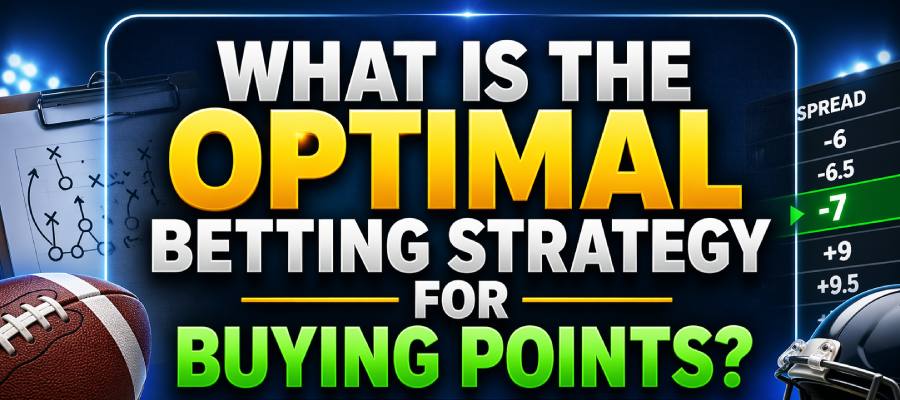
If, for example, a bettor saw a line on the New England Patriots published at -6 and felt that it was a good move to get an extra point on the line, the sportsbook would charge the bettor a fee for that request.
The line would thus be changed to -7, though it would come with increased betting odds. Similarly, if the bettor was wagering on the Patriots at +9 and wanted to buy an extra .5 point, the odds would become +9.5 with a fee charged for the changed odds.
The majority of times, the normal price for a standard NFL point spread or total is -110, so the price for buying half a point is usually -120.
For a more NFL-specific explanation of the mechanics, examples, and pricing involved, see this guide to buying points in NFL betting.
Key Insight
➤ What changes when you buy points:
You improve the number on your side of the bet, but you also pay more juice for that protection.
Why it matters:
A better spread or total may feel safer, but the increased price can erase the value of the wager if the move is not worth the cost.
| Original Bet | Adjusted Bet After Buying Points |
|---|---|
| Patriots -6 at -110 | Patriots -7 at a more expensive price, often around -120 |
| Patriots +9 at -110 | Patriots +9.5 at a more expensive price, with added juice |
| Total at 47 | Total moved to 47.5 or 46.5 depending on direction, with higher cost |
How Buying Points Works in Practice
In simple terms, buying points means paying the sportsbook to improve your betting number. That can be useful when a wager sits close to a highly important margin in football betting, where many games land on key numbers.
Before paying extra juice to improve a spread or total, bettors should also compare numbers across multiple sportsbooks. In many cases, a better line is already available elsewhere, making line shopping one of the most effective ways to improve a wager without increasing its cost.
This is where many bettors lose their edge, not because the concept is flawed, but because execution lacks discipline. Applying structured frameworks similar to the dos and don’ts of live wagering can help reinforce when paying extra juice is justified and when it becomes a long-term liability. The same discipline applies when evaluating in-game markets, where understanding the best sportsbook features for live betting can help bettors react more effectively to changing odds and game situations.
Visual Model
How to Buy Points Optimally and Profitably
Because sportsbooks charge additional juice when bettors buy points, profitability depends entirely on whether the improved number is worth the added cost. While buying points is often criticized as a negative-EV strategy, there are situations where it can provide value when used selectively.
For bettors who want to build a stronger foundation around odds, probability, and betting strategy, the Sports Betting Academy provides additional educational resources for understanding how different betting decisions affect price and risk.
Factors to Consider Before Buying Points
| Factor | Why It Matters |
|---|---|
| Key Numbers | Moving through 3 or 7 may provide meaningful value in football betting. |
| Price Increase | Additional juice can eliminate any benefit from the improved line. |
| Implied Probability | Converting odds into probabilities helps determine whether the move is justified. |
| Long-Term Impact | Repeatedly overpaying for points can significantly reduce profitability. |
To better understand how key numbers, game context, and situational edges influence these decisions, review NFL critical betting factors.
- ✔ Focus primarily on key numbers such as 3 and 7.
- ✔ Compare the added juice against the value of the new number.
- ✔ Convert betting odds into implied probability whenever possible.
- ✔ Avoid paying extra for line moves that provide little historical value.
Why Implied Probability Matters
Many betting studies suggest that evaluating wagers through implied probability provides a more reliable framework than relying on intuition alone. Bettors can perform these calculations manually or use an online betting calculator to simplify the process.
The real dividing line in this debate is value. Buying points is neither automatically smart nor automatically foolish. It becomes a poor decision when bettors pay extra without understanding whether the number they are crossing has enough historical importance to justify the increased price.
Best-Practice Framework
✓ Focus on key numbers:
In football betting, numbers like 3 and 7 matter more than random margins because games land there more often.
✓ Compare the price:
If the sportsbook is charging too much for the half-point, the better line may still be a negative-value play.
✓ Think long term:
The goal is not to make one bet feel safer. The goal is to avoid paying unnecessary juice across hundreds of wagers.
✓ Shop before you buy:
Sometimes a better number already exists elsewhere, making point buying unnecessary if you are comparing markets carefully.
| Situation | General Betting View |
|---|---|
| Buying through 3 | Often one of the few spots worth checking carefully |
| Buying through 7 | Also worth closer evaluation in football markets |
| Buying off random numbers | Usually poor value because the price increase is not justified |
| Not comparing odds first | Risky approach because line shopping may offer a better option without extra cost |
Odds to Implied Probability Tool
Enter American odds to estimate implied probability and compare whether the extra cost of buying points is justified.
Why Key Numbers Matter So Much
One of the biggest mistakes bettors make is assuming every half-point has equal value. It does not. In football, certain margins show up more frequently than others, which is why numbers like 3 and 7 carry much more weight in point spread betting.
That helps explain why experienced bettors are usually selective. They are not buying points just to feel protected. They are doing it, if at all, to move through a number with legitimate market importance. If a bettor ignores that principle, they are usually just paying extra juice for very little in return.
Quick Read
- Not all half-points are created equal.
- Football key numbers make some line moves far more meaningful than others.
- The sportsbook still protects itself by charging more, so discipline is essential.
Compare the number before you pay for it
Before deciding to buy points, review broader betting fundamentals and market pricing with sports betting guides so you can judge whether the extra juice is actually worth it.
Explore Betting GuidesFAQ
Is buying points always a bad idea?
No. It is not always a bad idea, but it is often overused. The value depends on the price you pay and whether the adjustment moves through a meaningful number such as 3 or 7 in football betting.
Why do sportsbooks charge more when you buy points?
Because they are giving you a more favorable betting line. That added protection comes with worse odds, which is how the sportsbook preserves its edge.
What is the most common standard price before buying points?
In many football markets, the standard point spread or total price is commonly around -110. Buying a half-point often pushes that price closer to -120, though exact pricing varies by sportsbook.
Should beginners buy points regularly?
Usually not. Beginners are often better served by learning line value, implied probability, and line shopping first. Buying points without understanding those basics can become an expensive habit.
Summary
- Buying points means improving your spread or total in exchange for worse odds.
- The strategy is most relevant in football markets, especially around key numbers like 3 and 7.
- Profitability depends less on comfort and more on price, probability, and disciplined line selection.
Conclusion
As a crucial reminder, always be mindful of the price you pay when buying points. Though buying half-points or more is not usually profitable, you can have some modicum of success with the getting-points betting strategy if you follow the pointers given above and shop for the best odds and prices.
This is where many bettors lose their edge, not because the concept is flawed, but because execution lacks discipline. Applying structured frameworks similar to the dos and don’ts of live wagering can help reinforce when paying extra juice is justified and when it becomes a long-term liability.
The most important lesson is that buying points should never be automatic. A bettor who understands market value, key numbers, and implied probability has a much better chance of making a smart decision than one who simply pays for extra cushion out of habit. In the long run, discipline matters more than convenience.
So while buying points can occasionally help, it works best as a selective tool rather than a standard routine. Treat it as a calculated pricing choice, not a shortcut to safer betting, and you will be in a much stronger position to protect your bankroll over time.
MyBookie: Bet On Anything. Anywhere. Anytime.
Important: Sports betting involves risk. No strategy guarantees results, and managing exposure is essential.

About the Author

Since 2008, D.S. Williamson has written about sports and sports handicapping. His philosophy is value-based, meaning statistics and other handicapping factors are only useful when compared with the available wagering odds. He believes bankroll management and consistently making value-based wagers are the most important factors separating successful sports bettors from unsuccessful bettors.
Sportsbook Bonuses
Read requirements in the Bonus page. However, if you want to take a deep knowledge, go to MyBookie Bonus Rules and How to


🔍 Explore Everything you Need to Know aboout your Licensed, Trusted Home For Casino and Sports Since 2014
👉 Gamble responsibly—must be 21+ and in a Legal Jurisdiction | Get Help at 1-800-Gambler