Buying points is a contentious subject that often draws divisive opinions from sports betting punters. On one hand, some bettors are open to the idea of getting points and half-points, doing it whenever there is a viable betting opportunity. On the other hand, other gamblers ridicule the idea and consider it a negative practice that should be avoided. Whatever your opinion is, the bottom line is that getting points is a chancy betting strategy, but it can also provide an advantage to bettors if it is used rightfully.
Core takeaway: buying points can help in specific cases, but the extra price only makes sense when the number you are moving through has real betting value.
That is why bettors should not look at buying points as an automatic upgrade to a wager. It is a pricing decision, and like any sportsbook decision, it should be judged by value, probability, and long-term cost rather than by short-term comfort alone.
What Does Buying Points Mean?
Buying half-points or points is a strategy that is mostly associated with betting on the NFL or college football point spread or game total. A good number of sportsbooks allow bettors to buy half a point or more from a published point spread or total.
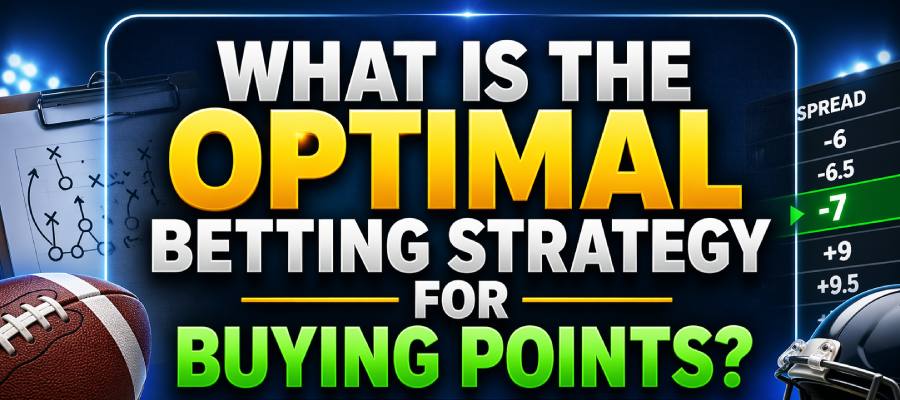
If, for example, a bettor saw a line on the New England Patriots published at -6 and felt that it was a good move to get an extra point on the line, the sportsbook would charge the bettor a fee for that request.
The line would thus be changed to -7, though it would come with increased betting odds. Similarly, if the bettor was wagering on the Patriots at +9 and wanted to buy an extra .5 point, the odds would become +9.5 with a fee charged for the changed odds.
The majority of times, the normal price for a standard NFL point spread or total is -110, so the price for buying half a point is usually -120.
Key Insight
➤ What changes when you buy points:
You improve the number on your side of the bet, but you also pay more juice for that protection.
Why it matters:
A better spread or total may feel safer, but the increased price can erase the value of the wager if the move is not worth the cost.
| Original Bet | Adjusted Bet After Buying Points |
|---|---|
| Patriots -6 at -110 | Patriots -7 at a more expensive price, often around -120 |
| Patriots +9 at -110 | Patriots +9.5 at a more expensive price, with added juice |
| Total at 47 | Total moved to 47.5 or 46.5 depending on direction, with higher cost |
How Buying Points Works in Practice
In simple terms, buying points means paying the sportsbook to improve your betting number. That can be useful when a wager sits close to a highly important margin in football betting, where many games land on key numbers.
This is where many bettors lose their edge, not because the concept is flawed, but because execution lacks discipline. Applying structured frameworks similar to the dos and don’ts of live wagering can help reinforce when paying extra juice is justified and when it becomes a long-term liability.
Visual Model
How to Buy Points Optimally and Profitably
Owing to the increased price that comes with getting points, this betting strategy is often considered not to be profitable, and rightfully so—to some extent.
Pricing plays an important role in determining if getting points is profitable and, generally speaking, it is unadvisable to buy points off numbers other than 7 or 3. To better understand how key numbers, game context, and situational edges influence these decisions, review NFL critical betting factors.
Sports bettors can, however, find a way of buying the points at an increased price but still realizing profits using the method detailed below.
Various studies done on buying points indicate that punters can better their betting endeavors through calculations, converting the odds into inferred probability.
This can be done in a simplistic way using a relevant mathematical formula or an online betting calculator.
Pricing plays an important role in determining if getting points is profitable and, generally speaking, it is unadvisable to buy points off numbers other than 7 or 3.
Going against this rule does not offer bettors any advantage over bookies or oddsmakers; it simply charges them more juice in the long run, draining them of valuable resources.
That is the real dividing line in this debate. Buying points is not automatically smart or automatically foolish. It becomes a bad move when bettors pay extra without understanding whether the number they are crossing has enough historical value to justify the price.
Best-Practice Framework
✓ Focus on key numbers:
In football betting, numbers like 3 and 7 matter more than random margins because games land there more often.
✓ Compare the price:
If the sportsbook is charging too much for the half-point, the better line may still be a negative-value play.
✓ Think long term:
The goal is not to make one bet feel safer. The goal is to avoid paying unnecessary juice across hundreds of wagers.
✓ Shop before you buy:
Sometimes a better number already exists elsewhere, making point buying unnecessary if you are comparing markets carefully.
| Situation | General Betting View |
|---|---|
| Buying through 3 | Often one of the few spots worth checking carefully |
| Buying through 7 | Also worth closer evaluation in football markets |
| Buying off random numbers | Usually poor value because the price increase is not justified |
| Not comparing odds first | Risky approach because line shopping may offer a better option without extra cost |
Odds to Implied Probability Tool
Enter American odds to estimate implied probability and compare whether the extra cost of buying points is justified.
Why Key Numbers Matter So Much
One of the biggest mistakes bettors make is assuming every half-point has equal value. It does not. In football, certain margins show up more frequently than others, which is why numbers like 3 and 7 carry much more weight in point spread betting.
That helps explain why experienced bettors are usually selective. They are not buying points just to feel protected. They are doing it, if at all, to move through a number with legitimate market importance. If a bettor ignores that principle, they are usually just paying extra juice for very little in return.
Quick Read
- Not all half-points are created equal.
- Football key numbers make some line moves far more meaningful than others.
- The sportsbook still protects itself by charging more, so discipline is essential.
Compare the number before you pay for it
Before deciding to buy points, review broader betting fundamentals and market pricing with sports betting guides so you can judge whether the extra juice is actually worth it.
Explore Betting GuidesFAQ
Is buying points always a bad idea?
No. It is not always a bad idea, but it is often overused. The value depends on the price you pay and whether the adjustment moves through a meaningful number such as 3 or 7 in football betting.
Why do sportsbooks charge more when you buy points?
Because they are giving you a more favorable betting line. That added protection comes with worse odds, which is how the sportsbook preserves its edge.
What is the most common standard price before buying points?
In many football markets, the standard point spread or total price is commonly around -110. Buying a half-point often pushes that price closer to -120, though exact pricing varies by sportsbook.
Should beginners buy points regularly?
Usually not. Beginners are often better served by learning line value, implied probability, and line shopping first. Buying points without understanding those basics can become an expensive habit.
Summary
- Buying points means improving your spread or total in exchange for worse odds.
- The strategy is most relevant in football markets, especially around key numbers like 3 and 7.
- Profitability depends less on comfort and more on price, probability, and disciplined line selection.
Conclusion
As a crucial reminder, always be mindful of the price you pay when buying points. Though buying half-points or more is not usually profitable, you can have some modicum of success with the getting-points betting strategy if you follow the pointers given above and shop for the best odds and prices.
This is where many bettors lose their edge, not because the concept is flawed, but because execution lacks discipline. Applying structured frameworks similar to the dos and don’ts of live wagering can help reinforce when paying extra juice is justified and when it becomes a long-term liability.
The most important lesson is that buying points should never be automatic. A bettor who understands market value, key numbers, and implied probability has a much better chance of making a smart decision than one who simply pays for extra cushion out of habit. In the long run, discipline matters more than convenience.
So while buying points can occasionally help, it works best as a selective tool rather than a standard routine. Treat it as a calculated pricing choice, not a shortcut to safer betting, and you will be in a much stronger position to protect your bankroll over time.
MyBookie: Bet On Anything. Anywhere. Anytime.

About the Author

Since 2008, D.S. Williamson has written about sports and sports handicapping. His philosophy is value-based, meaning stats and other handicapping factors are only worth something in comparison to wagering odds. He believes money management and making value-based wagers is the single more important factor that distinguishes successful sports bettors from non-successful sports bettors.
Sportsbook Bonuses


Get your Expert Tips, Insights and Strategies in our Sports Betting Guide
- 3-Way vs 2-Way Betting: Draw No Bet Explained for Soccer Bettors
- Live Betting the World Cup: How FIFA Odds Change In-Play
- Crypto Betting Sites Explained: How Cryptocurrency Betting Works and What to Know
- How to Bet on NFL Game Totals Over/Under
- Bitcoin for Online Sportsbooks & Casinos: How Crypto Betting Works