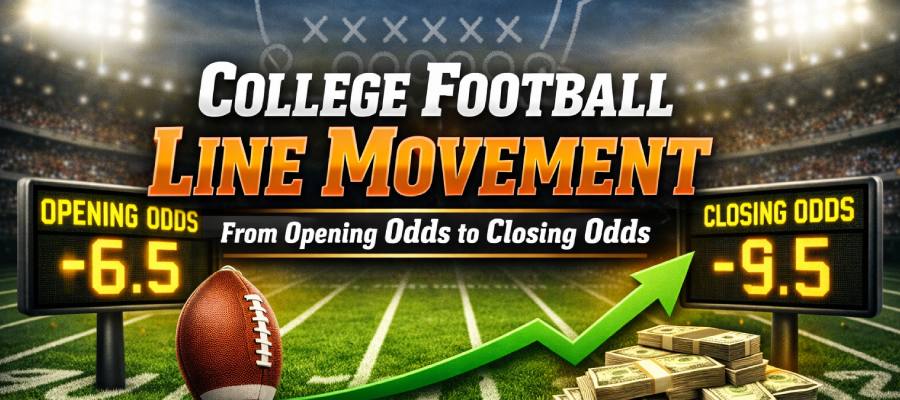
College football odds don’t stay still.
The number you see when lines open early in the week often looks very different by kickoff.
This guide breaks down how and why those odds move, what opening and closing lines really represent, and how understanding line movement can help you spot value.
Table of Contents

Line movement refers to how betting odds change after opening lines are released.
🎯 How Sportsbooks Set the Opening Line
The best way to think of NCAA odds is as a probability that a certain outcome will happen.
To reach that point, a whole slew of factors needs to be taken into account.
That includes things like injuries, power ratings, historical matchup data, and many more.
For the National Championship game, you also have neutral site assumptions coming into play.
For example, will Miami have an edge in a game played in Florida?
What you also need to understand is that the bookies are looking to balance the action so that they win regardless of the outcome.
If you are making picks according to sportsbook odds and assuming they are picking sides, that is a mistake.
Factors That Shape Opening Lines
- Injuries and roster status
- Power ratings and analytics
- Historical matchup data
- Neutral-site assumptions
- Action-balancing objectives
When Opening Odds Are Released — and Why Timing Matters
Sportsbook betting lines for college football are typically posted shortly after the current week’s games conclude.
In most cases, opening odds appear six to seven days before the next slate of matchups, giving sportsbooks an early read on how the market responds.
Occasionally, lines may be released even earlier for high-profile games or marquee matchups.
The purpose of these early numbers is not accuracy.
Opening lines are released to invite action, test pricing, and observe how bettors react before the market fully develops.
What Shapes Opening Odds
| Factor | How It Influences the Line |
|---|---|
| Power ratings | Baseline strength comparison |
| Recent performance | Momentum and form adjustments |
| Injuries & depth | Availability impacts pricing |
| Scheduling spot | Travel, rest, and look-ahead effects |
📈 What Causes Line Movement After Opening Odds Are Posted
Bookies do not change their minds after setting the early CFB betting lines.
When the line changes, it is sportsbooks reacting to betting behavior.
For example, if the early line is set at -4 ½ and moves to -6, more often that not, we are seeing the bookies reacting to sharp money entering the market.
Sharp bettors tend to jump on the early odds if they see what they believe to be a small flaw in the price.
The bookies them change the current market odds to reflect those wagers, not because they have a different opinion.
| Trigger | Market Reaction |
|---|---|
| Early sharp action | Line adjustment to manage exposure |
| Betting imbalance | Odds shift to attract opposing wagers |
What Line Movement Means in College Football Betting
Line movement describes the change between the opening number and the closing number before kickoff.
For example, if a team opens the week as a 7-point favorite and closes as a 9-point favorite, the market has moved two points.
These shifts help bettors understand how the market reacts to pressure throughout the week, rather than predicting outcomes.
Opening Line vs. Closing Line — A Simple Example
| Timing | Point Spread | What It Signals |
|---|---|---|
| Opening Line | -7 | Initial sportsbook opinion |
| Midweek Adjustment | -8 | Early action shaping the market |
| Closing Line | -9 | Final, most efficient price |
“Line movement reflects how the market reacts — not who the sportsbook thinks will win.”
📊 College Football Line Movement: Opening Odds vs. Closing Odds
For beginners, understanding line movement helps explain why the odds you see on Monday often look very different by Saturday.
Timing matters in college football betting.
Understanding how betting lines move between the moment they open and the moment a game kicks off can tell you a lot about market behavior, risk management, and when value actually appears.
Line movement is not random, and it is not guesswork.
It reflects how sportsbooks respond to money, perception, and risk throughout the week.
College football line movement refers to how sportsbook betting odds change from the opening line to the closing line as money, information, and market pressure enter the betting market.
Why Line Movement Matters
- Tracks market behavior — shows how money reacts to matchups.
- Reveals timing value — helps identify when numbers are soft.
- Explains odds changes — movement reflects risk, not predictions.
“Understanding movement helps bettors focus on price, not hype.”
Early Sharp Money and Its Impact
Professional bettors, often referred to as sharps, are usually the first to attack opening lines.
They look for numbers they believe are soft or mispriced.
By betting early, sharps aim to secure value before sportsbooks have time to adjust.
If you see significant line movement early in the week, that is often a sign that respected money has entered the market.
Early movement does not guarantee a winning bet.
It simply indicates that sharp bettors identified value at the opening number.
Sharp Money vs Public Money
| Sharp Bettors | Public Bettors |
|---|---|
| Bet early | Bet closer to game day |
| Target numbers | Follow teams and narratives |
| Create early movement | Drive midweek adjustments |
“Sharps shape the line early. The public pushes it later.”
The Influence of Public Betting
If there is one predictable force in college football betting, it is public opinion.
As the week progresses, casual bettors begin to place wagers based on rankings, recent highlights, media narratives, and team popularity.
This midweek action often causes noticeable line movement.
Public-driven movement does not always reflect value.
It reflects demand.
How Public Betting Moves Lines
- Ranked teams attract casual money
- Recent blowout wins inflate spreads
- Popular programs draw late action
“Public money moves lines because sportsbooks must manage exposure.”
Understanding how public money affects odds can help bettors decide whether to follow the move or look for opportunities on the other side.
Sharp Money vs Public Money in Championship Markets
Championship markets usually move more slowly than regular-season lines.
Bettors looking specifically at title games can also review a College Football Playoff and National Championship betting guide to understand how pricing and market behavior differ in high-profile matchups.
By the time the title game arrives, the betting market has far more information, the matchup has been discussed for weeks, and the opening number is typically sharper than a standard weekly line.
That means early sharp action is often smaller, and it takes more volume or a meaningful update (injury news, weather, or late public pressure) to push the market off its opener.
Instead of looking for “big moves,” bettors in championship games often focus on timing—watching whether the number drifts toward a key spread or total before kickoff.
Even when the line barely moves, the price can still change through juice adjustments as sportsbooks manage risk.
Sharp vs Public Betting Behavior
- Sharps attack early pricing inefficiencies
- Public money arrives closer to kickoff
- Emotion and narrative often drive public bets
- Both influence line movement differently
Why College Football Championship Lines Move More Slowly
By the time we get to the National Championship Game, we all know enough about both teams to have already made an informed decision on how the game might play out.
This tends to not be the case in the regular season, as you often see bettors overreacting to a single result or performance.
Once the big game rolls around and the early odds are released, you don’t often see many major line movements during the week.
↑ TopWhen Is the Best Time to Bet?
The best time to bet is not the same every week.
Sometimes value appears early, before lines move in response to sharp action.
This is especially true during conference title games, where understanding matchup context and motivation is critical — a topic covered in this NCAA conference championship handicapping guide.
Other times, waiting allows public betting to push numbers too far, creating value closer to kickoff.
Situational awareness matters.
Tracking line movement over time helps bettors recognize patterns and decide when to act.
The goal is not to bet early or late by default, but to bet when the number is most favorable.
This is why many experienced bettors track opening numbers early in the week and reassess their position as the line moves toward kickoff.
Choosing When to Bet
- Bet early when you spot a soft opening number
- Wait when public action may inflate the line
- Track movement to identify pressure points
“There is no universal rule — timing depends on the matchup.”
How Sportsbooks Manage Risk
Sportsbooks are not predicting outcomes when they post betting lines.
They are managing risk.
Odds move to encourage balanced action on both sides of a wager.
This ensures the sportsbook can limit exposure regardless of the result.
Understanding this helps bettors avoid the misconception that line movement equals inside information.
It does not.
It reflects how money is shaping the market.
What Sportsbooks Are Really Doing
- Balancing action, not predicting outcomes
- Adjusting prices to control exposure
- Reacting to money, not secrets
“Line movement is a response to risk, not inside information.”
Common Myths About Line Movement
One of the biggest myths is that line movement means sportsbooks know something bettors do not.
Another misconception is that only sharp money moves lines.
In reality, line movement is influenced by multiple factors, including injuries, public betting, and risk management decisions.
There is rarely a single reason behind a move, so understanding this helps bettors avoid overreacting to line changes.
Many of these misconceptions also show up in everyday betting habits, which are covered in detail in this guide on common college football wagering mistakes.
Line Movement Myths vs Reality
| Myth | Reality |
|---|---|
| Sportsbooks know the outcome | They manage betting exposure |
| Only sharps move lines | Public money plays a major role |
| Movement guarantees winners | It only reflects market pressure |
“Movement explains behavior, not results.”
🏁 What Closing Odds Represent
The closing line is the final betting line before kickoff.
It represents the most efficient price the market has produced.
Sportsbooks adjust lines throughout the week to balance action and manage exposure.
By kickoff, the closing line reflects all available information, including injuries, weather, sharp money, and public betting.
Closing line value is an important concept for long-term bettors.
Consistently beating the closing number suggests you are identifying value earlier than the market.
Opening Odds vs. Closing Odds
| Opening Odds | Closing Odds |
|---|---|
| Based on initial opinion | Based on full market reaction |
| More likely to contain soft numbers | More efficient and refined |
| Targeted by sharp bettors | Benchmark for long-term success |
“Opening odds test opinion, while closing odds reflect the most efficient market price.”
The Closing Line: What the Odds Look Like at Kickoff
If you are looking for the most accurate odds available, then you need to look at the closing line.
The final line takes everything into account, including general consensus, and is as accurate a representation as you are going to get.
The professionals use this number as a benchmark, which helps them with every other bet they make moving forward.
| Line Type | What It Represents |
|---|---|
| Opening Line | Initial probability and early risk balance |
| Closing Line | Market consensus at kickoff |
Compared to opening odds, the closing line reflects the most complete and accurate consensus of all available information before kickoff.
↑ TopWhy the Closing Line Matters More Than the Final Score
Closing line value (CLV) measures whether a bettor beat the market by securing better odds than the final closing line.
It’s one of the core concepts covered in any sports betting guide because it focuses on price and timing rather than short-term results.
CLV is something that needs to be tracked, even more so than the final score in games.
A positive CLV is a sign that you are doing the right thing when wagering in sports and trying to evaluate current market odds.
Let’s imagine for a moment that you wager on a favorite at -3 and their odds end up at -4 in the closing line.
That is a sign of positive CLV.
If the closing odds moved to -2, you are looking at a negative CLV.
Being consistently on the positive side shows that you are making smart betting decisions.
↑ Top🔍 Tracking Championship Odds Across Sportsbooks
It is never a bad idea to compare odds across multiple different sportsbooks to see if the latest odds from MyBookie are moving at the same rate as other places.
Generally speaking, there is not going to be a massive difference in odds, with a ½ point difference not that uncommon.
One thing to remember though, is that bookies change their odds based on betting volume, among other things, but you are still getting a pretty clear picture of what the betting public thinks when you do a little comparison shopping.
↑ TopCollege Football Line Movement FAQ
What causes college football betting lines to move?
Betting lines move in response to sharp money, public betting volume, new information such as injuries or weather, and sportsbook risk management. The goal is to balance action and control exposure, not predict outcomes.
Is it better to bet early or wait?
It depends on the situation. Value can appear at different times during the week.
What does sharp money mean?
Sharp money comes from experienced bettors who target soft opening lines.
How do sportsbooks decide when to move a betting line?
Sportsbooks move betting lines to manage risk and balance action, primarily reacting to sharp money, betting volume, and exposure on one side of the market.
How can bettors track current market odds before kickoff?
Log in to your favorite betting site regularly to track line movement, while also tracking movement on other sites.
What is the difference between sharp money and public money?
Sharp bettors are generally professionals or highly skilled bettors.
Public money is wagers made by everyone else.
What does the closing line represent?
The closing line represents the outcome of all factors, including public betting, taken into account and is the most accurate odds representation.
College Football Line Movement Timeline
| Stage | What Happens | Why It Matters to Bettors |
|---|---|---|
| Opening Odds | Lines are posted early in the week based on initial sportsbook opinion. | Early numbers may be softer and vulnerable to sharp action. |
| Early Week Movement | Sharps bet quickly on mispriced lines before the market reacts. | Early movement often signals professional betting interest. |
| Midweek Adjustment | Public betting begins to influence spreads and totals. | Public bias can create inflated favorites or totals. |
| Late Week / Closing Line | Sportsbooks balance action and manage risk before kickoff. | The closing line is usually the most efficient price available. |
“Line movement isn’t about prediction — it’s about timing, pressure, and risk management.”
↑ Top
✅ Final Thoughts
The difference between opening odds and closing odds reveals how the betting market thinks.
Learning how and why lines move will help you make more informed decisions.
By tracking line movement, understanding risk management, and recognizing when value appears, you can approach college football betting with more confidence.
In practice, successful bettors focus less on picking winners and more on beating the number before the market settles.
Having access to a reliable sportsbook makes it easier to track opening numbers, monitor line movement, and act when value appears.
Many bettors also compare insights from platforms like getbets us when evaluating line movement trends across different sportsbooks.
Use this guide as a foundation, and explore updated college football odds and sportsbook bonuses when you’re ready to place your next wager.
If you get in the habit of doing that, you will get a much better idea of how line movement can inform your betting decisions in a positive way.
The odds-setting process follows a consistent pattern: sportsbooks release opening lines, sharp bettors shape early movement, public money adds late pressure, and the closing line reflects final market consensus.
Track Line Movement with Live College Football Odds
Follow opening numbers, monitor movement, and find value before kickoff.
View College Football Betting LinesTiming beats guessing.
MyBookie: Bet On Anything. Anywhere. Anytime.

Ready to lock in your plays? Don’t wait — early bowl lines move fast.
Bookie Betting Lines
Updated Vegas Odds & Spreads at MyBookie
About the Author

- Henry Watkins
- Henry Watkins is a Sports Writer at MyBookie. Originally from Scotland and currently residing in Metro Atlanta with his wife Penny, Henry covers a range of topics, including competitive and professional sports as well as sports business. In addition to his sports writing, he is also an author of horror fiction, with works such as Karaoke Night, Crueller, and Off The Grid.
Sports Betting Odds
Explore everything You need to know about MyBookie Rules and Sportsbook Rules
Betting Online Casino
| Playing Blackjack or Poker |
| Understanding Live Casino |
| Best Casino Online Games |
- How FIFA World Cup Betting Works (From Group Stage to Final)
- UFC Fight Night Betting Odds Explained: How to Read the Lines Before Fight Night
- UFL Betting Guide: Off-Season Strategy & Championship Futures Picks
- What is the Monthly Income Sports Betting System?
- Best Bets for March Madness Beginners (And What to Avoid)
Sportsbook Odds | MyBookie Online
^ Top