English
Last updated: October 2026
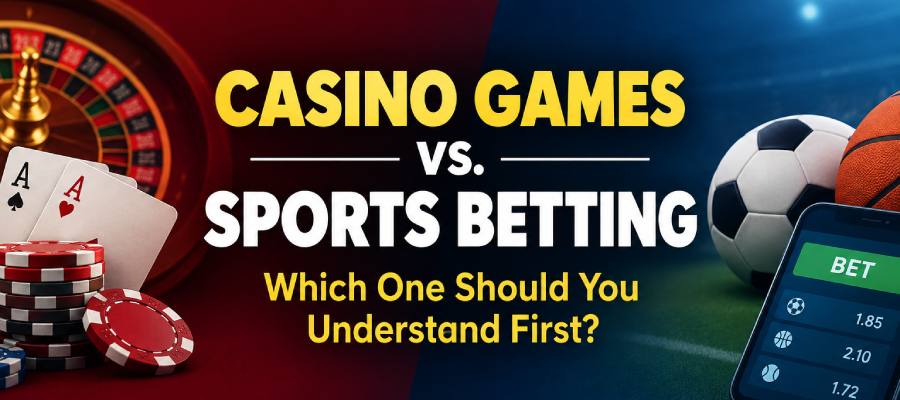
Casino Games vs. Sports Betting: A Beginner’s Guide to the Differences, Odds & Tips
Casino games and sports betting might look similar at a glance, but they work differently. Casino games generally use mathematical rules, game probabilities, and paytables to determine payouts, while sports betting involves wagering on the outcome of real-world sporting events at odds set by a sportsbook.
The main difference between casino games and sports betting is how outcomes are determined, how odds are priced, and what players can do to make informed decisions. Understanding house edge, return to player (RTP), sportsbook margins, implied probability, and bankroll management helps beginners compare the two forms of gambling before choosing where to play.
Key Insight: Casino Games vs. Sports Betting
🎰 Casino Games
Game rules, probability, paytables, and house edge determine the mathematical relationship between wagers and payouts.
🏀 Sports Betting
Sportsbook odds reflect estimated event probabilities, market information, and a bookmaker’s margin.
⚖ The Shared Factor
Both involve uncertainty, financial risk, and the possibility of losing your entire stake. Neither guarantees a profit.
What Are the Fundamental Differences Between Casino Games and Sports Betting?
The biggest difference is what determines the result. In a casino game, the outcome follows the rules and probability model of that particular game. In sports betting, the outcome depends on a sporting event, and the bettor must evaluate the odds offered on that event.
Casino games include slots, blackjack, roulette, baccarat, and live dealer games. Depending on the game, the outcome may be generated by a random number generator (RNG), physical equipment, or a live game process. Sports betting includes moneyline wagers, point spreads, totals, futures, and player props.
| Factor | Casino Games | Sports Betting |
|---|---|---|
| What determines the outcome? | Game rules, random outcomes, and player decisions where applicable | Real-world sporting performance and event conditions |
| How are payouts determined? | Game paytables and the rules for the wager | The sportsbook’s odds and the wager’s settlement rules |
| How does the operator earn money? | Typically through a house edge built into the game | Typically through a margin incorporated into the odds, plus risk management and other market factors |
| Does skill matter? | It can matter in decision-based games such as blackjack | Research and probability estimates can help assess whether odds offer value |
| Can results be predicted? | Some decisions can be evaluated mathematically, but individual outcomes remain uncertain | Research can inform probability estimates, but event outcomes remain uncertain |
| How quickly can you lose money? | Depends on game speed, bet size, and session length | Depends on the market, stake size, event frequency, and settlement |
| What should beginners learn first? | Rules, payouts, RTP, house edge, and volatility | Odds, implied probability, sportsbook margins, and market rules |
Example: Two Different Ways a Wager Works
Casino game: Imagine a slot game with a theoretical RTP of 96%. Over a very large number of wagers, the game is designed to return an average of $96 for every $100 wagered, with a theoretical $4 difference. Your actual session could end with a win or a loss.
Sports betting: Imagine a sportsbook offering odds of -110 on a football team. A $110 winning wager earns $100 in profit, plus the original $110 stake. The bet still loses if the selected outcome does not win under the market’s settlement rules.
What to learn: RTP describes a casino game’s theoretical long-run return. Sports betting odds describe the price and payout of a specific wager. Neither guarantees a result.
Neither format is inherently better for every player. Casino games may suit people who prefer a defined set of rules and a self-contained game. Sports betting may appeal to those interested in sports analysis and evaluating prices. In both cases, knowledge can improve decision-making without eliminating risk.

How Do Casino Games Work?
Casino games operate according to specific rules that determine how wagers are resolved and what payouts are available. The mathematical properties differ by game, so it is important to understand the rules of the particular game rather than assume that every casino game has the same advantage or winning frequency.
How do online slots work?
Online slots use a game system, commonly an RNG, to determine outcomes according to the game’s design. Symbols, paylines, bonus rounds, and paytables determine how qualifying combinations pay.
Slots can differ significantly in RTP, volatility, bonus features, maximum payouts, and wager limits. A high-volatility slot may produce longer stretches without a significant payout and occasionally deliver a large win. A lower-volatility slot may distribute payouts differently, but that does not mean it will necessarily return more money during an individual session.
Read this explanation of casino game volatility to understand why payout frequency and payout size are different concepts.
How do casino table games work?
Table games use defined rules to resolve wagers. Blackjack involves decisions such as hitting, standing, doubling, and splitting. Roulette uses a wheel and betting options tied to possible outcomes. Baccarat uses card outcomes and specific rules for resolving player and banker bets.
Player decisions can affect the mathematical expectation of some games. In blackjack, for example, basic strategy can reduce the house edge under specified rules. In roulette, the player generally selects a wager, but choosing a different betting pattern does not remove the house edge of a standard game.
The important distinction is between making a better decision within a game’s rules and changing the underlying probability of the game itself.
Are live dealer games different from regular online casino games?
Live dealer games use a streamed table and a human dealer, allowing players to observe the game as it unfolds. Online RNG games instead generate their outcomes through software. Both formats can offer games with defined rules, payout structures, and a house edge.
A live dealer format does not automatically provide better odds, and an RNG game is not automatically less fair. Compare the published rules, payout information, minimum and maximum bets, and any available game-specific fairness information.
How Does Sports Betting Work for Beginners?
Sports betting involves selecting a market, evaluating the odds, choosing a stake, and placing a wager on a sporting event. The sportsbook displays the price for each available outcome, and the wager is settled according to the market’s rules and the official result.
For example, a bettor might wager on which team will win a football game, whether a team will cover a point spread, or whether the combined score will exceed a total. Each market asks a different question and can have a different price.
What are sportsbook lines?
Sportsbook lines describe the betting terms offered on an event. These may include the moneyline, point spread, total, or other markets. The listed odds indicate the payout available if a wager wins, while the market’s rules determine how the bet is settled.
- Moneyline: Wager on a competitor to win outright.
- Point spread: Wager on a team to win by a specified margin or stay within a handicap.
- Totals: Wager on whether a combined score will finish over or under a specified number.
- Player props: Wager on a player’s statistical performance or another specified individual outcome.
- Futures: Wager on an outcome that will be decided later, such as a championship winner.
Read the beginner’s guide to betting on sports for a broader explanation of markets and wager types, or learn how sportsbooks work before placing a bet.
How are sports betting odds determined?
Sportsbook odds reflect an operator’s assessment of possible outcomes, the information available to the market, betting activity, and a margin that affects the prices offered to bettors. Odds can change as new information becomes available or as the market develops.
Odds are not necessarily an unbiased forecast of an event’s probability. The sportsbook’s margin means that the implied probabilities calculated from all outcomes in a market can add up to more than 100%.
For beginners, the essential skill is understanding what price is being offered and how that price compares with a reasonable estimate of the outcome’s probability.
What Is the Difference Between House Edge and Sportsbook Margin?
House edge and sportsbook margin both help explain how gambling operators build an economic advantage into their products, but they work differently.
House edge is the mathematical advantage a casino game has over a player under its stated rules and payout structure. It is usually expressed as a percentage of the amount wagered over the long run.
Sportsbook margin, often called the vig or juice, is reflected in the odds offered on a market. It can be illustrated by converting the odds for all mutually exclusive outcomes into implied probabilities and adding them together.
| Concept | Casino house edge | Sportsbook margin |
|---|---|---|
| Where it comes from | Game probabilities, rules, and payouts | Prices offered on the available outcomes |
| How it is measured | Expected loss relative to total wagers under the game’s mathematical model | Often illustrated by the excess of summed implied probabilities over 100% |
| Can it vary? | Yes, between games, paytables, and rule sets | Yes, between sportsbooks, markets, and prices |
| Can a player reduce its effect? | Sometimes, by choosing a lower-edge game or making mathematically sound decisions where relevant | Sometimes, by comparing prices and avoiding unnecessarily expensive odds |
Example: Understanding the Sportsbook Margin
Suppose both sides of a hypothetical two-outcome market are listed at -110.
- Side A: 52.38% implied probability.
- Side B: 52.38% implied probability.
- Combined total: 104.76%.
The total exceeds 100% by approximately 4.76 percentage points. This is the market’s overround, a common way to illustrate the pricing margin built into sportsbook odds.
What to learn: The 104.76% total is not the actual probability that one of the two outcomes will occur. It is calculated from the offered prices and illustrates why the odds should not be treated as unbiased probabilities.
Neither figure tells you exactly what will happen during one session or one bet. Both are mathematical tools for understanding the long-term economics of gambling.
For additional context, see how casino house edge works and the difference between RTP and house edge.
What Is RTP, and Does a Higher RTP Mean a Better Casino Game?
Return to player (RTP) is the theoretical proportion of total wagers that a casino game is expected to return to players over a very large number of plays under its specified conditions.
For example, a game with a theoretical RTP of 96% has an expected return of $96 for every $100 wagered over the long run, with an expected difference of $4. This is a statistical illustration, not a promise that a player who wagers $100 will receive $96 back.
Actual results can be much higher or lower during an individual session because outcomes vary. RTP also does not tell you how frequently a game pays, how large its payouts are, or how much money you need to play.
Is RTP the same as house edge?
For a game with a 96% RTP, the corresponding theoretical house edge is 4%, assuming the two figures refer to the same game, rules, and wager conditions. RTP and house edge describe complementary sides of the same long-run expectation in that context.
Do not assume that a higher RTP automatically makes a game suitable for your budget. Volatility, bet size, game speed, and the rules governing bonus features also affect the playing experience.
Example: Turning RTP Into House Edge
Suppose two hypothetical games have the following theoretical returns:
- Game A: 96% RTP means a 4% theoretical house edge.
- Game B: 94% RTP means a 6% theoretical house edge.
For every $100 wagered over the long run, Game A has a theoretical return of $96 and Game B has a theoretical return of $94, assuming the published figures apply to the same wager conditions.
What to learn: A higher RTP corresponds to a lower theoretical house edge when the figures describe the same game conditions. It does not mean you will lose less in every individual session.
Which casino games have the best odds?
There is no single answer for every casino because odds depend on the specific game, rules, payout table, and available bets. Some blackjack rule sets can offer a relatively low house edge when played using appropriate basic strategy. Certain baccarat bets and particular roulette formats also have defined mathematical expectations, but the available options differ.
Slots vary widely, and their advertised RTP does not establish that a particular session will be profitable. Compare the actual game information rather than relying on a general ranking of game names.
See how to compare casino game odds before choosing a game.
Which Requires More Skill: Casino Games or Sports Betting?
The answer depends on the game and what you mean by skill. Some casino games involve meaningful decisions, while other games offer limited control over the outcome. Sports betting involves estimating probabilities and evaluating prices, but expertise does not remove the uncertainty of sporting events.
Example: Better Decisions vs. Guaranteed Results
Blackjack: A player who learns basic strategy can make mathematically stronger decisions than someone who chooses randomly. However, even a correct decision can be followed by a losing hand.
Roulette: A player might switch from betting on red to betting on black after several losses. That change in betting choice does not remove the house edge or make the next spin more likely to win.
Sports betting: Someone might research injuries, compare team statistics, and estimate a game’s probabilities correctly as far as the available information allows. The actual result can still differ from that estimate.
What to learn: Skill can improve decisions in certain situations, but it does not eliminate randomness, uncertainty, or financial risk.
When skill matters in casino games
In blackjack, learning basic strategy can improve decisions compared with making choices at random. Other games may involve strategy, but the effect depends on their rules and whether the player can influence the expected outcome.
In slots and most standard roulette bets, choosing when to play or changing a betting pattern does not alter the underlying odds of a given wager. A winning streak does not establish that the next outcome is more likely to be favorable.
When skill matters in sports betting
Sports bettors can research team performance, player availability, weather, tactical matchups, and historical results. They can also compare prices across sportsbooks and use probability estimates to evaluate whether a wager is worth its cost.
However, a bettor’s analysis can be incomplete, the odds may already reflect relevant information, and unpredictable events can change the outcome. Knowing more about a sport does not automatically mean a bettor can identify prices that outperform the market.
The Decision-to-Outcome Gap: Why a Good Decision Can Still Lose
One important difference between making a decision and judging its result is the amount of uncertainty involved. A decision should be evaluated using the information and probabilities available when it was made—not only by whether the outcome was a win or a loss.
In casino games: A blackjack player can follow an appropriate basic-strategy decision and still lose the hand. The decision can be mathematically sound even when the immediate result is unfavorable.
In sports betting: A bettor might estimate that a team has a 55% chance of winning a wager offered at -110. The break-even probability at those odds is approximately 52.38%, so the estimate would suggest a potential pricing advantage if it were accurate. The team can still lose that particular game.
How to evaluate the decision:
- Before the wager: Identify the rules, price, relevant probabilities, and maximum amount at risk.
- After the outcome: Separate the result from the quality of the original reasoning.
- Over time: Review whether your assumptions were reasonable and whether your decisions consistently followed a sound process. A short run of wins or losses is not enough to prove that a strategy works.
Why this matters: A winning result does not automatically prove a decision was good, just as a losing result does not automatically prove it was bad. Evaluating the process separately from the outcome helps beginners avoid chasing losses, overconfidence after wins, and mistaking randomness for a reliable pattern.
Does sports betting have a house edge?
Sports betting does not usually have a fixed house edge in exactly the same way as a casino game. Instead, sportsbook odds commonly include a margin. The bettor needs a sufficient probability of winning at the offered price to overcome that margin over time.
For a deeper introduction, review probability in wagering and how implied probability works.
Ready to Put Your Knowledge Into Action?
You’ve explored the odds, rules, and key differences. If you’re ready to take the next step, create your MyBookie account and see what’s available to you.
Before getting started, review the available bonuses and their terms so you understand any eligibility requirements, wagering conditions, and restrictions.
18+ or the legal age in your jurisdiction. Gambling involves risk. Please play responsibly.
How Do You Compare Betting Odds and Implied Probability?
Implied probability converts a set of odds into the win probability needed to break even at those odds, before accounting for other costs. It is useful in sports betting because the payout alone does not show whether a wager is favorable.
For positive American odds, the basic formula is:
Implied probability = 100 / (odds + 100)
For negative American odds, use:
Implied probability = absolute value of odds / (absolute value of odds + 100)
| American odds | Break-even probability | Meaning |
|---|---|---|
| +150 | 40.00% | A winning bet returns $150 profit on a $100 stake. |
| +100 | 50.00% | A winning bet returns $100 profit on a $100 stake. |
| -110 | 52.38% | A winning bet returns about $90.91 profit on a $100 stake. |
| -150 | 60.00% | A winning bet returns about $66.67 profit on a $100 stake. |
Example: What Does -110 Actually Mean?
American odds of -110 mean you need to risk $110 to earn $100 in profit if the wager wins.
- Stake: $110.
- Potential profit: $100.
- Total returned on a win: $210, including the original stake.
- Break-even probability: $110 ÷ ($110 + $100) = 52.38%.
If you could win 55% of comparable wagers at these odds over time, your estimated win rate would exceed the break-even threshold. If your win rate were 50%, it would fall below it.
What to learn: The break-even percentage is a pricing benchmark, not a prediction. A higher estimated win probability does not establish an advantage unless the estimate is sufficiently accurate.
What Does Implied Probability Tell You About a Sportsbook’s Margin?
These are break-even probabilities for the listed prices, not predictions of what will happen. In a two-outcome market with both sides priced at -110, the implied probabilities total approximately 104.76%. The amount above 100% illustrates the market’s overround, commonly associated with the sportsbook’s margin.
When comparing casino games with sports betting, remember that implied probability describes the price of a sports wager, while RTP and house edge describe a casino game’s long-run mathematical return. They are related concepts, but they are not interchangeable measurements.
How Do Volatility and Risk Differ Between Casino Games and Sports Betting?
Volatility describes how widely results can vary around an expected return. It is especially useful when comparing casino games, but sports betting also has substantial uncertainty and can produce long winning or losing streaks.
In slots, volatility helps describe the distribution of payouts. A higher-volatility game may offer less frequent but larger potential payouts, while a lower-volatility game may distribute returns differently. Neither category guarantees a specific result.
Example: Comparing Slot Volatility
Imagine two hypothetical slots with the same 96% theoretical RTP but different payout distributions.
- Lower volatility: Payouts may occur more frequently, often in smaller amounts.
- Higher volatility: Payouts may be less frequent, with a greater share of returns coming from occasional larger wins.
Both games have the same stated theoretical RTP in this illustration, but a short session could produce very different results in each.
What to learn: RTP describes a theoretical long-run return, while volatility describes how results are distributed around that expectation. Neither figure guarantees a particular session outcome.
In sports betting, risk depends on the market, the odds, the stake, the accuracy of the bettor’s probability estimate, and the uncertainty of the event. A heavy favorite can still lose, and a longshot can win, but the payout reflects the price offered.
The most important beginner lesson is that a higher possible payout does not automatically mean better value. Before wagering, consider both the chance of the outcome and the amount you stand to lose.
How Do Casino Bonuses and Sports Betting Promotions Differ?
Casino bonuses and sports betting promotions may increase the amount of promotional play or provide a conditional benefit, but their value depends on the terms. The advertised bonus amount alone does not tell you whether the offer is suitable for you.
Casino promotions may include deposit matches, free spins, or promotional credits. Sports betting offers may include free bets, odds boosts, or other credits subject to eligibility requirements. The available products and conditions vary by promotion.
Example: Why a Bonus Is Not the Same as Cash
Suppose a hypothetical casino promotion offers a $100 bonus with a 20x wagering requirement on the bonus amount.
- Bonus amount: $100.
- Wagering requirement: 20x the bonus.
- Required eligible wagering: $100 × 20 = $2,000.
The $2,000 represents the amount of eligible wagers required under this example’s terms. It does not mean you must deposit $2,000, nor does it mean you will have $2,000 remaining afterward.
What to learn: Check which amount the wagering multiplier applies to, which games or markets qualify, the expiration period, and any withdrawal restrictions. Completing a wagering requirement does not guarantee a profit.
Before accepting either type of offer, check:
- Wagering requirements: Whether and how much you must wager before funds or winnings become withdrawable.
- Eligible games or markets: Whether some wagers count less toward requirements or are excluded.
- Expiration dates: How long the promotion remains available.
- Maximum conversion or withdrawal limits: Whether limits apply to promotional funds or winnings.
- Stake and odds restrictions: Whether minimum odds, maximum stakes, or other conditions apply.
- Withdrawal and account rules: Any additional requirements that apply before funds can be withdrawn.
Do not assume that a sports betting free bet and a casino deposit bonus have the same rules. Read the specific terms of the offer and calculate its practical value before deciding whether to accept it.
What Is the Difference Between Online Casino Games, Live Casinos, and Online Sports Betting?
Online casino games and online sports betting both allow wagers to be placed through a digital platform, but the experience and the products differ. Online casino games may use RNG software or live dealer streams. Online sports betting provides markets linked to sporting events, often with prices that change before or during an event.
Live casino games allow players to observe a dealer through a stream, while live sports betting offers in-play markets whose odds can change as the match progresses. The word “live” describes the format or timing, not a guarantee of better odds or greater fairness.
Before using an online platform, review its applicable rules, payment terms, security information, and the requirements that apply in your location. A professional-looking website alone does not prove that an operator is legitimate.
For more information, see the online casino guide and how to evaluate an online casino’s legitimacy.
Does Bitcoin Betting or Crypto Betting Change the Difference Between Casino Games and Sports Betting?
Bitcoin betting and crypto betting describe payment methods or account-funding options, not separate forms of game probability. A casino wager made using cryptocurrency still follows the casino game’s rules, while a sports wager funded with Bitcoin still depends on the sportsbook’s odds and the sporting outcome.
Using cryptocurrency does not automatically improve RTP, reduce a casino’s house edge, remove a sportsbook’s margin, or make a wager more likely to win. Payment speed, transaction fees, exchange-rate movements, withdrawal conditions, and applicable account terms may affect the overall experience.
Anyone considering online betting with cryptocurrency should verify the platform’s supported assets, deposit and withdrawal rules, transaction requirements, and local legal restrictions before transferring funds. Do not confuse payment convenience with a betting advantage.
How Should Beginners Manage a Bankroll for Casino Games and Sports Betting?
Bankroll management means deciding in advance how much money you can afford to lose and setting limits on how much you wager. It does not make a negative-expectation game profitable or prevent losing streaks, but it can help limit financial harm.
Beginners should consider these practical steps:
- Set a fixed budget: Use only money available for entertainment after essential expenses and financial obligations.
- Separate gambling from everyday finances: Keep gambling funds distinct from money needed for bills, savings, or emergencies.
- Set time and spending limits: Decide when to stop before starting a session.
- Do not chase losses: Increasing stakes to recover losses can magnify financial harm.
- Understand the risk of each wager: A bet can lose even when your reasoning appears sound.
- Take breaks: Avoid making gambling decisions when frustrated, tired, intoxicated, or under financial pressure.
Example: Setting a Gambling Budget
Imagine someone sets aside $100 per month strictly for gambling entertainment, after covering essential expenses and savings.
- Monthly limit: $100.
- Illustrative session limit: $20.
- Remaining monthly budget after one $20 session: $80, assuming no other gambling activity.
If the $20 session is lost, the person does not increase the next session’s limit to try to recover it. If the monthly budget is exhausted, gambling stops until the next planned budget period.
What to learn: Limits help control spending; they do not improve the odds or prevent losses. The budget should only use money that can be lost without affecting essential expenses, and it is always acceptable to choose not to gamble.
Keeping separate records for casino play and sports betting can help you understand where your money goes, but separate budgets do not change the underlying risk. Never treat gambling as a reliable source of income or borrow money to place wagers.
How Do You Choose Between Casino Games and Sports Betting?
The right choice depends on your interests, your understanding of the rules, and your willingness to accept the risks. You do not need to choose either format, and there is no requirement to gamble to enjoy sports or learn about probability.
| If you prefer… | What to consider |
|---|---|
| Short, self-contained games | Casino games may offer a more immediate format, but game speed can increase how quickly you wager money. |
| Analyzing teams and sporting events | Sports betting may appeal to you, but research does not eliminate uncertainty or guarantee positive returns. |
| Learning probability and game mechanics | Compare published rules, house edge, RTP, sportsbook margins, and implied probability. |
| Knowing the payout rules in advance | Read the exact game rules or market settlement terms before placing a wager. |
| Keeping gambling as occasional entertainment | Set a firm spending limit, avoid chasing losses, and consider non-gambling alternatives. |
Whichever format you explore, learn the rules first and understand the maximum amount you could lose. If you are not comfortable with that risk, do not place the wager.
Frequently Asked Questions: Casino Games vs. Sports Betting
Are casino games and sports betting the same thing?
No. Casino games resolve wagers according to specific game rules, probabilities, and payouts. Sports betting involves wagering on sporting outcomes at odds offered by a sportsbook. Both involve risk, but their pricing and outcome mechanisms differ.
Is casino gambling easier than sports betting for beginners?
It depends on the game and the person. Casino games may have straightforward rules, while sports betting requires understanding odds and markets. Both require learning the relevant rules and recognizing that a simple betting process does not mean a low financial risk.
Which is better: casino games or sports betting?
Neither is universally better. Casino games may suit people who prefer defined game mechanics, while sports betting may appeal to people interested in sports and probability. Compare the costs, risks, and rules rather than assuming one format offers better financial results.
Are casino games based entirely on luck?
No. Many casino outcomes involve randomness, but some games, such as blackjack, also involve decisions that affect expected results. The extent to which skill matters depends on the rules. Strategy cannot guarantee a win or remove every disadvantage.
Is sports betting a game of skill or luck?
It involves both analysis and uncertainty. Research can help bettors estimate probabilities and compare odds, but sporting outcomes remain uncertain. Skill in evaluating a price does not guarantee that a particular wager will win.
Do casino games always have a house edge?
Standard casino games are generally designed with a mathematical house advantage under their specified rules and payouts. The size varies by game and conditions. A player’s decisions may reduce the edge in some games, but standard betting systems do not automatically eliminate it.
Does a sportsbook always have an advantage?
Sportsbooks commonly include a margin in their odds, which creates a pricing hurdle for bettors. Whether a particular wager offers positive expected value depends on the true probability of the outcome relative to the price. Beating that margin consistently is difficult and not guaranteed.
What is the difference between RTP and implied probability?
RTP describes a casino game’s theoretical return relative to wagers over the long run. Implied probability converts betting odds into the probability needed to break even at that price, before accounting for other costs. They measure different aspects of gambling and should not be used interchangeably.
Does a 96% RTP mean I will get 96% of my money back?
No. A 96% RTP is a theoretical long-run expectation under the specified game conditions. Your actual result in a session may be substantially higher or lower because individual outcomes vary.
Which casino game has the best odds?
There is no universal answer. The mathematical expectation depends on the specific game, rules, payouts, and wagers. Compare the actual house edge or RTP information where available rather than relying on the game name alone.
Can you make a living from sports betting or casino games?
Neither should be treated as a reliable source of income. Both can result in financial losses, and positive results are not guaranteed. Keep gambling separate from essential financial needs and use only money you can afford to lose.
Are online casino games fair?
Fairness depends on the operator, the game’s implementation, its rules, and the relevant oversight. Look for clear game information and appropriate licensing or independent testing where applicable. A website’s appearance alone does not establish fairness or legitimacy.
Are live dealer games better than RNG casino games?
Not automatically. Live dealer games use streamed table play, while RNG games use software-generated outcomes. Compare their rules, payouts, available bets, and other relevant details rather than assuming one format has better odds.
Do casino bonuses and sports betting bonuses work the same way?
No. Casino promotions may involve free spins or deposit matches, while sportsbook promotions may include free bets or odds boosts. Eligibility, wagering requirements, expiration dates, and withdrawal conditions vary by offer, so read the specific terms.
Does Bitcoin betting give you better odds?
No. Bitcoin is a payment method, not a probability advantage. The casino game’s payout structure or the sportsbook’s odds still determine the wager’s mathematical conditions. Transaction costs and account terms can affect the overall experience.
Can I use the same bankroll for casino games and sports betting?
You can set one overall entertainment budget, but it is useful to track spending on each activity separately. Establish firm limits, do not transfer money between activities to chase losses, and never use funds needed for essential expenses.
What should beginners learn before gambling online?
Learn the rules, payouts, odds, fees, and account terms for the specific product. Check that the platform is appropriate for your location, set spending limits, and understand that losses are possible. If the risks are not acceptable, do not wager.
Final Takeaway: Understand the Game Before You Bet
Casino games and sports betting share an important feature: the possibility of losing money. Their main differences lie in how outcomes are determined, how payouts are calculated, and how players evaluate the odds.
For casino games, focus on rules, RTP, house edge, and volatility. For sports betting, understand sportsbook lines, odds, implied probability, and the margin built into prices. Bonuses and payment methods should be evaluated separately from the underlying odds.
The goal of learning these differences is not to find a guaranteed way to win. It is to understand what you are participating in, make informed decisions, and recognize when the financial risk is not worth taking.
Start Smart
Learn the Rules Before You Play
Explore the Betting Academy, review the applicable rules, and set a clear entertainment budget before considering any wager.