English
Last updated: October 2026
The college football line movement timeline runs from opening odds to closing odds shortly before kickoff. Sportsbooks release an initial spread, moneyline, and total, then adjust those prices as bets come in and new information becomes available.
Early sharp action, public betting, injuries, weather, and roster news can all influence how the numbers change throughout the week. Comparing opening and closing odds helps bettors evaluate market movement and determine whether they secured a better number than the final price.
Quick Answer: College Football Line Movement Timeline
College football line movement follows a timeline from opening odds to closing odds. Sportsbooks post an initial number, early betting action can trigger adjustments, new information and public wagers can cause further movement, and the closing line reflects the market’s final price shortly before kickoff. Tracking these changes helps bettors understand market behavior and evaluate closing line value (CLV), but it does not guarantee a winning bet.
🎯 How Sportsbooks Set the Opening Line
College football odds are built around probability, not prediction. Before posting opening lines, sportsbooks combine statistical models, roster information, and market expectations to estimate how likely different outcomes are.
📊 What Shapes Opening Odds?
| Factor | Why It Matters |
|---|---|
| Injuries and roster changes | Player availability affects team strength and pricing. |
| Power ratings | Analytics create the baseline spread and total. |
| Historical data | Past matchups and trends influence projections. |
| Neutral-site games | Championship venues change home-field assumptions. |
| Schedule strength | Teams may be stronger or weaker than their record suggests. |
🔄 Modern Factors That Influence College Football Odds
- Transfer portal movement: Major additions and departures can reshape preseason expectations. Bettors tracking early markets should understand how transfer portal changes affect college football futures odds.
- Coaching changes: New head coaches and coordinators often force sportsbooks to reevaluate power ratings. Learn more about college football coaching changes and betting value.
- Strength of schedule: Sportsbooks adjust for the quality of competition, which is why understanding how to use strength of schedule in college football betting can provide additional context.
🏆 Championship Games Add Another Layer
National Championship odds include extra considerations, especially when games are played at neutral venues. Sportsbooks must determine whether factors like travel distance, climate, or regional support create subtle advantages.
These markets also require bettors to consider whether a program’s conference affiliation, schedule strength, and potential playoff path are already reflected in the price. That context is especially important when evaluating whether a non-Power conference team can win the National Title despite facing longer odds than established contenders.
For example, would Miami benefit from playing a championship game in Florida? Those assumptions are built into the opening number.
Key takeaway
- Sportsbooks are not trying to predict the final score.
- Opening lines are designed to attract balanced action.
- Odds move as money enters the market.
- Line changes reflect risk management, not insider knowledge.
If you assume sportsbooks are simply choosing which team will win, you are misunderstanding how betting markets operate.
Factors That Shape Opening Lines
- Injuries and roster status
- Power ratings and analytics
- Historical matchup data
- Neutral-site assumptions
- Action-balancing objectives
When Opening Odds Are Released — and Why Timing Matters
College football opening lines are typically posted shortly after the current week’s games conclude. In many cases, sportsbooks release them six to seven days before the next slate, although high-profile matchups can appear earlier.
Some sportsbooks also release early numbers before the full betting market develops. These college football look-ahead lines give bettors an early reference point before opening odds are widely available and can provide insight into how the market develops throughout the week.
🕐 Why Timing Matters
- Early lines: Give sportsbooks an initial read on market demand.
- Opening numbers: Allow bettors to identify potential pricing inefficiencies.
- Early action: Gives sportsbooks information about how bettors view the matchup.
- Line movement: Develops as new information and betting pressure enter the market.
Week 0 can be especially important for bettors tracking the first college football markets of the season. With a smaller slate of games, individual matchups can attract more attention and create an early look at how the market responds. For a closer look at the schedule, odds, and betting opportunities, see this College Football Week 0 betting guide.
📊 What Happens After the Opening Line?
| Stage | What Happens |
|---|---|
| Opening Line | Sportsbook posts its initial price. |
| Early Action | Bettors react to the number and identify potential value. |
| Market Adjustment | Odds change as betting activity and new information arrive. |
| Closing Line | The market reaches its final price before kickoff. |
The purpose of an opening line is not simply to predict the final score. Sportsbooks use the initial number to attract action, test their pricing, and monitor how the market responds before kickoff.
🎯 Where Preseason Timing Fits In
Opening numbers can also matter before the regular season begins, particularly in futures markets. Bettors evaluating preseason opportunities can review this guide on which college football futures bets offer the best value, including National Championship futures, conference title markets, and season win totals.
For a practical example of how a limited preseason bankroll could be allocated, see this breakdown of $100 in college football futures.
💡 Key Takeaway
- Earlier lines can offer more opportunities for price discovery.
- Sharp action can influence the market before public betting increases.
- Week 0 provides an early look at how college football markets develop.
- Closing odds reflect the market after information and betting pressure have been incorporated.
What Shapes Opening Odds
| Factor | How It Influences the Line |
|---|---|
| Power ratings | Baseline strength comparison |
| Recent performance | Momentum and form adjustments |
| Injuries & depth | Availability impacts pricing |
| Scheduling spot | Travel, rest, and look-ahead effects |

Line movement refers to how betting odds change after opening lines are released.
📈 What Causes Line Movement After Opening Odds Are Posted
Bookies do not change their minds after setting the early CFB betting lines.
When the line changes, it is sportsbooks reacting to betting behavior. For example, if the early line is set at -4 ½ and moves to -6, more often that not, we are seeing the bookies reacting to sharp money entering the market.
Sharp bettors tend to jump on the early odds if they see what they believe to be a small flaw in the price.
Line movement can also affect individual statistical markets as sportsbooks react to player availability, projected roles, matchups, and betting action. This guide to college football player props explains how passing, rushing, receiving, and touchdown markets work and what can cause their odds to change before kickoff.
The bookies them change the current market odds to reflect those wagers, not because they have a different opinion.
| Trigger | Market Reaction |
|---|---|
| Early sharp action | Line adjustment to manage exposure |
| Betting imbalance | Odds shift to attract opposing wagers |
What Line Movement Means in College Football Betting
Line movement describes the change between the opening number and the closing number before kickoff. To understand what those numbers represent in the first place, see this guide to college football betting lines and how sportsbooks display spreads, moneylines, totals, and their associated prices.
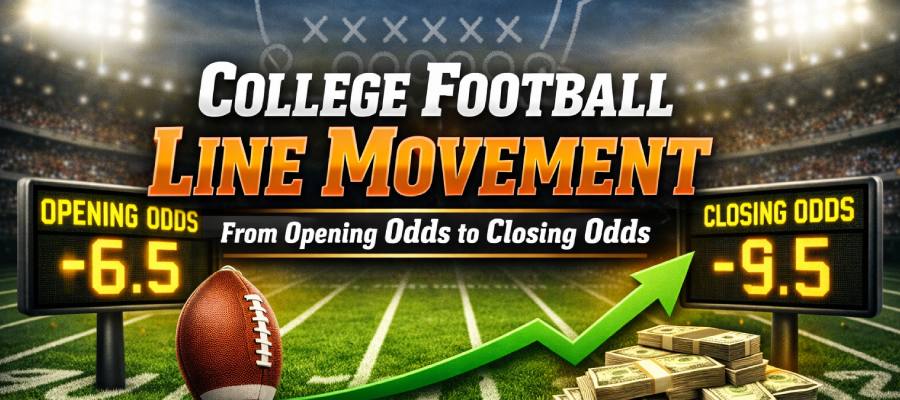
For example, if a team opens the week as a 7-point favorite and closes as a 9-point favorite, the market has moved two points. These shifts help bettors understand how the market reacts to pressure throughout the week, rather than predicting outcomes. For bettors focused on point spreads, it also helps to understand what ATS means in college football betting and how a team’s performance against the spread differs from simply winning the game.
Understanding how each wager type is settled is also important when analyzing line movement. Reviewing the sports betting rules can help clarify how spreads, totals, moneylines, and other markets are graded.
Opening Line vs. Closing Line — A Simple Example
| Timing | Point Spread | What It Signals |
|---|---|---|
| Opening Line | -7 | Initial sportsbook opinion |
| Midweek Adjustment | -8 | Early action shaping the market |
| Closing Line | -9 | Final, most efficient price |
“Line movement reflects how the market reacts — not who the sportsbook thinks will win.”
📊 College Football Line Movement: Opening Odds vs. Closing Odds
College football odds rarely look the same on Saturday as they did on Monday. As the week goes on, sportsbooks adjust spreads and totals based on betting activity, new information, and shifting market conditions.
📈 How College Football Lines Change
Line movement can affect more than the full-game spread or total. Sportsbooks may also adjust individual scoring markets as new information enters the market.
| Market | What Can Change |
|---|---|
| Full-game spread | The point difference between the teams can move as betting pressure changes. |
| Game total | The projected combined score can rise or fall with new information. |
| Team total | A single team’s scoring projection can change independently of the overall game total. |
| Live odds | In-game prices can change after major plays, scores, turnovers, injuries, or momentum shifts. |
For more context on team-specific markets, see how college football team totals work.
⏱ Line Movement Before and During the Game
- Before kickoff: Opening lines can change as betting activity and new information enter the market.
- Closer to kickoff: Public betting and late news can create additional movement.
- During the game: Live odds can react quickly to scores, turnovers, injuries, and other major developments.
Our guide to how college football live betting works explains how sportsbooks update lines during the game and what to watch for.
🎯 Why Timing Matters in College Football Betting
In college football betting, timing can matter almost as much as the pick itself. Knowing why lines move can help you understand how the market changes before it settles.
Before tracking those changes, it is also useful to understand the wagering process from start to finish. This guide on how to bet college football games covers choosing a matchup, picking a market, evaluating the line, and reviewing a wager before kickoff.
📈 The Journey From Opening Line to Kickoff
| Stage | What Happens |
|---|---|
| Opening odds | Sportsbooks release their initial numbers. |
| Early sharp action | Professional bettors target soft prices. |
| Midweek movement | News, injuries, and public betting influence the market. |
| Closing line | The final odds reflect the week’s betting activity. |
How College Football Line Movement Develops Throughout the Week
College football line movement describes the changes between the opening line and the closing line as money, information, and market pressure enter the sportsbook throughout the week. For bettors who are still learning how spreads, moneylines, and totals work together, this beginner’s guide to reading college football odds explains the fundamentals behind the numbers that sportsbooks post.
🎯 Why Line Movement Matters
- Tracks market behavior — reveals how bettors react to specific matchups.
- Highlights timing opportunities — early numbers can be softer than closing odds.
- Explains price changes — sportsbooks adjust risk rather than predict winners.
Understanding line movement helps bettors focus on price instead of hype.
💰 Early Sharp Money and Its Impact
Professional bettors, commonly known as sharps, are often the first people to attack newly released lines. Their goal is not simply to pick winners—it is to find odds that they believe are mispriced.
| What Sharps Look For | Why It Matters |
|---|---|
| Soft opening numbers | Lines may not fully reflect market expectations. |
| Injury or roster news | New information can create value before adjustments. |
| Statistical mismatches | Power ratings may differ from sportsbook pricing. |
| Key numbers | Moving across important spreads changes betting value. |
When significant movement happens early in the week, it often signals that respected bettors found value at the opening price.
⚠ Important:
- Sharp money influences markets early.
- Line movement does not guarantee a winning bet.
- Odds changes reflect market pressure, not certainty.
Early movement is best viewed as information about the market—not as proof that one side will win.
Sharp Money vs Public Money
| Sharp Bettors | Public Bettors |
|---|---|
| Bet early | Bet closer to game day |
| Target numbers | Follow teams and narratives |
| Create early movement | Drive midweek adjustments |
How Public Betting Influences College Football Line Movement
“Sharps shape the line early. The public pushes it later.”
If there is one predictable force in college football betting, it is public opinion.
As the week progresses, casual bettors begin to place wagers based on rankings, recent highlights, media narratives, and team popularity. Because rankings heavily influence public perception, they can also create inflated betting prices, making it worthwhile to understand why college football ranked teams are overvalued before following the crowd.
This midweek action often causes noticeable line movement. Public-driven movement does not always reflect value. It reflects demand.
How Public Betting Moves Lines
- Ranked teams attract casual money
- Recent blowout wins inflate spreads
- Popular programs draw late action
“Public money moves lines because sportsbooks must manage exposure.”
Understanding how public money affects odds can help bettors decide whether to follow the move or look for opportunities on the other side.
🏆 Sharp Money vs. Public Money in Championship Markets
Championship betting markets usually move more slowly than regular-season lines. By the time the National Championship arrives, sportsbooks have already processed months of results, power ratings, injuries, and public sentiment.
Bettors looking specifically at title games can also review this College Football Playoff and National Championship betting guide to understand how market behavior changes on college football’s biggest stage.
Because postseason betting introduces additional futures markets and elimination scenarios, bettors following line movement into December and January should also understand CFP bracket betting. The expanded playoff format creates new paths to the National Championship, which can influence how sportsbooks price teams throughout the postseason.
📊 Why Championship Markets Behave Differently
| Regular-Season Games | Championship Games |
|---|---|
| Limited information | Weeks of analysis and discussion |
| More pricing inefficiencies | Sharper opening numbers |
| Frequent overreactions | Smaller line adjustments |
| Faster market swings | More stable betting markets |
Because the opening line is usually more refined, sportsbooks often need substantial betting volume, injury news, weather updates, or heavy public action to move the market significantly.
💰 How Sharp and Public Money Affect Championship Odds
Sharp vs. Public Betting Behavior
- Sharp bettors attack early pricing inefficiencies.
- Public money typically arrives closer to kickoff.
- Media narratives influence casual wagers.
- Both groups shape line movement in different ways.
| Sharp Money | Public Money |
|---|---|
| Bets early in the week | Bets later in the week |
| Focuses on price and value | Follows rankings and storylines |
| Targets soft opening lines | Creates late-market pressure |
| Looks for small edges | Often reacts emotionally |
How Championship Betting Lines Adjust Before Kickoff
Instead of chasing dramatic line moves, championship bettors often monitor whether the spread or total drifts toward key numbers before kickoff.
Even when the spread stays the same, sportsbooks may adjust the juice to manage risk.
⏱ Why College Football Championship Lines Move More Slowly
By the National Championship Game, bettors generally know both teams inside and out. That reduces the type of overreaction that often occurs during the regular season.
Common Triggers for Championship Line Movement
- 🏥 Injury reports and roster updates.
- ⛈ Weather forecasts.
- 📰 Breaking news.
- 💵 Late public betting volume.
As a result, major swings are less common, and bettors tend to focus on timing rather than simply following movement.
🕒 When Is the Best Time to Bet?
The best time to bet depends on the matchup and the market. Sometimes value appears immediately after the opening line is posted. Other times, patience allows bettors to benefit from public overreactions.
This is especially true in conference title games, where motivation and matchup dynamics matter. For a deeper look, see this NCAA conference championship handicapping guide.
| ✅ Bet Early When… | ⏳ Wait When… |
|---|---|
| You believe the opener is mispriced. | Public money could inflate the line. |
| You expect sharp action. | Important news is still pending. |
| You want the best number. | You anticipate late value. |
The goal is not to always bet early or late—it is to place your wager when the number offers the greatest value.
Choosing When to Bet
- Bet early when you spot a soft opening number
- Wait when public action may inflate the line
- Track movement to identify pressure points
“There is no universal rule — timing depends on the matchup.”
How Sportsbooks Manage Risk
Sportsbooks are not predicting outcomes when they post betting lines.
They are managing risk.
Odds move to encourage balanced action on both sides of a wager.
This ensures the sportsbook can limit exposure regardless of the result.
Understanding this helps bettors avoid the misconception that line movement equals inside information.
It does not.
It reflects how money is shaping the market.
What Sportsbooks Are Really Doing
- Balancing action, not predicting outcomes
- Adjusting prices to control exposure
- Reacting to money, not secrets
“Line movement is a response to risk, not inside information.”
Common Myths About Line Movement
One of the biggest myths is that line movement means sportsbooks know something bettors do not.
Another misconception is that only sharp money moves lines. In reality, line movement is influenced by multiple factors, including injuries, public betting, and risk management decisions.
There is rarely a single reason behind a move, so understanding this helps bettors avoid overreacting to line changes.
Misreading line movement can lead bettors to chase steam, overvalue public opinion, or assume that every adjustment signals sharp money. Avoiding these pitfalls is part of making more disciplined decisions, so review these common college football betting mistakes before acting on a changing line.
Line Movement Myths vs Reality
| Myth | Reality |
|---|---|
| Sportsbooks know the outcome | They manage betting exposure |
| Only sharps move lines | Public money plays a major role |
| Movement guarantees winners | It only reflects market pressure |
“Movement explains behavior, not results.”
🏁 What Closing Odds Represent
The closing line is the final betting line before kickoff.
It represents the most efficient price the market has produced. Sportsbooks adjust lines throughout the week to balance action and manage exposure.
By kickoff, the closing line reflects all available information, including injuries, weather, sharp money, and public betting. Closing line value is an important concept for long-term bettors.
Bettors who want to build a stronger foundation can explore additional concepts through the MyBookie Betting Academy, including market analysis, odds evaluation, and betting terminology.
Consistently beating the closing number suggests you are identifying value earlier than the market.
Opening Odds vs. Closing Odds
| Opening Odds | Closing Odds |
|---|---|
| Based on initial opinion | Based on full market reaction |
| More likely to contain soft numbers | More efficient and refined |
| Targeted by sharp bettors | Benchmark for long-term success |
“Opening odds test opinion, while closing odds reflect the most efficient market price.”
The Closing Line: What the Odds Look Like at Kickoff
If you are looking for the most accurate odds available, then you need to look at the closing line.
The final line takes everything into account, including general consensus, and is as accurate a representation as you are going to get. The professionals use this number as a benchmark, which helps them with every other bet they make moving forward.
| Line Type | What It Represents |
|---|---|
| Opening Line | Initial probability and early risk balance |
| Closing Line | Market consensus at kickoff |
Compared to opening odds, the closing line reflects the most complete and accurate consensus of all available information before kickoff.
🏆 Why Does the Closing Line Matter More Than the Final Score?
Closing line value (CLV) measures whether you beat the market by getting a better number than the final odds available at kickoff. Professional bettors track CLV because it focuses on price and timing rather than the outcome of a single game.
For bettors who want a deeper understanding of why professionals pay so much attention to this metric, our guide to closing line value (CLV) in sports betting explains why beating the market can be a more reliable indicator of long-term success than wins and losses alone.
It is one of the most important concepts covered in any sports betting guide because successful betting is often about securing the best number before the market adjusts.
💡 In Simple Terms
✅ Positive CLV
You placed your bet at a better price than the closing line.
❌ Negative CLV
The market moved against your wager before kickoff.
📊 Positive vs. Negative CLV Example
| Your Bet | Closing Line | Result |
|---|---|---|
| Favorite -3 | Favorite -4 | ✅ Positive CLV |
| Favorite -3 | Favorite -2 | ❌ Negative CLV |
Imagine that you wager on a team at -3 and the market closes at -4. Even before the game starts, you secured a better number than everyone betting later in the week.
On the other hand, if the line closes at -2, the market believes your original ticket carries less value than the current price.
🎯 Why Bettors Track CLV
- It measures whether you consistently beat the market.
- It emphasizes timing instead of short-term results.
- It helps identify strong betting habits over time.
- It removes some of the randomness that affects individual games.
In practice, experienced bettors care more about getting the best price than celebrating a single winning ticket.
📈 CLV Visual Model
🔍 Tracking Championship Odds Across Sportsbooks
Comparing odds across multiple sportsbooks remains one of the simplest ways to understand how the market is evolving. Even small differences between sportsbooks can affect long-term betting results.
When you compare current prices with those available at MyBookie, you gain insight into how sportsbooks are reacting to betting volume, risk exposure, and public sentiment.
📉 Why Odds Differ Between Sportsbooks
| Factor | Impact on the Market |
|---|---|
| Betting volume | Heavy action can force books to adjust prices. |
| Risk management | Sportsbooks move lines to limit exposure. |
| Public opinion | Popular teams often attract extra money. |
| Sharp action | Professional bettors can trigger early movement. |
In most cases, the differences between sportsbooks are relatively small. A half-point adjustment is common, especially in championship markets where opening numbers are already efficient.
💰 What Comparison Shopping Reveals
- How quickly sportsbooks react to new wagers.
- Whether sharp money has influenced the market.
- How public sentiment changes during the week.
- Where the best number is currently available.
📊 Championship Market Pressure
Comparing sportsbooks does not guarantee better results, but it does provide valuable context. In practice, line shopping helps bettors understand how the market values each team and where pricing opportunities may exist before the game begins.
College Football Line Movement FAQ
What causes college football betting lines to move?
College football odds move because sportsbooks react to sharp betting, public money, injuries, weather updates, and overall market exposure. Their goal is to manage risk rather than predict winners.
Why do opening odds differ from closing odds?
Opening lines reflect a sportsbook’s initial assessment, while closing lines incorporate a full week of betting activity, new information, and market pressure.
Is it better to bet early in the week or wait until game day?
It depends on the matchup. Betting early can capture soft opening numbers, while waiting may create value if public money pushes the line too far.
What does sharp money mean in college football betting?
Sharp money comes from experienced bettors who target inefficient prices and often influence line movement early in the week.
How do sportsbooks decide when to adjust a betting line?
Sportsbooks move lines to balance action and limit risk, responding to betting volume, injuries, and exposure on one side of the market.
What is the difference between sharp money and public money?
Sharp bettors usually wager early based on value, while public bettors tend to bet closer to kickoff and are more influenced by rankings and narratives.
What does the closing line represent?
The closing line is the final market price before kickoff and reflects the combined impact of injuries, public betting, and sharp action.
Why is closing line value (CLV) important?
CLV measures whether a bettor secured a better number than the final line, making it a useful indicator of long-term betting performance.
How can bettors track line movement before kickoff?
Tracking odds across sportsbooks throughout the week helps bettors identify market pressure, compare prices, and spot potential value.
College Football Line Movement Timeline
| Stage | What Happens | Why It Matters to Bettors |
|---|---|---|
| Opening Odds | Lines are posted early in the week based on initial sportsbook opinion. | Early numbers may be softer and vulnerable to sharp action. |
| Early Week Movement | Sharps bet quickly on mispriced lines before the market reacts. | Early movement often signals professional betting interest. |
| Midweek Adjustment | Public betting begins to influence spreads and totals. | Public bias can create inflated favorites or totals. |
| Late Week / Closing Line | Sportsbooks balance action and manage risk before kickoff. | The closing line is usually the most efficient price available. |
“Line movement isn’t about prediction — it’s about timing, pressure, and risk management.”
✅ Final Thoughts
The difference between opening odds and closing odds reveals how the betting market thinks.
Learning how and why lines move will help you make more informed decisions.
By tracking line movement, understanding risk management, and recognizing when value appears, you can approach college football betting with more confidence.
In practice, successful bettors focus less on picking winners and more on beating the number before the market settles.
Having access to a reliable sportsbook makes it easier to track opening numbers, monitor line movement, and act when value appears.
Many bettors also compare insights from platforms like getbets us when evaluating line movement trends across different sportsbooks.
Use this guide as a foundation, and explore updated college football odds and sportsbook bonuses when you’re ready to place your next wager.
If you get in the habit of doing that, you will get a much better idea of how line movement can inform your betting decisions in a positive way.
The odds-setting process follows a consistent pattern: sportsbooks release opening lines, sharp bettors shape early movement, public money adds late pressure, and the closing line reflects final market consensus.
Track College Football Odds Before the Market Moves
Compare opening numbers, monitor line movement throughout the week, and see how sharp and public betting influence the market in college football betting.
Explore Live College Football OddsMyBookie: Bet On Anything. Anywhere. Anytime.
Important: Sports betting involves risk. No strategy guarantees results, and managing exposure is essential.

About the Author

Henry Watkins is a Sports Writer at MyBookie. Originally from Scotland and currently residing in Metro Atlanta with his wife, Penny, Henry covers competitive and professional sports as well as the business of sports. In addition to his sports writing, he is an author of horror fiction, including Karaoke Night, Crueller, and Off The Grid.
Sportsbook Bonuses
Read requirements in the Bonus page. However, if you want to take a deep knowledge, go to MyBookie Bonus Rules and How to


🔍 Explore Everything you Need to Know aboout your Licensed, Trusted Home For Casino and Sports Since 2014
👉 Gamble responsibly—must be 21+ and in a Legal Jurisdiction | Get Help at 1-800-Gambler