English

Last updated: September 2026
Picking winners is only part of sports betting. The price has to work, too. A sports betting model turns available data into a probability estimate, then compares that estimate with the odds you could actually take. Start with one market, a clear decision time and an honest test on unseen games.
Table of Contents
- What Does a Sports Betting Model Need to Predict?
- Which Data Should You Use to Build a Sports Betting Model?
- How Do You Build a Simple Sports Betting Model Step by Step?
- How Do You Turn Sports Data Into a Win Probability?
- Which Modeling Method Fits the Market?
- How Do You Compare Your Model Probability With Sportsbook Lines?
- How Do You Calculate Expected Value for a Model Bet?
- What Does a Complete Model Decision Look Like?
- How Do You Backtest a Betting Model Without Fooling Yourself?
- How Should You Measure Model Accuracy and Calibration?
- Can Sports Betting Trends Become Useful Features?
- When Is a Model Ready to Compare With Live Sportsbook Odds?
- FAQ
- Final Thoughts
What Does a Sports Betting Model Need to Predict?
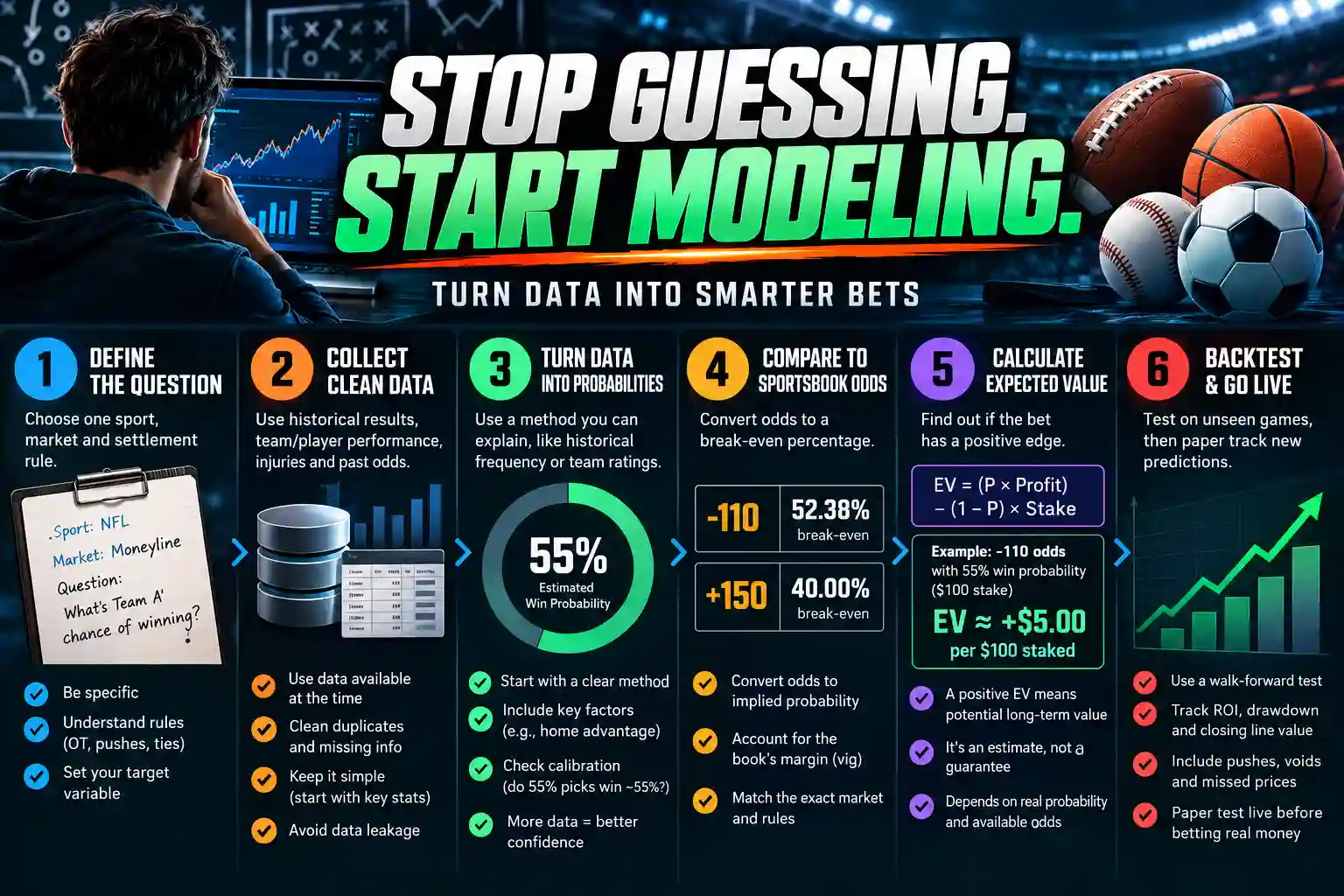
A sports betting model needs a specific question to answer. For an NFL moneyline, that might be: What’s Team A’s chance of winning this game?
That’s different from asking whether Team A covers -3.5. Choose one sport, one market and one settlement definition before building anything.
The outcome you’re predicting is the target variable. For a market that refunds ties, you could estimate win probability conditional on a non-tie result and track refunds separately. Check overtime rules, too.
A sports betting prediction model should produce a probability you can compare with a timestamped price. “Team A wins” isn’t enough to decide whether an online betting offer is worth taking.
Which Data Should You Use to Build a Sports Betting Model?
A sports betting model is only as reliable as the information used to build it. The best inputs are measurable, available before the wager and connected to the market you are trying to predict.
What Data Inputs Should a Sports Betting Model Use?
Useful sports betting data include historical results, team or player performance, known injuries and historical odds. The catch: every input must have been available when you would have made the bet.
- Historical results: Previous game outcomes and performance records.
- Team or player statistics: Measurable performance indicators related to the market.
- Injury and availability information: Player status known before the decision point.
- Historical odds: The prices available when the wager could have been placed.
A basic game log might contain the game date, pregame team ratings, posted moneyline, final result and an “as-of” timestamp for each input.
How Do You Choose Features for a Sports Betting Model?
A feature is an input used to make the prediction. Start with a few understandable sports betting statistics rather than adding every available metric. More columns do not automatically create a better model.
For a closer look at using stats, trends and statistical tools, distinguish measurable inputs from stories assembled after the result.
- Use statistics that have a clear connection to the prediction.
- Avoid features that rely on information unavailable before the wager.
- Test whether each feature improves the model compared with a baseline.
- Remove unnecessary inputs that add complexity without improving results.
How Do You Prevent Data Problems in a Betting Model?
Clean duplicate games, inconsistent team names and missing records before testing. A blank injury field does not mean every player was healthy.
When choosing stats for sports betting, consider whether older seasons still represent today’s teams. Keep future information out of your sports betting stats. Using season-ending rankings to predict September games is data leakage, and it makes a weak model look better.
How Do You Build a Simple Sports Betting Model Step by Step?
For a first model, use one market and make one forecast per game at a fixed pregame time. The example below uses NFL moneylines.
What Is the First Step in Building a Sports Betting Model?
For a first version, choose NFL moneylines with one forecast per game at a fixed pregame time. Store each game as one row with a unique event ID and a consistent home-team perspective.
- Define the market being predicted.
- Choose the exact prediction target.
- Set the decision time for available information.
- Record the final result separately after the event.
Save the home and away ratings calculated only through the prior game, an availability flag for injury information, the offered home moneyline and the quote time. Record the final winner later in a separate outcome field.
What Should You Document Before Testing a Betting Model?
Write down the version of the model, data cutoff, intended entry time, market and handling of pushes and voids. If an input is unknown at that time, mark it unknown rather than filling it with information learned later.
| Stage | Record | Timing rule |
|---|---|---|
| Before the game | Team ratings, known injuries and available moneyline | Save each input as it existed at your planned betting time. |
| Forecast | Model version, win probability and decision threshold | Freeze the method before checking future results. |
| After the game | Result, settlement and closing price | Add these only after the forecast has been recorded. |
| Review | Calibration, ROI, drawdown and sample size | Evaluate later games the model did not train on. |
How Do You Turn Sports Data Into a Win Probability?
If you’re learning how to calculate probability in sports betting, begin with a baseline you can explain.
You might use historical win frequency among comparable matchups. A rating approach could use the difference between team ratings, plus home advantage, to estimate win probability from earlier results.
Suppose your model gives a selection a 55% chance of winning. Across many comparable forecasts assigned 55%, you would expect roughly 55% of selections to win if the model is well calibrated. It says nothing certain about this particular game.
Calibration checks whether those forecasts hold up. Across enough unseen games assigned approximately 55%, the selected teams should win around 55% of the time.
A handful of results won’t settle that question. Neither will an impressive-looking dashboard. AI sports betting models need the same checks as a spreadsheet: honest inputs, unseen tests and probabilities that match outcomes reasonably well. MyBookie’s discussion of AI predictive models offers context, but an AI label alone supplies no evidence of an edge.
Which Modeling Method Fits the Market?
Ratings and logistic regression can turn team strength differences into win probabilities. A score-based model can answer different questions: a Poisson distribution may help represent goal counts in a lower-scoring sport when its assumptions are reasonable. A Monte Carlo simulation samples outcomes from stated inputs; it cannot repair poor input probabilities.
Machine learning may capture interactions, but compare it with a simple benchmark on the same future test period. Extra complexity should earn its place through better calibration and decision results, rather than a higher in-sample win rate. A model for moneylines cannot automatically be reused for spreads, totals or player props.
How Do You Compare Your Model Probability With Sportsbook Lines?
Convert betting odds into a break-even percentage before comparing them with your forecast.
For negative American odds, divide the odds’ absolute value by that value plus 100. At -110: 110 ÷ 210 = 52.38%.
For positive odds, divide 100 by the odds plus 100. At +150, the threshold is 40%.
American Odds Break-Even Calculator
Enter American odds to see the win rate needed to break even on settled bets, before considering pushes or fees.
To explore payouts as well as implied probability, use MyBookie’s betting odds calculator.
How Do You Compare a Model Probability With Implied Probability?
The calculator shows the break-even win rate implied by the quoted odds. At -110, that rate is 52.38%. A 55% model estimate exceeds it by 2.62 percentage points, provided the estimate is reliable.
But sportsbook lines include a margin. If both sides are -110, their implied probabilities total 104.76%. Dividing each side’s implied probability by that total gives 50% for each in this symmetric example. That no-vig estimate is a market benchmark; it doesn’t reveal the true probability.
Your model’s fair odds at 55% would be about -122, before margin. When comparing odds for sports, match the exact selection, market and settlement rules. For a moneyline, a lower price such as -110 offers a better payout than -120 for the same selection; a change in spread or total creates a different bet.
How Do You Calculate Expected Value for a Model Bet?
Here’s the expected value sports betting calculation with a $100 stake and no push or tie outcome.
At -110, a winning $100 bet earns $90.91 profit. The total return is $190.91 because you also get your stake back.
With a 55% chance of winning: EV = (0.55 × $90.91) − (0.45 × $100) ≈ +$5.00 per $100 staked. Rounding the $90.909… payout to cents before multiplication makes the result approximately $5.00.
That’s estimated sports betting EV, not $5 you collect every time. One wager either wins $90.91 or loses $100.
The estimated edge comes from beating the 52.38% break-even rate. Value betting depends on that probability being sound and those betting odds being available. If the model overstates your chances, the apparent value can disappear. See the fuller expected value guide for the pricing framework.
What Does a Complete Model Decision Look Like?
Assume a model estimates 55% for a selection, while the available moneyline is -110. The break-even rate is 52.38%, the estimated probability gap is 2.62 percentage points, and the estimated EV is about 5% of stake. Those are three different quantities: probability gap, estimated return on the wager and actual result.
If the price moves to -130 before you act, the break-even rate becomes 56.52%. With the same 55% forecast, the wager no longer qualifies. Save both quotes with their timestamps; a backtest must use the price available at its stated entry time.
Same Forecast, Different Price
How Do You Backtest a Betting Model Without Fooling Yourself?
The first rule of how to backtest a sports betting model is simple: don’t let it see the answers.
Train on earlier dates. Test on later, unseen games using only the features and prices available at the planned betting time.
A walk-forward test repeats that process. Fit the model, test the next period, then move forward. Don’t keep adjusting it to fix the same losing test set and still call that set unseen.
Key Insight: Keep the Timeline Honest
⚙ Available at decision time
Pregame ratings, news already known and the quoted price at your planned entry time can inform the forecast.
Added after the decision
The final score and closing price belong in the review record. Using them to reconstruct an earlier forecast introduces lookahead bias.
What Should You Track When Backtesting a Sports Betting Model?
For sports betting model backtesting, record every decision point so the results match what would have happened in real conditions. Track the event date, quoted price and time, forecast probability, stake, outcome and closing price.
- Event details: Date, market, selection and outcome.
- Model information: Forecast probability, model version and inputs used.
- Betting details: Available odds, quote timestamp and intended stake.
- Market comparison: Closing price and line movement after the wager.
How Do You Avoid Lookahead Bias in Sports Betting Backtesting?
If your strategy makes its decision on Friday, Sunday’s best price is not a fair substitute. Record missed prices, pushes, voids and the applicable MyBookie rules as they would have applied at the decision time. Otherwise, the test can credit your model with information or opportunities it never had.
How Should You Measure a Sports Betting Model After Backtesting?
A backtest should evaluate more than just wins and losses. Review multiple performance measures to understand whether the model produces reliable probabilities and realistic betting decisions.
- ROI: Measures the return generated from the tested wagers.
- Sample size: Shows whether results are based on enough observations.
- Calibration: Checks whether predicted probabilities match actual outcomes.
- Drawdown: Measures the decline from a bankroll peak.
- Closing line value (CLV): Compares your obtained price with the closing market price.
One profitable stretch, especially one driven by a few longshots, requires further investigation. MyBookie’s closing line value explainer covers this comparison, but positive CLV alone does not prove long-term profitability.
How Should You Measure Model Accuracy and Calibration?
Win rate answers how often selected wagers won. It does not say whether the prices made them profitable. For probability quality, group forecasts into ranges such as 50–59%, 60–69% and 70–79%, then compare each group’s forecast average with its actual win rate on unseen games. Thin groups have large uncertainty.
A Brier score averages the squared difference between predicted probability and outcome (1 for a win, 0 for a loss). For one 55% forecast that wins, the squared error is (0.55 − 1)² = 0.2025; if it loses, it is 0.55² = 0.3025. Lower is better when calculated over the same events and compared with a baseline. Log loss is another probability metric and penalizes confident mistakes strongly.
Report the count of forecasts, count of eligible bets, average quoted odds, ROI and maximum drawdown alongside these scores. Keep training, tuning and final test periods separate. A strong ROI from a tiny number of bets cannot establish reliable calibration.
Can Sports Betting Trends Become Useful Features?
Sports betting trends can become useful model features when they provide measurable information that improves a probability estimate. A trend by itself is not a prediction; it needs to be tested against a baseline to determine whether it adds value after accounting for the current betting price.
What Makes a Sports Betting Trend Useful?
A trend should have a logical reason to influence outcomes, a defined measurement period and only use information available before the wager. The goal is not to find patterns after the fact, but to test whether a statistic adds predictive value beyond what sportsbook lines already reflect.
- Plausible mechanism: The trend should have a reason it could affect future results.
- Defined lookback window: Measure the trend over a consistent period rather than selecting convenient samples.
- Available information: Only include data that would have been known before the betting decision.
- Market comparison: Test whether the trend adds value after accounting for the current betting price.
A winning streak, recent scoring run or historical matchup trend may look meaningful, but it can simply repeat information already included in sportsbook odds.
How Should You Test Trends Inside a Betting Model?
Test one trend against a baseline using later games that were not part of the original research. Keep failed tests in your research log instead of removing them, because choosing only successful results can create overfitting.
- Compare the trend model against a simpler baseline.
- Use future games that were not included during development.
- Track whether the trend improves probability estimates or expected value.
- Review results over a meaningful sample size rather than a short winning stretch.
MyBookie’s guides to using trends to predict outcomes and trend-based handicapping provide additional background, but any feature still needs to demonstrate value outside the original sample.
When Is a Model Ready to Compare With Live Sportsbook Odds?
How Do You Test a Model Before Using Real Money?
Paper track new forecasts before placing wagers. Set the minimum EV and entry time in advance, then record the price available when the decision was due.
- Define your minimum expected value threshold before reviewing odds.
- Record the forecast, available price and decision timestamp.
- Recalculate if the odds change before entry.
- Compare paper results with the original model assumptions.
For example, if your minimum estimated EV is 2%, a price change can remove that advantage. The original quote cannot justify a different wager after the market moves.
What Should You Check Before Comparing a Model With Sportsbook Lines?
Check that the selection, market and settlement terms match your forecast. Save the price and timestamp you could actually use; realistic entry timing matters as much as a promising backtest.
The MyBookie Betting Academy provides introductory material for understanding markets, odds and betting prices.
- Calibration: Are your probability estimates matching outcomes over time?
- Execution: Could you realistically obtain the prices used in testing?
- Consistency: Does the process work beyond one profitable sample?
- Discipline: Are decisions based on your model rules rather than short-term results?
Passing a backtest does not prove future profitability. Sports betting conditions change, so focus on stable calibration, accurate inputs and consistent execution rather than a single positive balance.
FAQ
Can I build a sports betting model in a spreadsheet without coding?
Yes. A spreadsheet can store data, estimate probabilities, convert odds and calculate expected value (EV). Start with a simple model you can inspect and explain.
How much historical data does a sports betting model need?
There is no universal minimum. It depends on how often comparable events occur and how complex the model is. Reserve later games for testing, and report uncertainty even when you have a large dataset.
Why can a sports betting model with a high win rate still lose money?
A high win rate does not guarantee profit because the odds determine the payout. A model can win often but still lose if the prices are too low.
What is the difference between backtesting and a live paper test?
A backtest evaluates past decisions using historical data, while a live paper test records predictions before future games to test real-world execution.
Should a sports betting model use sportsbook odds as an input?
It can, as long as those odds were available at the time of the prediction. Compare the model against market benchmarks and avoid using future closing prices.
How do I know if my sports betting model is overfitted?
Signs include strong training results but weak future performance, too many adjustments to one test period and results that depend on a narrow set of conditions.
Is closing line value proof that my model is profitable?
No. Closing line value can help measure price quality, but it should be reviewed alongside results, calibration and expected value.
What should I record before using a sports betting model?
Record the event, market, prediction, model version, timestamp, odds, stake and outcome. This creates a clear record for testing and improvement.
Final Thoughts
Start with one market and a question your model can answer. Use only information available at the decision time, turn it into a probability estimate, and compare that estimate with the price you could actually take. Then test the process on later games and paper track new forecasts before trusting the results.
The 55% example shows why price matters: -110 can offer estimated value while -130 does not, even when the forecast stays the same. If the available price misses your threshold, leave the wager alone.
NEXT STEP
Compare Your Model Against Real Betting Prices
Check the current price, confirm the market rules and apply the same threshold you used in testing.
View Sportsbook LinesMyBookie: Bet On Anything. Anywhere. Anytime.
Important: Sports betting involves risk. No strategy guarantees results, and managing exposure is essential.

About the Author

Since 2008, D.S. Williamson has written about sports and sports handicapping. His philosophy is value-based, meaning statistics and other handicapping factors are only useful when compared with the available wagering odds. He believes bankroll management and consistently making value-based wagers are the most important factors separating successful sports bettors from unsuccessful bettors.
Sportsbook Bonuses
Read requirements in the Bonus page. However, if you want to take a deep knowledge, go to MyBookie Bonus Rules and How to