English
Last updated: September 2026
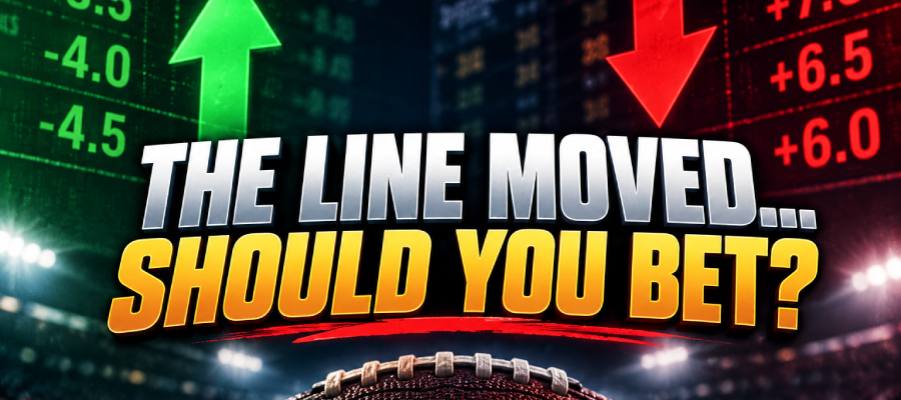
You liked the underdog at +3.5 on Monday. By Sunday, it’s +3. Same team and game, but a different bet. Before placing it, you need to know what changed, whether the move matters, and whether the price available now still fits your analysis.
This guide explains how to track NFL opening lines, read movement in both the spread and its odds, assess reported betting splits, and compare your accepted ticket with the closing line. Every game and price example below is hypothetical.
Quick Answer: What Is NFL Betting Market Analysis?
NFL betting market analysis is the process of tracking how a betting line changes from its opening price to kickoff. It involves comparing the spread, odds, market news, current prices, and closing line to understand what changed and what price you actually received.
Editorial Note
This guide explains how NFL betting lines, market movement, betting splits, and closing line value work. Examples are hypothetical and are provided for educational purposes; market movement does not guarantee a particular game outcome or betting result.
Table of Contents
- What Is NFL Betting Market Analysis?
- When Do NFL Lookahead Lines and Opening Lines Appear?
- How Do You Read NFL Betting Lines and American Odds?
- Why Are 3 and 7 Important NFL Spread Numbers?
- Why Do NFL Betting Lines Move Before Kickoff?
- What Are Steam Moves in NFL Betting?
- Can NFL Betting Splits and Reverse Line Movement Reveal Sharp Money?
- When Should You Bet NFL Opening Odds Instead of Waiting?
- How Do You Compare NFL Sportsbook Lines Before You Bet?
- How Do You Convert American Odds to Implied Probability?
- How Do You Measure Closing Line Value on an NFL Bet?
- Does the Closing Line Prove a Bet Had Positive Expected Value?
- How Do Other NFL Bet Types Affect Line-Movement Analysis?
- What Should You Check Before Placing an NFL Bet?
- FAQ
- Final Thoughts
What Is NFL Betting Market Analysis?
NFL betting market analysis follows a defined wager from its first available price to kickoff. For a full-game spread, record the team, point spread, American odds, sportsbook, and timestamp. Repeat that process as the market changes.
Suppose an underdog opens at +3.5 (-110) and later moves to +3 (-110). The earlier ticket wins if that team loses by exactly three; the later ticket pushes. Getting +3.5 was a better number, although either wager can still lose.
Sportsbook lines are offers to wager at a particular moment. Their movement can reveal where the market settled, but the move alone cannot identify who bet, why the price changed, or which team will win.

When Do NFL Lookahead Lines and Opening Lines Appear?
A lookahead line is a preliminary price that may appear before either team plays its preceding game. A main-week opener is the sportsbook’s first price for that week’s regular game market, often posted Sunday or Monday. The timing depends on the book and matchup.
Imagine this timeline for one underdog’s full-game spread, with each quote priced at -110:
Lookahead: +2.5. Main-week opener: +3.5. Thursday: +3. Close: +3.
The lookahead and main-week opener are different reference points. The current line is the offer visible when you check. The closing line is the final available pregame price from your defined source. Record the date, time, time zone, and sportsbook so those labels remain meaningful.
Visual Model: NFL Line Movement Timeline
How Do You Read NFL Betting Lines and American Odds?
Read the number and the price separately. A favorite at -3 (-110) must win by at least four points for that spread bet to win. A three-point win pushes. At -110, you risk $110 to win $100 in profit.
If the favorite changes to -3 (-120), the spread and push condition remain the same, but you now risk $120 to win $100. If it changes to -3.5 (-110), a three-point win loses. That half-point changes the result for one common margin of victory.
The same reading applies to other NFL betting odds. If Over 44.5 (-110) becomes Over 46 (-110), the game needs more points for the over to win. If a moneyline underdog moves from +150 to +130, a winning $100 bet returns $130 in profit rather than $150.
For a deeper explanation of spread outcomes and pushes, see MyBookie’s guide to how NFL point spreads work. The Betting Academy also covers the basic language of sports betting.
Spread vs. Price Movement
Why Are 3 and 7 Important NFL Spread Numbers?
Three and seven are important because NFL games can finish with those exact winning margins. Moving a favorite from -3 to -3.5 turns a three-point win from a push into a loss. Moving an underdog from +3 to +3.5 turns a three-point loss from a push into a win.
That does not mean every half-point has the same value. The cost of crossing a number depends on the probability of landing on that margin and on the change in odds. Compare both before buying points or selecting a different spread. MyBookie’s buying-points explanation covers the price tradeoff.
Key Insight: Why 3 and 7 Matter
⚙ At +3:
A three-point loss is a push rather than a loss.
At +3.5:
A three-point loss becomes a win, assuming the same wager terms.
Why Do NFL Betting Lines Move Before Kickoff?
A line can respond to confirmed injuries, weather, team information, wagers, changed limits, or prices at other sportsbooks. For example, a starting quarterback being ruled out could affect a spread. A stronger wind forecast could affect a total. Neither example explains every move.
Check when the information became public. If you see an injury report after a price has already changed, that news may already be reflected in the current betting odds. A move from -3 (-110) to -3 (-120) may also precede a change to -3.5; following only the spread would miss the first price adjustment.
Record observations before assigning a cause. A changed line shows that the available offer changed. It does not prove that a particular bettor or syndicate caused it.
What Are Steam Moves in NFL Betting?
A steam move is a rapid change in price across multiple sportsbooks, often described as a response to influential action or new information. To evaluate one, compare the same market at multiple books and note when each price changed.
Several books moving together is more informative than one isolated screenshot, but it still does not reveal the identity of the bettors. By the time you notice a move, the earlier price may be gone. Decide whether the current offer has value instead of assuming that following the move will reproduce the earlier bettor’s position.
Can NFL Betting Splits and Reverse Line Movement Reveal Sharp Money?
NFL betting splits commonly report a share of tickets and a share of wagered dollars. Tickets count bets; dollars measure the amount wagered. Ten small tickets can represent less money than one large ticket.
Suppose 70% of reported tickets back a favorite, yet its spread moves from -6 to -5.5. Bettors often call that reverse line movement because the line moved against the side with the majority of reported tickets.
Before interpreting it as sharp money, identify the reporting sportsbook, sample period, market, and timestamps. The reported splits may omit bets at other books or action outside the reporting window. News and broader market changes could also explain the move. A percentage cannot establish a bettor’s identity or skill.
Use splits as a question to investigate: What changed, when did it change, and what price can I bet now? Do not treat them as a standalone NFL pick.
Reverse Line Movement Example
When Should You Bet NFL Opening Odds Instead of Waiting?
Early NFL odds can be attractive when your analysis gives a defensible reason to expect the price to move against your side. Waiting can be useful when important injury, lineup, or weather information is unresolved. Neither timing choice is automatically better.
For example, taking +3.5 early helps if the market later offers only +3 at the same odds. But if new information makes your original estimate wrong, holding the earlier number does not make the wager sound. Conversely, waiting for clarity may leave you with a worse spread or more expensive juice.
Set the number and maximum price you would accept before deciding when to wager. That makes an early bet, a late bet, and a pass three deliberate outcomes.
Key Insight: Early vs. Waiting
⚙ Bet Earlier:
You may secure a better number before later information changes the market.
Wait:
You can incorporate later injury, lineup, weather, or other information before accepting a price.
How Do You Compare NFL Sportsbook Lines Before You Bet?
Compare the same team, game, market, period, and settlement conditions. Consider two hypothetical full-game offers: Book A has the underdog +3.5 (-115); Book B has +3 (-105).
| Offer | Spread | American Odds | Risk to Win $100 | Three-Point Loss |
|---|---|---|---|---|
| Book A | +3.5 | -115 | $115 | Win |
| Book B | +3 | -105 | $105 | Push |
How Do You Compare the Cost and Value of NFL Lines?
Book A gives you a win rather than a push if the underdog loses by exactly three. Book B charges less: you risk $105 instead of $115 to win $100. Which offer is better depends on whether that half-point is worth the additional cost under your estimate.
Do not put a first-half spread, an alternate spread, or a live line beside a standard full-game spread and call it the same market. MyBookie’s NFL alternate-lines guide explains how a separately posted spread changes both the number and payout.
To inspect a current offer, open the MyBookie NFL sportsbook, select the matchup and market, and read the spread alongside its American odds. The broader NFL betting guide provides a starting point for the available bet types.
How Do You Convert American Odds to Implied Probability?
For negative American odds of -A, the break-even implied probability is A ÷ (A + 100). At -110, that is 110 ÷ 210 = 52.38%. At -120, it is 120 ÷ 220 = 54.55%.
For positive odds of +B, use 100 ÷ (B + 100). At +150, that is 100 ÷ 250 = 40.00%. These percentages reflect the offered price; they are not independent predictions of what will happen.
Use the betting odds calculator to check the implied probability of an American odds price.
American Odds Implied Probability
Enter American odds to calculate the break-even implied probability.
How Does Vig Affect Implied Probability?
Odds for both sides typically include the sportsbook’s margin, often called vig or juice. If both sides are -110, their raw implied probabilities total 104.76%. To estimate a two-sided no-vig market consensus, divide each side’s raw implied probability by that total. Two identical -110 sides normalize to 50% each.
For an asymmetric example, suppose one side is -120 and the other is +100. Their raw probabilities are 54.55% and 50.00%. Dividing each by their 104.55% total gives approximately 52.17% and 47.83% before vig. This normalization is a simple market estimate, not a guarantee that the market’s probabilities are correct.
How Do You Measure Closing Line Value on an NFL Bet?
Closing line value, or CLV, compares your accepted wager with an equivalent final pregame market price. Save the sportsbook, acceptance timestamp, side, market, spread or total, American odds, and the closing reference you will use consistently.
If you took an underdog at +3.5 (-110) and the same market closed at +3 (-110), you secured a better number. Because the spread changed, however, you should not call that a specific percentage of CLV without estimating the probability difference between +3.5 and +3.
Visual Model: NFL Closing Line Value
How Do You Calculate CLV From a Price Change?
Price-only comparisons are easier to calculate when the selection and spread remain identical. Suppose you accepted -110 and the identical selection closed at -120. The break-even implied probabilities are 52.38% and 54.55%, respectively. The closing price is 2.17 percentage points higher in raw implied probability. That describes a price change; it is not your realized return or an exact no-vig edge.
For a more rigorous estimate, remove vig from a comparable closing market and evaluate your accepted odds against that closing probability. If p is your estimated probability of winning and d is the decimal payout including stake, expected return per $1 staked is (p × d) – 1. That calculation requires a defensible probability estimate and equivalent settlement terms.
See MyBookie’s NFL closing line value guide for a dedicated tracking and calculation walkthrough. Beating the close repeatedly can help you review your pricing decisions, but a better number cannot guarantee profit over a small sample.
Does the Closing Line Prove a Bet Had Positive Expected Value?
No. The closing market can serve as a useful benchmark, but it can still be wrong, and its quoted prices include vig. Positive expected value requires your estimated probability and the payout on your accepted ticket to produce an expected return above zero.
CLV is a diagnostic: across many comparable wagers, it can show whether you regularly obtain prices that later become less favorable. Track it alongside actual results, bet type, sample size, and your pre-bet reasoning. A single winning bet can have poor CLV; a losing bet can have good CLV.
Key Insight: CLV Is Not the Game Result
⚙ Favorable CLV:
Your accepted price later becomes less favorable, such as +3.5 closing at +3.
Actual Result:
The bet can still win or lose independently of the closing-line comparison.
How Do Other NFL Bet Types Affect Line-Movement Analysis?
Keep a separate record for every market. A full-game total and a team total respond to different scoring outcomes. First-half and second-half lines have different time periods; second-half odds may incorporate what happened before halftime. Player props can change with participation news and may have different grading conditions.
If you move beyond the full-game spread, review MyBookie’s first-half betting guide or its second-half line explanation before comparing prices. For full-game totals, the totals guide explains the over and under.
For bitcoin betting or crypto betting on NFL games, the payment method does not change how you read the underlying spread, American odds, or closing reference. Check the actual wager’s market and settlement terms as you would for any other online betting ticket.
| Market | What to Track |
|---|---|
| Full-game spread | Point spread and American odds |
| Full-game total | Total number and price |
| First-half line | Half-specific spread or total and price |
| Second-half line | Second-half market and settlement terms |
| Player prop | Player, prop type, number, price, and participation status |
What Should You Check Before Placing an NFL Bet?
Start with your own estimate and the maximum price you would accept. Then confirm the matchup, side, market, period, current number, and odds. Check relevant news and compare equivalent offers. Finally, choose a stake that fits your bankroll.
Before you bet on sports, review the applicable MyBookie rules, including how that market treats overtime, postponements, and settlement. On the betslip, verify the accepted odds and potential payout. A sportsbook line can change between your first page view and wager acceptance.
If you also want a game-level opinion, use NFL picks and predictions as a starting point for questions to examine, then compare any conclusion with the price you can actually get. A pick and a good wager are not automatically the same thing.
FAQ
What is the difference between an NFL lookahead line and an opening line?
A lookahead is a preliminary price posted before the main-week market, while an opening line is the sportsbook’s first main-week price for that market.
What does a move from -3 (-110) to -3 (-120) mean?
The spread stays at -3, but the price becomes more expensive. You now risk $120 instead of $110 to win $100.
Does moving from -3 to -3.5 always mean sharp money?
No. News, betting activity, changes at other sportsbooks, or multiple factors can move a line. The move alone cannot verify who caused it.
How can I spot reverse line movement in NFL betting splits?
Compare a timestamped ticket-share report with movement in the same market. If most reported tickets favor one side while the line moves against it, that is commonly called reverse line movement.
Which NFL closing line should I compare with my ticket?
Use a timestamped final pregame price from a consistently defined source and match the same team, market, period, line, and settlement rules.
Does beating the closing line mean my NFL bet will win?
No. CLV measures the price you received against a later benchmark. An individual bet can still lose despite a favorable closing-line comparison.
Are this week’s NFL betting lines the same as the opening lines?
Usually not. Current NFL betting lines show the available price when you check, while establishing movement from the opener requires an earlier timestamped quote for the same sportsbook and market.
Final Thoughts
NFL betting market analysis starts with the opening line and follows the market through kickoff. Record the opener, track both the spread and its price, investigate material news, and compare equivalent current offers. After the game, compare your accepted ticket with a consistently defined closing line to evaluate the price you received.
Line movement can explain how the market changed, but it does not guarantee a game result or identify who caused the move. The practical approach is to understand the market, define the price you are willing to accept, and be prepared to pass when the available odds no longer fit your analysis.
NFL Betting Market Analysis: Key Takeaways
- Track the opening line: Record the sportsbook, market, spread or total, American odds, date, and time.
- Read the full price: Separate movement in the point spread from movement in the juice, and pay attention to key NFL numbers such as 3 and 7.
- Investigate movement: Check injuries, weather, news, betting activity, and changes at other sportsbooks without assuming one factor caused the move.
- Compare equivalent prices: Make sure you are comparing the same team, game, market, period, and settlement rules.
- Measure CLV consistently: Compare your accepted ticket with a timestamped closing line from a defined reference source.
- Keep CLV in context: A favorable closing-line comparison can help evaluate pricing decisions, but it does not guarantee that an individual bet will win or that a bettor will profit.
NEXT STEP
Compare the NFL Line Before You Bet
Put the concepts into practice by checking the current NFL betting lines, comparing the market and price, and reviewing the wager details before confirming your bet.
View NFL SportsbookMyBookie: Bet On Anything. Anywhere. Anytime.
Important: Sports betting involves risk. No strategy guarantees results, and managing exposure is essential.

About the Author

Since 2008, D.S. Williamson has written about sports and sports handicapping. His philosophy is value-based, meaning statistics and other handicapping factors are only useful when compared with the available wagering odds. He believes bankroll management and consistently making value-based wagers are the most important factors separating successful sports bettors from unsuccessful bettors.
Sportsbook Bonuses
Read requirements in the Bonus page. However, if you want to take a deep knowledge, go to MyBookie Bonus Rules and How to