English
Last updated: September 2026
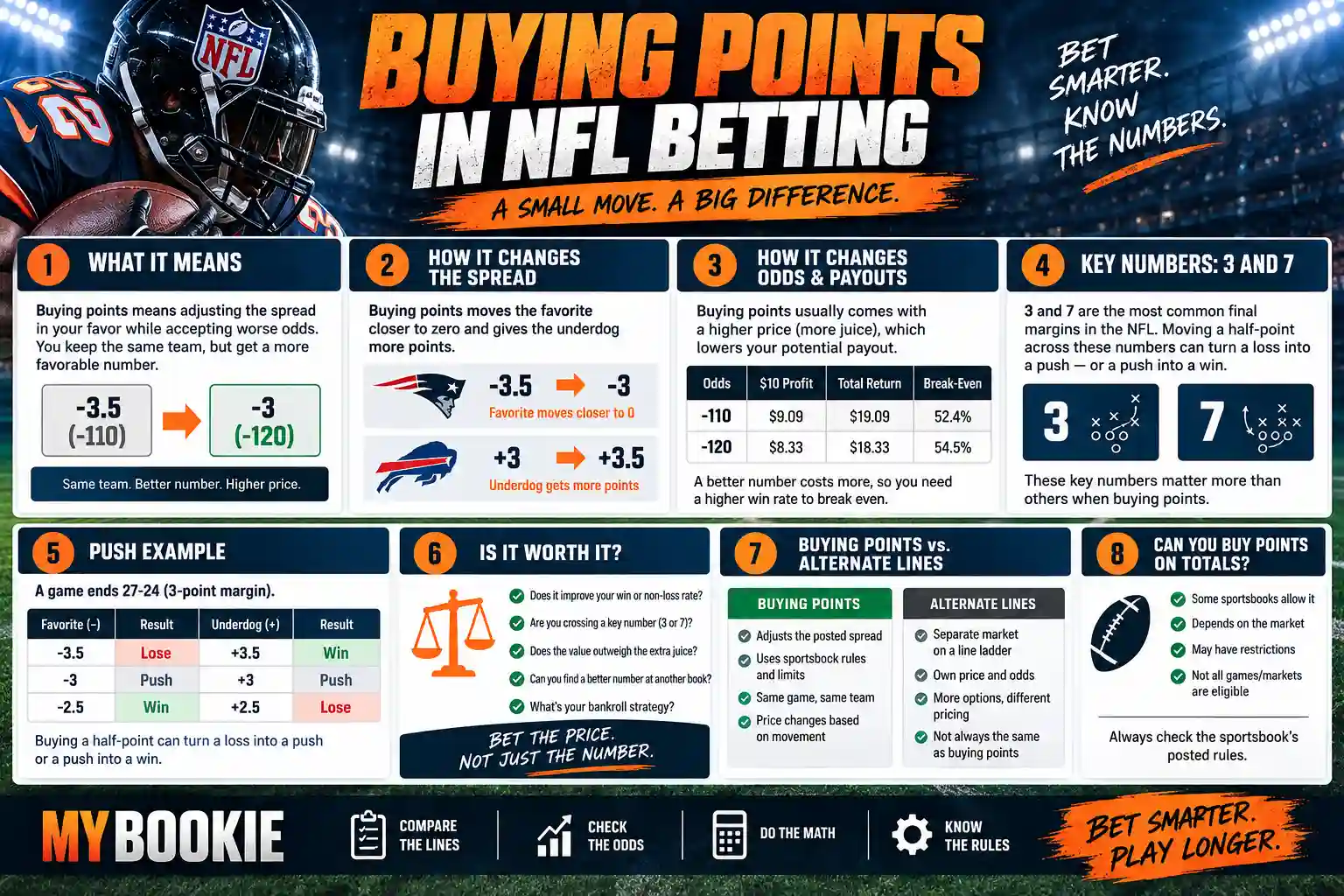
Buying points in NFL betting means paying extra juice to move a point spread in your favor. A favorite might move from -3.5 to -3, while an underdog might move from +3 to +3.5. The teams, matchup, and stake stay the same, but the adjusted spread becomes the number used to grade the wager.
The tradeoff is that a more favorable spread normally comes with worse odds, which lowers potential profit and raises the break-even rate. For example, a hypothetical $10 bet at -110 earns $9.09 in profit, while the same $10 stake at -120 earns $8.33. Buying points can change whether a ticket loses, pushes, or wins, but the added cost means the better number is not automatically better value.
Editorial Note
This guide explains buying points in NFL betting, including spread adjustments, odds, payouts, key numbers, pushes, and alternate lines. Examples are hypothetical and provided for educational purposes. Available point-buying options, prices, limits, and settlement rules can vary by sportsbook and event.
Quick Answer
Buying points in NFL betting means moving an eligible point spread in your favor in exchange for more expensive odds. For example, buying half a point can move a favorite from -3.5 to -3 or an underdog from +3 to +3.5. The better spread can improve the chance of a win or push, but the higher price reduces potential profit and increases the break-even rate.
Table of Contents
- Editorial Note
- What Does Buying Points Mean in NFL Betting?
- How Does Buying Points Change an NFL Point Spread?
- What Does Buying the Hook Mean in NFL Betting?
- How Does Buying Points Change NFL Odds and Payouts?
- NFL Buying Points Calculator: Compare the Cost of the Adjustment
- How Much Does It Cost to Buy a Half Point?
- Why Do NFL Key Numbers 3 and 7 Matter When Buying Points?
- How to Use Buying Points in NFL Betting
- What Happens When Buying Points Creates or Removes a Push?
- What Is the Difference Between Buying Points and Alternate Lines?
- What Is the Difference Between Buying Points, Selling Points, and Teasers?
- Can You Buy Points on NFL Totals or Every Game?
- Is Buying Points Worth the Extra Juice?
- How Should Bettors Compare a Standard Spread With a Bought Line?
- FAQ
- Final Thoughts on Buying Points in NFL Betting
What Does Buying Points Mean in NFL Betting?
Buying points is a spread adjustment offered before a wager is submitted. You select an eligible favorite or underdog, move the line by an allowed increment, and accept the new odds shown on the bet slip. If you are still learning the underlying market, this guide to how NFL point spreads work explains favorites, underdogs, covers, and pushes before any adjustment is made.
Suppose Team A is listed at -3.5 (-110). Buying half a point could move the favorite to -3 at a more expensive price. The half-point is the spread adjustment. Your stake is the amount wagered. If the bet wins, the sportsbook returns your stake plus the profit calculated from the accepted odds.
The phrase also appears in broader sports betting searches, but it is especially associated with football because common scoring margins can make certain half-points more meaningful. MyBookie’s Betting Academy provides additional explanations of spreads, odds, and other sportsbook mechanics.
How Does Buying Points Change an NFL Point Spread?
Buying points moves either side of the spread in the bettor’s favor. A negative spread moves closer to zero for the favorite, while a positive spread becomes larger for the underdog. The sportsbook then attaches a new price to the adjusted line.
| Selected side | Standard spread | After buying 0.5 | What changed |
|---|---|---|---|
| Favorite | -3.5 | -3 | A three-point win changes from a loss to a push. |
| Favorite | -3 | -2.5 | A three-point win changes from a push to a win. |
| Underdog | +3 | +3.5 | A three-point loss changes from a push to a win. |
| Underdog | +2.5 | +3 | A three-point loss changes from a loss to a push. |
These examples show why the exact starting number matters. Bettors who want a broader foundation can review how to bet on NFL point spreads before comparing a standard spread with a bought line.
What Does Buying the Hook Mean in NFL Betting?
The “hook” is the half-point attached to a whole-number spread. Buying the hook usually means moving from a number such as -3.5 to -3 or from +2.5 to +3. That half-point can remove a loss or create a push when the final margin lands exactly on the whole number.
Buying the hook does not guarantee a better betting value. It describes the number being purchased, not whether the new price is favorable. The bettor still needs to compare the probability gained with the additional juice charged.
How Does Buying Points Change NFL Odds and Payouts?
Buying points normally makes the American odds more expensive. If a standard spread is priced at -110 and a bought spread is -120, the bettor must accept a lower potential profit for the more favorable number. This is how the sportsbook prices the additional protection.
| American odds | Profit on a $10 stake | Total return | Break-even rate |
|---|---|---|---|
| -110 | $9.09 | $19.09 | 52.38% |
| -120 | $8.33 | $18.33 | 54.55% |
| -130 | $7.69 | $17.69 | 56.52% |
For negative American odds, divide the absolute odds by the absolute odds plus 100 to calculate the break-even rate. At -120, the calculation is 120 ÷ (120 + 100) = 54.55%. Sportsbooks account for market probability, risk, and margin when attaching prices to different numbers. This guide to how sportsbooks set betting lines provides more context for how numbers and prices are formed.
The word “odds” can cause confusion here. Buying points improves the spread condition, but it normally worsens the betting price. It does not make the team more likely to win the game. It changes the condition under which the ticket covers, pushes, or loses.
NFL Buying Points Calculator: Compare the Cost of the Adjustment
You do not need a specialized calculator to make a first comparison. Record the original spread and price, the bought spread and price, and the stake. Then compare the potential profit and break-even rate for both wagers.
How to Compare the Cost of Buying Points
The key question is whether the better spread changes enough possible outcomes to justify the higher price. Use the same stake for both examples so the difference in potential profit and break-even rate is easy to see.
- Write down the standard spread and its American odds.
- Write down the adjusted spread and its new American odds.
- For negative odds, calculate profit as
stake × 100 ÷ absolute odds. - Calculate break-even probability as
absolute odds ÷ (absolute odds + 100). - Identify whether the adjustment moves onto, off, or through a key number.
- Compare the probability gained with the higher break-even requirement.
For example, moving from -110 to -120 raises the break-even threshold from 52.38% to 54.55%. That 2.17 percentage-point increase is the pricing hurdle the bought line has to overcome; the actual value depends on your estimated probability for the exact spread.
For a quick odds check, use the betting odds calculator to compare potential payouts and break-even rates.
NFL Buying Points Break-Even Calculator
Enter negative American odds to estimate the break-even rate for the price you are considering.
How to Compare the Cost of Buying Points
Compare the standard and adjusted wagers side by side. The goal is to see how the spread change affects the price, potential profit, break-even rate, and exposure to key numbers before deciding whether the adjustment is worth its added cost.
- Write down the standard spread and its American odds.
- Write down the adjusted spread and its new American odds.
- For negative odds, calculate profit as
stake × 100 ÷ absolute odds. - Calculate break-even probability as
absolute odds ÷ (absolute odds + 100). - Identify whether the adjustment moves onto, off, or through a key number.
- Compare the probability gained with the higher break-even requirement.
In the -110 versus -120 example, the bought line must justify a break-even increase from 52.38% to 54.55%. That is a 2.17 percentage-point difference at the break-even thresholds. The correct expected-value comparison still depends on your estimated probability for each exact spread, not just the size of the odds change.
How Much Does It Cost to Buy a Half Point?
There is no universal price for buying half a point in NFL betting. The cost depends on the original spread, the adjusted spread, the number crossed, market conditions, and the sportsbook’s posted terms. A move from -5.5 to -5 may not be priced the same as a move from -3.5 to -3.
A change from -110 to -120 is a hypothetical illustration, not a fixed “10-cent rule.” The real cost is visible in the before-and-after odds, lower potential payout, and higher break-even rate. For a deeper strategy discussion, review when buying points may or may not provide value.
Why Do NFL Key Numbers 3 and 7 Matter When Buying Points?
Three and seven remain the most important NFL spread key numbers because they are closely tied to common scoring outcomes: a field goal produces three points, while a touchdown followed by a successful extra point produces seven. Historical NFL scoring data shows that final margins of three and seven occur more frequently than many other margins, although scoring patterns can change over time. That makes adjustments involving 3 or 7 particularly important to evaluate, not automatically valuable.
Visual Model: Buying Around NFL Key Numbers
Buying from -3.5 to -3 moves onto 3 and can turn a three-point loss against the spread into a push. Buying from -3 to -2.5 moves off 3 and can turn a three-point push into a win. Buying from -3.5 to -2.5 moves through 3 and changes both outcomes. The reverse logic applies to underdogs. MyBookie’s guide to key numbers in wagering explains why scoring margins matter when evaluating spreads.
A key number does not make any price automatically worth paying. The value still depends on the exact odds, the probability assigned to each possible margin, and the sportsbook’s terms. Historical scoring patterns can also change, so bettors should avoid treating every season or matchup as identical.
How to Use Buying Points in NFL Betting
Using buying points effectively starts with identifying what number you are buying, what it costs, and which final margins the adjustment changes. In NFL betting, adjustments involving key numbers such as 3 and 7 deserve particular attention because those margins occur more frequently than many others. That does not make every purchase worthwhile; the price still determines whether the adjustment is justified.
Step 1: Start With the Standard Spread
First, record the original spread and price before making any adjustment. Suppose the Eagles are listed at -3.5 (-110). If you buy half a point, the spread may move to -3, with a new price such as -120. The exact price and available adjustment depend on the sportsbook and market.
The key is to treat the two options as separate wagers: -3.5 at -110 versus -3 at -120. You are not simply getting a “better” number; you are paying a higher price to obtain it.
Step 2: Identify What the Half-Point Changes
Next, look at the final margins that change the grading of the wager. With a favorite at -3.5, a three-point victory is a loss against the spread. Buying the half-point to -3 changes that same three-point victory into a push.
| Final margin | -3.5 | -3 | Effect of buying 0.5 |
|---|---|---|---|
| Favorite wins by 7+ | Win | Win | No grading change |
| Favorite wins by 4–6 | Win | Win | No grading change |
| Favorite wins by exactly 3 | Loss | Push | Loss becomes push |
| Favorite wins by 1–2 | Loss | Loss | No grading change |
| Favorite loses | Loss | Loss | No grading change |
This is the practical reason the number matters. Buying the half-point did not make the favorite more likely to win the game. It changed how one specific final margin is graded against the spread.
Step 3: Check Whether You Are Buying Through a Key Number
The next question is whether the adjustment crosses a key number. Consider a favorite priced at -3.5. Buying one full point to -2.5 moves through 3 rather than simply moving onto it.
Example: Buying Through 3
⚙ -3.5 → -3:
A three-point win changes from a loss to a push.
-3.5 → -2.5:
A three-point win changes from a loss to a win.
For example, if the favorite wins 27-24, the -3.5 ticket loses, the -3 ticket pushes, and the -2.5 ticket wins. That illustrates why bettors should examine the exact number being purchased rather than thinking of every half-point as having the same impact.
Step 4: Compare the New Price With the Benefit
After identifying the changed outcomes, compare the price. Suppose the standard line is -3.5 (-110) and buying the half-point produces -3 (-120). On a hypothetical $100 stake, -110 produces $90.91 in profit if it wins, while -120 produces $83.33.
That means the bought line gives up $7.58 in potential profit per $100 stake in exchange for changing a three-point result from a loss to a push. The adjustment has a measurable benefit, but it also has a measurable cost.
Key Insight: The Number Is Only Half the Decision
⚙ Better Number:
-3.5 → -3 gives the favorite additional protection when the final margin is exactly 3.
Higher Cost:
-110 → -120 lowers the potential profit and raises the break-even threshold.
Step 5: Apply the Same Logic to Underdogs
Buying points works in the opposite numerical direction for an underdog. If an underdog is listed at +2.5 (+110), buying half a point could move the spread to +3 at a different price. If the underdog loses by exactly three points, +2.5 loses while +3 pushes.
For example, a final score of 24-21 creates a three-point margin. The +2.5 underdog ticket loses, while the +3 ticket pushes. If the underdog wins outright, both spreads cover. Again, the point adjustment changes the grading condition rather than the underlying game result.
Step 6: Check 7 Before Paying for an Adjustment
The same process applies around 7. Suppose a favorite is listed at -7.5. Buying half a point to -7 changes a seven-point victory from a loss to a push. Buying another half-point to -6.5 can turn that same seven-point margin into a win, subject to the price offered.
For example, if the favorite wins 31-24, the result is a seven-point margin. At -7.5 the spread loses, at -7 it pushes, and at -6.5 it wins. The closer the adjustment gets to or moves through a key number, the more important it becomes to compare the changed outcome distribution with the additional juice.
Same $100 Stake, Different Buying-Point Prices
A more favorable spread can change the grading of key margins, but the higher price reduces the potential profit on the same stake.
Step 7: Verify the Final Ticket
Before submitting the wager, confirm the team, spread, adjusted number, American odds, stake, potential profit, market period, and applicable settlement rules. The number shown after buying points is the number that determines how the accepted wager is graded.
A useful workflow is therefore: start with the standard line, identify the number being purchased, check whether 3 or 7 is involved, compare the old and new prices, calculate the break-even change, and verify the final ticket. This keeps the decision focused on the actual tradeoff rather than assuming that a more favorable spread automatically provides better value.
What Happens When Buying Points Creates or Removes a Push?
A push can occur when the accepted spread is a whole number and the adjusted score lands exactly on that number. Consider a game that ends 27-24, a three-point margin.
| Side | Spread | Result at 27-24 |
|---|---|---|
| Favorite | -3.5 | Loss |
| Favorite | -3 | Push |
| Favorite | -2.5 | Win |
| Underdog | +3.5 | Win |
| Underdog | +3 | Push |
| Underdog | +2.5 | Loss |
The accepted spread controls grading, not an earlier line or a number displayed after the bet was placed. Push treatment, overtime inclusion, market availability, and other settlement conditions depend on the posted betting rules and the accepted ticket.
What Is the Difference Between Buying Points and Alternate Lines?
Buying points and alternate lines can produce similar-looking numbers, but they are not necessarily the same betting option. Buying points adjusts an eligible standard spread through a sportsbook’s point-buying feature, while an alternate line is a separately posted market with its own spread and price. The distinction matters because the same number can carry a different price, availability, or set of settlement conditions depending on how it is offered.
For example, suppose Team A is -3 (-110). A point-buying option might allow the bettor to move the spread to -2.5 at a higher price. An alternate-line market could also list Team A -2.5, but there is no requirement that the two prices match. Treat the adjusted number and the attached odds as a package rather than assuming that identical spreads have identical value.
What Should You Compare Before Choosing?
Check the spread, American odds, potential profit, market availability, and settlement terms for each option. If an alternate spread already provides the desired number at a lower price than buying the same half-point, paying extra for the point adjustment may not be necessary. The full guide to NFL alternate lines explains how these markets are displayed and priced.
Buying Points vs. Alternate Lines
⚙ Buying Points:
Adjusts an eligible standard spread, usually for a higher price. Example: -3 to -2.5.
Alternate Line:
Uses a separately posted spread with its own number and price. Example: an alternate -2.5 line.
Buying and selling points are opposite forms of spread adjustment. Buying points moves the spread in your favor and normally increases the cost of the wager, while selling points moves the spread against your selected side and can provide a better payout. The important comparison is not simply which number looks easier, but how the number and price change together.
For example, a favorite listed at -3 could potentially be bought to -2.5 at a higher price or sold to -3.5 at a different price. The first gives the favorite more room to cover; the second requires a larger margin to cover. Neither adjustment should be evaluated independently of its odds.
Visual Model: How Point Adjustments Move the Spread
How Are Teasers Different?
A teaser changes the spread or total on multiple legs within one combined wager, subject to the sportsbook’s teaser rules and pricing. Buying a point normally applies to an individual eligible market, while a teaser creates a separate multi-leg wager with its own requirements. Moving several football spreads through key numbers can therefore produce a substantially different risk and pricing structure than buying a single half-point.
Bettors comparing these mechanics should understand the number being adjusted, the price being charged, and how each wager is graded. See the guide to NFL teasers for a closer look at how teaser adjustments differ from buying points.
Can You Buy Points on NFL Totals or Every Game?
Point buying is not guaranteed to be available on every NFL game, spread, total, or market. Availability depends on the sportsbook, event, market type, current trading status, and the adjustments permitted for that wager. Some markets may offer point-buying controls, while others may provide only separately posted alternate lines.
When point buying is available on a total, the same basic principle applies: the bettor pays for a more favorable scoring threshold. For example, moving an Over to a lower total gives the bettor more room for the game to finish above the number, while moving an Under to a higher total gives the bettor more room below the threshold. The price normally becomes more expensive as the threshold becomes more favorable.
Totals should be evaluated differently from spreads. NFL spread margins have pronounced concentrations around numbers such as 3 and 7, while individual game-total numbers are less rigid and generally occur less frequently. A favorable total adjustment can still matter, but it should not automatically be treated like buying through a major spread key number.
Visual Model: Buying Points on NFL Totals
Over Adjustment:
Moving an Over from 44.5 to 44 creates a lower scoring threshold, making it easier for the Over to cash if the final total lands between those numbers.
Under Adjustment:
Moving an Under from 44.5 to 45 creates a higher scoring threshold, giving the Under more room below the number.
Why Does Market Availability Matter?
A displayed standard line does not mean every possible adjustment is available. A sportsbook may restrict the amount a line can be moved, suspend a market during significant events, or offer certain adjustments only on selected markets. If no point-buying control appears, do not assume that the number can be purchased.
Key Insight: Check the Market Before Adjusting
⚙ Point Buying Available:
Use the available adjustment control and review the new spread and price before submitting.
Alternate Line Only:
Compare the separately posted number and price rather than assuming the standard spread can be moved.
When evaluating a total, also distinguish between a game total and a team total. A game total covers the combined score of both teams, while a team total applies only to one team. Bettors unfamiliar with these markets can first review how totals betting works.
Before submitting the wager, confirm the final market, period, total or spread, adjusted number, American odds, and overtime treatment shown on the bet slip. The accepted ticket is the reference point for how the wager is graded.
Is Buying Points Worth the Extra Juice?
There is no universal answer because the value of a point adjustment depends on how much the probability of each betting outcome changes compared with the additional price. A more favorable spread can reduce the chance of losing on certain margins, but the sportsbook charges for that improvement through the new odds.
Measure the Number Against the Price
Start with the standard spread and price, then compare them with the bought spread and price. Pay particular attention to whether the adjustment moves onto, off, or through a key number such as 3 or 7. A half-point can have a different practical impact at -3.5 than it does at -5.5 because the distribution of final scoring margins is not uniform.
The next step is to calculate the break-even rate for both prices. If buying a half-point changes the odds from -110 to -120, the break-even threshold rises from 52.38% to 54.55%. The extra 2.17 percentage points must be justified by the additional probability assigned to the more favorable spread.
Visual Model: What Buying a Half-Point Costs
Check the Market Before Paying for the Adjustment
Line shopping should come before automatically buying points. Another sportsbook may already offer the preferred spread, or a separately posted alternate line may provide the same number at a different price. Comparing the number and the odds together can reveal whether the point adjustment is actually adding useful value or simply adding cost.
This explanation of sports betting line shopping provides additional context on why comparing available numbers and prices is an important part of evaluating a wager.
Questions to Ask Before Buying NFL Points
Use these questions to separate the benefit of the adjusted spread from the cost of obtaining it:
- What are the standard spread and price?
- What are the bought spread and new price?
- Does the adjustment move onto, off, or through 3 or 7?
- How much does the break-even rate increase?
- How much potential profit is lost at the same stake?
- Could another sportsbook already offer the preferred number?
- Is the same number available as an alternate line at a different price?
- What do the posted rules say about pushes, overtime, and settlement?
- Does the wager fit the bettor's bankroll and risk limits?
How Should Bettors Compare a Standard Spread With a Bought Line?
Compare the standard and bought lines as two separate wagers with different grading conditions and prices. For a hypothetical example, consider -3.5 (-110) versus -3 at the displayed bought price. The first question is what happens at every relevant margin, especially a three-point result. The second is how much additional price is being paid for that change.
Compare the Spread, Price, and Outcome Distribution
Start with the spread adjustment itself. Determine whether the new number moves onto, off, or through a key number. Then calculate the break-even rate and potential profit at the same stake. Finally, consider how frequently the changed margin would matter based on your estimate of the possible scoring outcomes.
For example, moving a favorite from -3.5 to -3 changes a three-point margin from a loss to a push. Moving from -3 to -2.5 changes that same margin from a push to a win. The value of either adjustment depends on the price attached to it and the probability assigned to those outcomes.
Complete the Comparison Before Submitting the Bet
Research should include the factors relevant to the matchup, such as team strength, injuries, weather, matchup characteristics, market movement, and the expected distribution of scoring margins. MyBookie’s broader guide to sports wagering research explains how to organize information before evaluating a betting market.
Finally, verify the accepted ticket. The selected team, market period, standard or adjusted spread, American odds, stake, potential profit, and total return should all match the intended wager before submission. The easier spread is only one part of the comparison; the price paid to obtain it is equally important.
FAQ
What does buying points mean in NFL betting?
Buying points means moving an eligible NFL spread in your favor while accepting a more expensive betting price. The selected team stays the same, but the spread and odds change.
What does buying a half point mean in NFL betting?
It means adjusting the spread by 0.5 points, such as moving a favorite from -3.5 to -3 or an underdog from +3 to +3.5.
How much does a half point cost in NFL betting?
The cost varies by sportsbook, market, original spread, adjusted spread, and number crossed. Compare the odds before and after buying the half point.
Does buying points change the odds?
Yes. Buying points normally makes the odds more expensive, which lowers potential profit for the same stake and raises the break-even rate.
Does buying points increase the chance of winning?
It improves the spread condition and can increase the chance that a wager wins or pushes. It does not change the teams’ actual chances of winning the game.
Why are 3 and 7 key numbers in NFL betting?
Three and seven are common NFL scoring margins associated with a field goal and a converted touchdown. Moving onto, off, or through these numbers can change spread outcomes.
What is the difference between -3 and -2.5?
A favorite that wins by exactly three points pushes at -3 but covers at -2.5. A win by fewer than three points or an outright loss does not cover either spread.
What is the difference between +3 and +3.5?
An underdog that loses by exactly three points pushes at +3 but covers at +3.5. An outright underdog win covers both spreads.
What does buying the hook mean?
Buying the hook usually means purchasing a half-point attached to a whole-number spread, such as moving from -3.5 to -3 or +2.5 to +3.
Is buying points the same as an alternate line?
No. Buying points modifies an eligible spread through a point-buying option, while an alternate line is a separately posted selection with its own number and price.
What is the difference between buying and selling points?
Buying points improves the spread and normally makes the odds more expensive. Selling points makes the spread harder to cover and may provide a higher potential payout.
Can you buy points on NFL totals?
Some sportsbooks and eligible markets may allow point buying on totals, while others may offer only alternate totals. Check the available market controls and posted rules.
Should you buy points through 3 or 7?
Crossing 3 or 7 can materially change the possible spread outcomes, but the higher price must be compared with the probability gained from the adjusted number.
Can Bitcoin be used for online NFL betting?
Some online sportsbooks support Bitcoin or other cryptocurrency payment methods, subject to availability, account eligibility, and the operator’s current terms.
Final Thoughts on Buying Points in NFL Betting
Buying points moves an eligible NFL spread in your favor, but the sportsbook charges for that protection through more expensive odds and a lower potential payout. Compare the standard and bought prices, calculate both break-even rates, check whether the move involves 3 or 7, and verify the accepted ticket and posted rules.
For a broader path through football markets and strategy, continue with the NFL betting guide. When you are ready to compare active matchups, visit the NFL sportsbook to review current spreads, odds, totals, and available alternate markets.
Summary
- Buying points moves an eligible NFL spread in your favor, but the sportsbook normally charges for the adjustment through more expensive odds.
- The value of a point adjustment depends on the exact number, price, and probability of the scoring margins that change the wager’s result.
- NFL key numbers such as 3 and 7 can make certain adjustments more consequential because moving onto, off, or through them can change losses to pushes or wins.
- Compare the standard spread with the bought line, including the break-even rate, potential profit, and applicable sportsbook rules.
NEXT STEP
Put NFL Spread Knowledge Into Practice
Review current numbers and prices after understanding how buying points changes the spread, odds, and potential outcomes. Continue with the NFL betting guide for more information on spreads, totals, moneylines, and other football markets.
View NFL OddsMyBookie: Bet On Anything. Anywhere. Anytime.
Important: Sports betting involves risk. No strategy guarantees results, and managing exposure is essential.

About the Author

Henry Watkins is a Sports Writer at MyBookie. Originally from Scotland and currently residing in Metro Atlanta with his wife, Penny, Henry covers competitive and professional sports as well as the business of sports. In addition to his sports writing, he is an author of horror fiction, including Karaoke Night, Crueller, and Off The Grid.
Sportsbook Bonuses
Read requirements in the Bonus page. However, if you want to take a deep knowledge, go to MyBookie Bonus Rules and How to