English
Last updated: June 2026
Most bettors see the number after the hard part is done. The book already built it, posted it, watched the money, and maybe moved it twice.
That’s the basic idea behind how sportsbooks set betting lines. A line starts as a price. Then the market tests it. Sometimes the number holds. Sometimes it gets hit right away.
This guide explains the process without picks. Just sports betting, price, risk, and why the number on Monday may not be the number on Sunday.
In short: sportsbooks start with a probability estimate, publish an opening line, watch how the market reacts, and keep adjusting the price until the event kicks off. Pricing, risk management, and betting activity together explain almost every line a bettor sees.
Quick Answer
Sportsbooks set betting lines by turning probability into price, then adjusting that price as money, news, injuries, weather, and risk change the market. Opening odds are the first number; line movement shows how the market reacts before the closing line.
Editorial Note
This content explains how betting markets behave and how to interpret odds, volatility, and timing. It is designed for educational purposes and does not guarantee outcomes.
Table of Contents
- Quick Answer
- What Are Sportsbook Betting Lines?
- What Sports Can You Bet on at the MyBookie Sportsbook?
- How Do Sportsbooks Create Opening Betting Lines?
- Who Actually Sets Sportsbook Odds?
- How Do Sportsbooks Manage Risk Instead of Predicting Winners?
- Why Do Betting Lines Move After They Open?
- What Is the Difference Between an Opening Line and a Closing Line?
- What Is Closing Line Value and Why Does It Matter?
- What Happens When a Major Injury Breaks?
- Why Do Different Sportsbooks Have Different Betting Lines?
- Do Sportsbook Betting Lines Work Differently in California and Florida?
- Why Are Some Betting Markets More Efficient Than Others?
- Why Do Some Sportsbooks Move the Odds Instead of the Spread?
- How Does Sharp Money Influence Sportsbook Lines?
- Why Doesn’t Every Bet Move the Line?
- Can Sportsbooks Make Mistakes?
- Does Bitcoin or Crypto Betting Change How Odds Are Set?
- How Do Live Betting Lines Work?
- How Can Understanding Opening Lines Help You Become a Better Bettor?
- Why Timing Matters More Than Picking Winners?
- Which Betting Markets Move the Most?
- How Can You Convert Odds Into Implied Probability?
- What Is the Sportsbook Odds Lifecycle?
- What Are the Key Betting Terms Used in Line Setting?
- What Are Common Myths About Sportsbook Odds?
- FAQ
- Where Can You Use These Sportsbook Line Strategies at MyBookie?
- What Should You Do Before Placing Your Next Sports Bet?
- Final Thoughts
What Are Sportsbook Betting Lines?
Sportsbook lines are the prices attached to wagers. Point spread, moneyline, total, prop, future, live bet — all of it starts with a number. If these markets are new to you, start with how to bet on sports to make the pricing easier to follow.
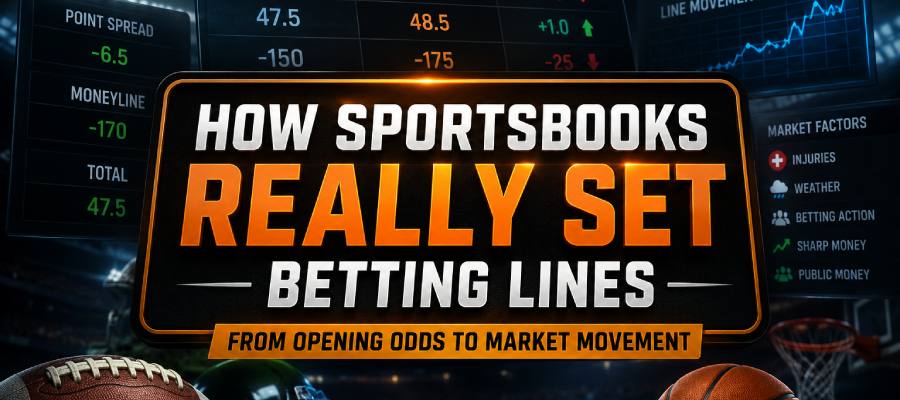
NFL favorite -6.5 means the favorite has to win by more than 6.5 points. Total 47.5 means bettors are playing over or under that combined score. Moneyline -170 means the team is favored, but the payout is smaller.
| Line Type | What It Prices |
|---|---|
| Point spread | The margin a team must cover. |
| Total | The combined score going over or under a listed number. |
| Moneyline | The price of a team or player winning outright. |
| Prop | A specific player, team, or game event. |
| Future | A long-term outcome before it is decided. |
| Live bet | A number that updates during the event. |
Betting Line Translation Guide
Spread:
The sportsbook is pricing margin, not just the winner.
Total:
The sportsbook is pricing pace, scoring, and game environment.
Moneyline:
The sportsbook is pricing win probability into payout.
Props:
The sportsbook is pricing a smaller event inside the larger game.
Understanding Betting Lines and Sportsbook Odds
Betting lines are not promises or predictions. They are probabilities turned into prices based on the information available when the sportsbook posts the market.
Quick Take
A betting line is the sportsbook’s current estimate of probability after accounting for team strength, matchup data, injuries, market conditions, and expected betting activity.
| Term | What It Represents |
|---|---|
| Betting Line | The market number, such as a point spread or total. |
| Sportsbook Odds | The price attached to that betting line. |
| Moneyline | The price to pick the winner without a point spread. |
Although bettors often use betting lines, sportsbook odds, betting odds, and sportsbook prices interchangeably, they all describe different parts of the same pricing system.
Whether you are new to sports betting or compare markets every day, understanding how sportsbooks build and adjust betting lines helps you decide whether the available price offers value before placing a wager.
Regardless of the terminology, the bettor’s objective remains the same: determine whether the sportsbook’s price is worth taking.
In Simple Terms
A sportsbook line is the market price attached to an outcome. Every market starts somewhere, and that starting point is the opening number.

What Sports Can You Bet on at the MyBookie Sportsbook?
Whether the market is NFL football, NBA basketball, MLB baseball, NHL hockey, soccer, tennis, golf, UFC, or live betting, sportsbooks follow the same core pricing process. Only the underlying data changes—the framework used to create the odds remains consistent.
One Pricing Model, Many Sports
Every sportsbook market starts with probability, publishes an opening line, and then adjusts prices as betting activity, injuries, weather, and new information enter the market.
| Sport | Primary Factors Behind the Odds |
|---|---|
| Football | Power ratings, injuries, weather, and key numbers. |
| Basketball | Pace, player availability, rest, and scoring efficiency. |
| Baseball | Starting pitchers, bullpen usage, and offensive matchups. |
| Hockey | Goaltenders, special teams, and scheduling. |
| Soccer | Team strength, injuries, tactics, and expected goals. |
| Tennis & Combat Sports | Player form, style matchups, rankings, and recent performance. |
| Live Betting | Score, clock, momentum, and real-time probability. |
Although every sport has unique betting markets and scoring patterns, the MyBookie Sportsbook uses the same probability-based approach to publish opening lines, react to market movement, and manage risk before and during the event.
| Sport | Common Betting Markets |
|---|---|
| NFL Football | Spreads, moneylines, totals, player props, futures, and live betting. |
| College Football | Game lines, conference futures, player props, and championship markets. |
| NBA Basketball | Spreads, totals, player props, quarter betting, and live markets. |
| College Basketball | Game lines, conference tournaments, March Madness, and futures. |
| MLB Baseball | Moneylines, run lines, totals, innings betting, and player props. |
| NHL Hockey | Puck lines, totals, moneylines, props, and live betting. |
| Soccer | Moneylines, totals, BTTS, Asian handicaps, draws, and futures. |
| Tennis | Match winners, set betting, totals, and live point-by-point markets. |
| Golf | Tournament winners, head-to-head matchups, and finishing position props. |
| UFC & Boxing | Fight winners, method of victory, round betting, and totals. |
| Motorsports | Race winners, podium finishes, qualifying, and season futures. |
| Esports | Match winners, maps, rounds, and tournament futures. |
No matter which sport you choose, the same pricing philosophy applies. Sportsbooks use statistical models, historical performance, injuries, scheduling, weather when applicable, betting volume, and market risk to determine the opening odds before continuously adjusting the line as new information becomes available.
That consistency is why understanding how betting lines work gives bettors an advantage across virtually every market offered by the MyBookie Sportsbook. Once you understand how a sportsbook builds and manages odds, the concepts apply whether you are betting on the Super Bowl, the World Cup, the Stanley Cup Playoffs, Wimbledon, UFC title fights, or live in-game markets.
How Do Sportsbooks Create Opening Betting Lines?
Opening betting lines usually come from ratings and models first. Books look at team strength, past results, injuries, travel, rest, weather, coaching, matchup edges, and home-field value.
It sounds fancy, but the idea is simple. The book tries to get close before anyone bets. Whether someone follows the NFL in California or the Dolphins in Florida, sportsbooks begin with the same probability-based pricing process before the first wager is placed.
The goal is not to predict the exact final score. The goal is to publish a number that accurately reflects expected probability before market information begins changing the price.
Opening Line Inputs
Team strength:
Ratings, past results, matchup edges, and coaching context shape the first number.
Game conditions:
Travel, rest, weather, injuries, and home-field value can pull the opening number up or down.
Say a model makes Team A 4.8 points better. The sportsbook may open Team A -4.5. That becomes the opening line.
Those opening odds are not random. They are also not perfect. They are the first opinion from the book before sharp money, public money, injury news, and weather reports start pulling on the number. Understanding why sportsbook odds matter helps explain why those early prices receive so much attention from experienced bettors.
That is why the opening line matters. It shows where the market began.
Market Starting Point
| Input | How It Can Affect the Line |
|---|---|
| Injuries | Can move spreads, totals, moneylines, and player props when availability changes. |
| Weather | Can affect totals, passing props, kicking markets, and game pace expectations. |
| Rest and travel | Can shift team ratings when fatigue or schedule spots matter. |
| Matchup edges | Can influence the opening number before public action enters the market. |
Who Actually Sets Sportsbook Odds?
Sportsbook odds usually come from a mix of traders, oddsmakers, models, and risk teams. Not one guy smoking in a back room. At least not anymore.
The trading team builds markets, checks betting action, changes prices, and watches liability. A sportsbook algorithm can help with the first price, but humans still manage the mess.
| Role | Function |
|---|---|
| Models | Create the first probability-based price. |
| Traders | Adjust numbers as betting action and information change. |
| Risk teams | Monitor liability and exposure across markets. |
| Oddsmakers | Shape opening numbers and market structure. |
An injury report comes out. A quarterback is limited. A starting left tackle is ruled out. The model changes. The trader may move the spread, the total, or player props.
That is sportsbook betting behind the counter. Create the number. Watch the number. Adjust when needed.
Key Insight
Odds are not set once. They are managed.
How Do Sportsbooks Manage Risk Instead of Predicting Winners?
Sportsbooks are not only trying to predict what will happen. They are also managing risk, exposure, and liability after the market opens.
If too much money lands on one side, the book may adjust the price to attract action elsewhere or reduce future exposure.
Risk Management Basics
Liability:
How much the sportsbook may owe if one outcome wins.
Exposure:
Where the book has too much money concentrated.
Price adjustment:
The book changes odds or lines to manage future action.
This distinction matters because sportsbooks earn revenue from pricing markets over thousands of wagers rather than trying to correctly predict every individual game.
In simple terms, sportsbooks manage prices. They do not need to be perfect predictors on every game if they manage market risk correctly. That is also why understanding the bookmaker advantage gives bettors a clearer picture of how sportsbooks balance action over the long run.
Why Do Betting Lines Move After They Open?
Betting lines move because something changed. Maybe it was injury news. Maybe weather. Maybe public money. Maybe a sharp bettor hit a bad number before the book could correct it.
A spread opens -3. Respected money takes the favorite. The line goes to -4.5. That is line movement.
Line Movement Path
Opening Line:
The first price posted by the sportsbook.
Market Reaction:
Bets, news, injuries, weather, and opinions test the number.
Closing Line:
The final pregame price after the market has reacted.
The move does not mean the favorite is a sure thing. It means the old price may have been too cheap, or the sportsbook wanted less action on that side.
That is odds movement in plain English. The sportsbook market is arguing with the first number. That little path is the whole story for a lot of markets.
Quick Answer
What causes odds movement? News, betting volume, respected money, public money, and risk exposure can all move odds.
Does line movement predict the winner? No. It shows price adjustment, not certainty.
Line Movement Pressure Meter
Most line movement can be grouped into four categories: new information, betting activity, sportsbook risk management, and market price discovery. Nearly every adjustment fits one or more of these reasons.
What Is the Difference Between an Opening Line and a Closing Line?
The opening line is the first price posted by the sportsbook. The closing line is the final pregame price after the market has reacted to money, news, injuries, weather, and risk.
Understanding when to act on those prices is just as important as understanding how they are created. Comparing the advantages of betting early versus waiting until closer to kickoff can help bettors decide which approach fits a particular market. Learn more in our guide on Best Time to Bet Soccer Matches: Opening vs Closing Lines.
The gap between the opening line and closing line shows how the market changed. Understanding closing line value (CLV) helps bettors evaluate whether they secured a better price than the final market before the event began.
| Line Stage | What It Means | Why It Matters |
|---|---|---|
| Opening Line | The first number posted by the book. | Shows where the market began. |
| Current Line | The available number after movement. | Shows how the market has adjusted so far. |
| Closing Line | The final pregame price. | Helps bettors judge whether they beat the market price. |
A bettor who takes -2.5 before the line closes -4 got a better price than the late bettor. That does not guarantee a win, but it shows stronger timing. The same concept applies across different sports, including soccer betting and NHL betting, where comparing your ticket to the closing number helps measure the quality of the wager instead of only the final result.
What Is Closing Line Value and Why Does It Matter?
Closing line value, often called CLV, means getting a better number than the final pregame market price.
If a bettor takes -2.5 and the line closes -4, the bettor beat the closing line. If a bettor takes -4.5 and the line closes -3.5, the bettor likely took a worse price.
CLV Reading Guide
Beat the close:
The bettor got a better number than the final market price.
Missed the close:
The bettor took a worse number than what became available later.
Good process:
Over time, consistently beating the closing number can show better market timing.
CLV is not a guarantee. A bet can beat the close and still lose. But it helps bettors judge process instead of only judging wins and losses.
Professional bettors often evaluate the quality of a wager by comparing it to the closing line rather than judging the result of a single game. This separates long-term decision quality from short-term outcomes and is the foundation behind closing line value (CLV).
What Happens When a Major Injury Breaks?
Major injury news can force a sportsbook to pause, adjust, or reopen a market at a new price.
The impact depends on the player, position, market, and how much the injury changes team probability.
Injury News Market Reaction
Spread:
The team rating may change, which can move the point spread.
Total:
Scoring expectations may change if the injury affects offense or pace.
Moneyline:
Win probability may be repriced quickly.
Props:
Player usage, replacement roles, and related markets may adjust.
When injury news is already expected, the line may move less. When the news surprises the market, the adjustment can be sharper. Learning more about how injured players affect betting markets shows why some injuries move the line much more than others.
Why Do Different Sportsbooks Have Different Betting Lines?
Different online sportsbooks do not always need the same number. One book may have too much money on the favorite. Another may need favorite money. Another may be slower to move.
That is how you get Chiefs -7 at one book and Chiefs -6.5 somewhere else. Same game. Different risk.
This is true whether bettors compare sportsbooks nationally or follow markets connected to teams like the Los Angeles Rams, San Francisco 49ers, Miami Dolphins, or Tampa Bay Buccaneers.
| Reason | What It Means |
|---|---|
| Customer mix | Different bettors create different exposure. |
| Risk position | One book may need money on a different side. |
| Timing | Some books move faster than others. |
| Pricing model | Each book may value the same market differently. |
Why Price Shopping Matters
That matters if you use a sportsbook betting platform or place wagers through sportsbook betting online. The number is part of the bet, and even a half-point can make a meaningful difference, especially around key football numbers.
Those differences become even more important during football season, when key numbers and late-week movement can significantly affect the value of a wager. Bettors who regularly compare spreads and totals often rely on an NFL line shopping strategy across sportsbooks to find better prices before kickoff.
Why Compare Sportsbook Lines?
- ✔ A better spread can improve your long-term betting value.
- ✔ A stronger moneyline can increase your potential return.
- ✔ Small pricing differences add up over many wagers.
- ✔ Comparing sportsbooks helps you avoid taking a worse number.
| Sportsbook A | Sportsbook B | Why It Matters |
|---|---|---|
| Favorite -7 | Favorite -6.5 | Laying fewer points improves the betting price. |
| Underdog +6.5 | Underdog +7 | An extra half-point can be valuable around key football numbers. |
| Moneyline -170 | Moneyline -160 | A lower price reduces the cost of backing the favorite. |
This is why bettors compare sportsbook betting lines. It is not an advanced strategy—it is basic price shopping. Many of the same principles are explained in line shopping strategies.
Before placing a wager, compare today’s MyBookie Sportsbook lines with the broader market to see whether the current number still offers fair value. Understanding why betting odds change across sportsbooks makes those comparisons even more useful.
Price Shopping Rule
Bad price, bad bet. Even if the side is right.
| Market Situation | Better Price | Why It Matters |
|---|---|---|
| Favorite spread | -6.5 instead of -7 | The bettor avoids needing to win by more than a full touchdown. |
| Underdog spread | +7 instead of +6.5 | The bettor gets the stronger protection around a key number. |
| Total | Over 47 instead of over 47.5 | The bettor needs less scoring to beat the number. |
| Moneyline | Lower favorite price or higher underdog return | The payout structure improves without changing the pick. |
Do Sportsbook Betting Lines Work Differently in California and Florida?
No. Sportsbook betting lines are created the same way regardless of where bettors live. Probability models, market activity, injuries, weather, and sportsbook risk management determine the number—not the bettor’s location.
However, the legal availability of sports betting differs by state. California does not currently offer statewide legal online sports betting, while Florida offers legal online sports betting through the Seminole Tribe’s Hard Rock Bet platform. Because regulations vary, many bettors compare how sportsbooks price the same games across available markets.
State Comparison
California
Sportsbook pricing works the same, although statewide online sports betting is not currently available.
Florida
The same pricing principles apply, even though sports betting operates under a different legal framework.
Why Are Some Betting Markets More Efficient Than Others?
Major markets usually become more efficient because more bettors, sharper accounts, and more information pressure the number.
Smaller markets can be slower to adjust because there may be less betting volume and less public attention.
| Market | Typical Efficiency | Reason |
|---|---|---|
| NFL sides and totals | Higher | Large betting volume and strong market attention. |
| NBA and MLB main markets | High | Active pricing and frequent market updates. |
| College sports | Mixed | Team depth, injuries, and information quality can vary. |
| Props | Mixed to lower | Smaller limits and faster reaction to lineup or usage news. |
| Smaller leagues | Lower | Less liquidity and fewer market signals. |
As market efficiency increases, obvious pricing mistakes generally become smaller and disappear faster because more information reaches the sportsbook and betting market.
In practice, the more attention and money a market attracts, the harder it becomes to find an obvious bad number.
Why Do Some Sportsbooks Move the Odds Instead of the Spread?
A sportsbook does not always move from -6.5 to -7 right away. Sometimes it changes the juice first, such as moving from -6.5 (-110) to -6.5 (-115). This lets the book adjust price without crossing into a more important number.
This matters because odds movement is not always obvious from the spread alone. Sometimes the real movement starts in the price attached to the number. In NFL markets, bettors can also pay extra juice to change the spread by buying points. If you want to understand how that works, see what buying points means in NFL betting.
| Adjustment | What It Means | Why It Happens |
|---|---|---|
| -6.5 (-110) | Standard price on the spread. | The market is stable at the current number. |
| -6.5 (-115) | The same spread becomes more expensive. | The book is testing demand before moving to -7. |
| -7 (-110) | The spread itself moves. | The book adjusts the main number after pressure builds. |
This matters because odds movement is not always obvious from the spread alone. Sometimes the real movement starts in the price attached to the number.
How Does Sharp Money Influence Sportsbook Lines?
Sharp money is money the book respects. It can come from pros, syndicates, or accounts with a history of beating soft numbers.
That does not mean sharp bettors always win. They don’t. Nobody does.
Sharp Money Signals
Source matters:
The sportsbook may react more strongly to accounts with a respected betting history.
Timing matters:
Early action can expose a soft opening number before the wider market catches up.
Account history matters:
Not every big bet has the same influence on the line.
But sportsbooks react to them because their bets may say something useful. Maybe the opening number was off. Maybe the model missed a matchup. Maybe the market was just slow.
A respected bettor hits under 48 early. The book moves to 47.5. Then 47. Public bettors may not even know why.
That is price discovery. The book is using the market to improve the number.
Not every big bet moves a line. Source matters. Timing matters. Account history matters.
From a Betting Perspective
From a betting perspective, sharp movement is useful because it shows where respected action may have challenged the first price. It still does not make the new number automatic value.
Sharp Money vs Public Money
Sharp money:
Often arrives early, attacks soft numbers, and may influence the sportsbook’s next adjustment.
Public money:
Often follows popular teams, familiar players, recent results, or late-week betting attention.
Book reaction:
The sportsbook may move the number based on source, timing, liability, and market confidence.
Sharp action is best viewed as one market input rather than a prediction of the final result. Bettors often combine it with line movement analysis instead of treating every move as a betting signal.
Why Doesn’t Every Bet Move the Line?
Not every bet carries the same signal. A large public bet may not move the line if the sportsbook does not view it as meaningful market information.
A smaller bet from a respected account may matter more if that account has a history of beating soft prices.
| Factor | Impact on Line Movement |
|---|---|
| Account history | Respected accounts may influence movement faster. |
| Bet timing | Early bets can matter more when the opener is still being tested. |
| Market liquidity | Smaller markets may move faster than major markets. |
| Book confidence | If the sportsbook trusts its number, it may resist moving quickly. |
That is why source, timing, and market context matter. Line movement is not only about bet size.
Can Sportsbooks Make Mistakes?
Yes. Sportsbooks can post soft numbers, react slowly to news, or rely on a model that misses important context.
A mistake does not mean the book is careless. It means the first price can be challenged by sharper information or faster market reaction.
Common Reasons a Line Can Be Soft
Model miss:
The first number may undervalue a matchup, injury, or team situation.
Late information:
Weather, lineup news, or injury updates can change the true price.
Slow market reaction:
Some markets take longer to correct than others.
This is where sharp bettors try to act early. They are not betting because the outcome is guaranteed; they are betting because the price may be wrong.
Does Bitcoin or Crypto Betting Change How Odds Are Set?
Bitcoin betting and crypto betting do not usually change the number. A spread is still a spread.
If an NFL team is -6.5, it is -6.5 whether the account is funded with cash, Bitcoin, or another crypto option.
| Area | What Changes | What Does Not Change |
|---|---|---|
| Deposits | Funding method and speed may differ. | The spread remains based on the market. |
| Withdrawals | Cashout process may feel different. | The team probability does not change. |
| Betting lines | The same market can still move with news and money. | Crypto does not create a different probability. |
Crypto changes access. It can affect deposits, withdrawals, speed, and funding flexibility. It does not change team probability.
If you are new to betting with digital assets, understanding how crypto betting mechanics work can help explain how wallets, blockchain transactions, and funding methods fit into the betting process without changing how sportsbooks calculate their odds.
So bitcoin sportsbooks and crypto sportsbooks may feel different on the payment side. But the pricing side still comes down to models, money, news, and risk.
That is true for most online betting. The payment method is not the market.
Simple Rule
Crypto can change how the account is funded, but it does not change how a spread, total, moneyline, prop, future, or live bet is priced.
How Do Live Betting Lines Work?
Live betting lines update during the game as the score, clock, possession, pace, injuries, and game state change.
Algorithms can adjust prices quickly, but traders may still oversee markets when volatility increases.
Live Betting Inputs
Score:
The current score changes win probability and totals expectations.
Clock:
Less time usually means fewer remaining scoring chances.
Possession:
Who has the ball can change live price quickly.
Game pace:
Fast or slow tempo can move live totals and props.
Live lines move faster than pregame markets because the information changes every play, possession, or sequence. You can see these markets in action through MyBookie’s live betting sportsbook, where odds continuously update as the game unfolds. The same concepts are explored in more detail in how live betting lines work.
Unlike pregame markets, live betting continuously recalculates probability as new information becomes available throughout the game.
How Can Understanding Opening Lines Help You Become a Better Bettor?
Knowing where a line opened helps you see what changed.
If a number opens -2.5 and closes -4, something happened. Maybe sharp money. Maybe injury news. Maybe both. If you bet -2.5, you got a better price than the late bettor at -4.
Opening Line Reading Framework
1. Record the open:
Start with the first posted price so you know where the market began.
2. Track the move:
Watch whether bets, news, injuries, weather, or public action changed the number.
3. Compare the current price:
Ask whether the available number is still worth taking.
4. Respect the close:
Use the closing line to evaluate whether your timing beat the market.
How to Apply Opening Line Analysis
That does not guarantee anything. The ticket can still lose.
But over time, understanding the closing line helps bettors think better. You stop asking only, “Who wins?” You start asking, “Is this still the right price?”
That is useful for anyone who wants to bet on sports without chasing noise. Developing that habit is part of becoming a more successful sports bettor. Compare sportsbook lines. Watch movement. Learn what news actually matters.
Old terms like sports betting bookie and bookie sports betting point to the same basic thing. A book makes a price. Bettors test it. The price moves.
Better Bettor Takeaway
Better bettors respect the number.
Opening Line Decision Checklist
- Did the number move because of news, money, or both?
- Is the current price still better than the expected closing line?
- Did the move create value on the other side?
- Is the bettor reacting to information or chasing movement?
- Does the new price still match the original betting reason?
A useful way to analyze any sportsbook line is to ask four questions: Where did it open? Why did it move? What information changed? Is the current price still fair?
Why Timing Matters More Than Picking Winners?
Betting is not only about choosing the right side. It is also about taking the right price at the right time.
A bettor can like the right team but still make a weaker bet by entering after the number has already moved too far.
| Scenario | What It Means |
|---|---|
| Good pick, bad price | The side may be right, but the bettor lost value by entering late. |
| Bad result, good price | The bet can lose even if the bettor beat the market number. |
| Good price, good process | The bettor used timing and market reading instead of chasing movement. |
The stronger question is not only “Who wins?” It is “Is this still the right number?”
Which Betting Markets Move the Most?
Different markets move at different speeds. Some markets react quickly to news, while others may adjust slowly because the information is less direct.
| Market | Movement Level | Common Trigger |
|---|---|---|
| Player props | High | Lineups, injuries, usage, minutes, or role changes. |
| Live betting | Very high | Score, clock, possession, pace, and in-game events. |
| Totals | Medium to high | Weather, pace, injuries, and scoring expectations. |
| Point spreads | Medium | Injuries, sharp action, and team rating changes. |
| Futures | Lower day-to-day | Major injuries, trades, schedule shifts, or standings changes. |
Markets with more direct information triggers usually move faster. That is why player props and live betting can shift quickly.
How Can You Convert Odds Into Implied Probability?
Every sportsbook betting line reflects an implied probability. Converting betting odds into implied probability helps bettors compare the sportsbook’s price with their own expectations before placing a wager. Understanding implied probability makes it much easier to evaluate whether a betting line offers value before placing a wager. A simple implied probability check helps you understand what a line is asking you to believe before you place a wager.
You can also use the betting odds calculator when you want to compare prices faster.
| Odds | Market Meaning | Approximate Implied Probability |
|---|---|---|
| -200 | Heavier favorite price | 66.67% |
| -150 | Moderate favorite price | 60.00% |
| +100 | Even-money price | 50.00% |
| +150 | Underdog return | 40.00% |
| +200 | Larger underdog return | 33.33% |
American Odds Implied Probability Calculator
Enter American odds to estimate the implied probability behind the price.
Important Limitation
It’s important to note: implied probability explains the price, not the result. Outcomes remain uncertain because injuries, timing, volatility, and game conditions cannot be fully predicted.
Line Movement Difference Calculator
Compare an opening spread with the current spread to see how far the market moved.
What Is the Sportsbook Odds Lifecycle?
Taken together, opening lines, line movement, closing lines, implied probability, market efficiency, and sportsbook risk management all describe different stages of the same pricing process. Understanding how these concepts connect makes betting markets much easier to interpret.
The sportsbook odds lifecycle starts with a model price and ends with the closing line. Between those points, the market tests the number.
Sportsbook Odds Lifecycle
1. Model price:
The book creates the first probability-based number.
2. Opening line:
The first public price goes live.
3. Market reaction:
Sharp money, public money, and news test the number.
4. Risk adjustment:
The sportsbook changes odds or lines to manage exposure.
5. Current line:
The market shows the updated price.
6. Closing line:
The final pregame number reflects the market’s last price.
Key Concepts Covered
This guide explains sportsbook pricing, opening lines, closing lines, line movement, risk management, liability, exposure, sharp money, public betting, market efficiency, implied probability, closing line value (CLV), and live betting markets.
At a Glance
- Sportsbooks begin with probability models.
- Opening lines become public market prices.
- Sharp bettors, public betting, injuries, weather, and news influence movement.
- Risk teams adjust prices to manage liability and exposure.
- The closing line represents the market's final consensus before the event begins.
Expert Tip
Experienced bettors often track how a line moves before deciding whether the current price still offers value. The goal is not simply finding the right team—it is finding the best available number.
Key Takeaway for California and Florida Bettors
Whether a bettor follows sports in California, Florida, or another U.S. state, sportsbooks build betting lines using the same combination of probability models, betting activity, news, and risk management. Local regulations affect where betting is available, but they do not change how odds are created.
Key Takeaways
- Sportsbooks convert probability into betting prices before publishing opening odds.
- Opening lines are built using statistical models, team ratings, injuries, weather, scheduling, and market assumptions.
- Odds move because of new information, betting activity, liability, exposure, and sportsbook risk management.
- Sharp bettors influence markets differently than public bettors because sportsbooks evaluate betting history and timing.
- Closing lines represent the market's final consensus before an event begins.
- Understanding line movement helps bettors evaluate price rather than simply predicting winners.
NEXT STEP
Check the Price Behind the Number
Before treating any spread, total, or moneyline as value, convert the odds into implied probability and compare the price against the market.
Use the Odds CalculatorMarket Reading Framework
1. Start with the open:
The opening line shows the book’s first price before the full market reacts.
2. Identify the trigger:
Look for injury news, weather, public betting, sharp action, or risk exposure.
3. Compare the current number:
The current line tells you whether the market has already corrected the price.
4. Judge the close:
The closing line helps evaluate whether the bettor beat the market timing.
What Are the Key Betting Terms Used in Line Setting?
Understanding sportsbook line movement is easier when the core pricing terms are clear.
Many betting terms describe different parts of the same pricing process. Liability, exposure, vig, juice, sharp money, and closing line value (CLV) are connected concepts that explain how sportsbooks create, adjust, and manage betting markets rather than separate ideas.
| Term | Meaning |
|---|---|
| Liability | The amount the sportsbook may owe if a result wins. |
| Exposure | The sportsbook’s risk concentration on one outcome or side. |
| Vig | The built-in cost attached to many betting prices. |
| Juice | Another term for the price attached to a wager. |
| Consensus line | The common market number across multiple sportsbooks. |
| Steam move | A fast market move that appears across books. |
| Reverse line movement | Line movement that goes against the side receiving more public attention. |
| Sharp money | Money from bettors or accounts the sportsbook respects. |
| Public money | Money from the broader recreational betting market. |
| CLV | Closing line value, or beating the final pregame price. |
| Fair odds | A price estimate before sportsbook margin is considered. |
What Are Common Myths About Sportsbook Odds?
Sportsbook odds are often misunderstood. A line move can mean the price changed, but it does not mean the sportsbook knows the result.
Sportsbook Odds Myths
Myth: Sportsbooks know the winner.
Reality: Sportsbooks price probability and manage risk.
Myth: Line movement guarantees the result.
Reality: Movement shows price adjustment, not certainty.
Myth: Every big bet moves the line.
Reality: Source, timing, market liquidity, and book confidence matter.
Myth: The opening line is always wrong.
Reality: Some openers hold because the first price was strong.
Bottom line: sportsbooks do not simply predict winners—they continuously price probability as new information enters the market.
Viewed together, sportsbook pricing, line movement, implied probability, closing line value, and risk management form the foundation of modern sports betting markets.
FAQ
How do sportsbooks determine betting lines?
They use ratings, models, injuries, matchup data, betting action, and risk management.
Who creates sportsbook odds?
Traders, oddsmakers, models, and risk teams create and manage the odds.
Why do sportsbook odds change?
They change because of money, injury news, weather, lineups, sharp action, and public betting.
Why are betting lines different at every sportsbook?
Each book has its own customers, timing, risk, and pricing model.
What is an opening betting line?
It is the first price posted on a game or market.
Do sportsbooks use different betting lines in California or Florida?
No. Sportsbooks generally build betting lines using the same pricing models and market principles. State laws determine where sports betting is available, not how odds are calculated.
What causes odds movement?
News, betting volume, respected money, public money, and risk exposure can all move odds.
Can sportsbooks change odds after bets are placed?
They can change the market for new bets. An accepted ticket usually keeps the price listed on the slip.
Do sportsbooks use algorithms to set betting lines?
Yes. Models and algorithms help, but human traders still adjust the market.
How often do sportsbooks update betting odds?
As often as needed. Fast markets can change many times in one day.
Does bitcoin betting change sportsbook odds?
No. Bitcoin changes the payment method, not the odds.
Why do sharp bettors move betting lines?
Because sportsbooks respect certain bettors and may treat their action as a market signal.
Are sportsbook odds predictions or probabilities?
They are probabilities turned into prices. Not guarantees.
Where Can You Use These Sportsbook Line Strategies at MyBookie?
The way sportsbooks create opening lines, adjust odds, and manage risk applies across virtually every market available at the MyBookie Sportsbook. Whether you bet on football, soccer, basketball, baseball, combat sports, or international tournaments, every wager begins with the same pricing process explained throughout this guide.
Different sports have different scoring patterns and betting markets, but sportsbooks still rely on probability models, market information, betting activity, and risk management to create and adjust the odds before and during an event.
Because individual sports and wager types can have different settlement conditions, it is also important to review the applicable sports betting rules before placing a wager. The pricing process may be similar across markets, but the rules governing how a specific bet is graded can differ.
How Line Movement Applies Across Sports
| Sport | How This Guide Applies | Explore |
|---|---|---|
| NFL Football | Opening spreads, key numbers, injury news, line movement, props, and live betting. | NFL Sportsbook | College Football | Team ratings, weather, roster depth, and market movement often drive price changes. | College Football |
| NBA Basketball | Player availability, rest, pace, props, and live markets create frequent odds adjustments. | NBA Sportsbook |
| MLB Baseball | Pitching matchups, bullpen news, totals, run lines, and moneyline movement. | MLB Sportsbook |
| NHL Hockey | Goaltending news, puck lines, totals, and player props regularly move prices. | NHL Sportsbook |
| Soccer | Moneylines, totals, BTTS, Asian handicaps, futures, and live markets all respond to market information. | Soccer Sportsbook |
| FIFA World Cup | Group-stage odds, knockout pricing, futures, and live betting all follow the same pricing principles. | FIFA World Cup |
| UEFA Champions League | Opening odds react to team news, public betting, and market movement throughout the tournament. | Champions League |
| Combat Sports | Moneylines, round betting, props, and late injury information influence fight markets. | UFC Sportsbook |
| Tennis | Player form, surface, injuries, and live momentum can move betting prices quickly. | Tennis Sportsbook |
Reading Line Movement Across Markets
No matter which sport you follow, the same principle remains true: sportsbooks begin with an opening number, the market reacts, traders manage risk, and the betting line evolves until the event begins. Learning how to read that process helps bettors make more informed decisions across every sportsbook market.
EXPLORE MORE MARKETS
See How Sportsbook Lines Move Across Different Sports
Compare opening odds, monitor line movement, and explore betting markets available throughout the MyBookie Sportsbook before placing your next wager.
Explore the MyBookie SportsbookImportant: Sports betting involves risk. No strategy, line move, opening number, sharp signal, or calculator result guarantees an outcome. Managing exposure is essential.
| Situation | How to Read It |
|---|---|
| Move caused by confirmed injury news | More meaningful because the market is reacting to new information. |
| Move caused by public team popularity | Useful to note, but not automatically a value signal. |
| Early sharp move | Can suggest the opener was soft, but the new price may already be corrected. |
| Late move without clear news | Worth treating carefully because the reason may not be obvious. |
| No movement after major news | Can signal the market already expected the information. |

What Should You Do Before Placing Your Next Sports Bet?
Understanding how sportsbooks build betting lines is only the first step. Before placing any wager, compare the opening line with the current price, check for important injury or lineup news, and decide whether the available odds still represent fair value.
Successful sports betting is rarely about reacting to the latest headline. It is about understanding how probability changes as new information enters the market and recognizing when the sportsbook has already adjusted the price.
If you want to put these concepts into practice, compare today's odds, explore live betting markets as games unfold, and review implied probability before making your final decision. For more structured lessons on odds, strategy, bankroll management, and betting fundamentals, explore the MyBookie Sports Betting Academy. Developing that routine helps create a more disciplined betting process over time.
Final Thoughts
Sportsbooks build betting odds with data, models, trading teams, and risk management. Then the market gets involved.
That is why sportsbook lines move. Money comes in. News breaks. Weather changes. Sharp bettors take a stand. Public bettors pile on. The number adjusts.
Understanding how sportsbooks set betting lines gives bettors a better base. It also helps explain how sportsbooks think when pricing betting markets. You can read odds movement, compare prices, and avoid treating every move like a prediction.
Keep learning through the MyBookie Sports Betting Academy, compare sportsbook prices before placing wagers, calculate implied probability when evaluating odds, explore live betting markets as games unfold, and use the MyBookie Sportsbook to watch how opening lines evolve into closing prices.
Viewed as a complete system, sportsbook odds represent a continuously updated estimate of probability rather than a prediction. Models create the first price, bettors test it, traders adjust it, and the closing line becomes the market's final consensus before kickoff.
The best bettors rarely chase line movement—they understand it. Learning how sportsbooks create betting lines helps you recognize stronger prices, avoid emotional decisions, compare sportsbooks more effectively, and approach every wager with a clearer understanding of probability, timing, and value.
The key takeaway is that better betting starts with price awareness, not prediction alone. A sportsbook line is the market’s current argument about probability, risk, and timing. When bettors understand where the number opened, why it moved, and whether the current price still makes sense, they make cleaner decisions and avoid chasing noise.
MyBookie: Bet On Anything. Anywhere. Anytime.
Important: Sports betting involves risk. No strategy guarantees results, and managing exposure is essential.

About the Author

Since 2008, D.S. Williamson has written about sports and sports handicapping. His philosophy is value-based, meaning statistics and other handicapping factors are only useful when compared with the available wagering odds. He believes bankroll management and consistently making value-based wagers are the most important factors separating successful sports bettors from unsuccessful bettors.
Sportsbook Bonuses
Read requirements in the Bonus page. However, if you want to take a deep knowledge, go to MyBookie Bonus Rules and How to