English


Last updated: August 2026
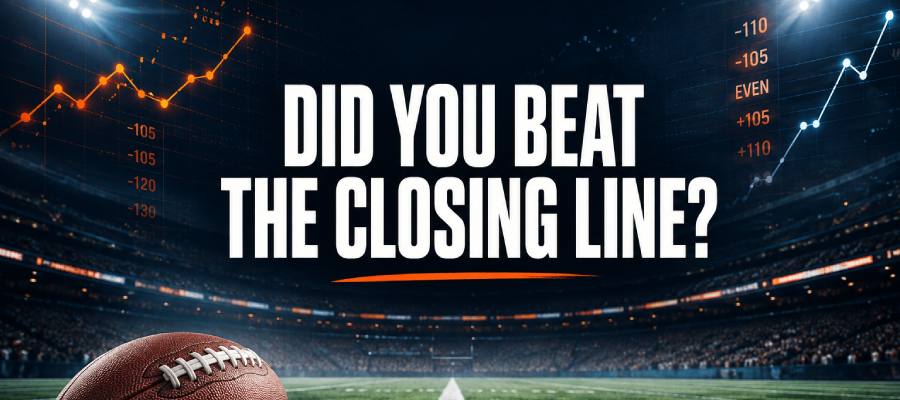
NFL closing line value (CLV) compares the line or price you bet with the final comparable pregame market price before kickoff. It shows whether you secured a more favorable number or price than the closing market. CLV can be positive or negative, but it does not determine whether an individual NFL betting ticket wins or loses.
For example, take +3.5 at -110 when the same team closes at +3 at -110. You secured a better spread than the closing number, which is positive CLV. The bet can still lose. In sports betting, CLV evaluates the price you secured, while the final score determines the result of the wager.
The core takeaway is simple: NFL closing line value measures the quality of the price you secured, while the final score measures the result of the wager.
Quick Answer: NFL Closing Line Value
NFL closing line value, or CLV, compares the spread, total, or moneyline you bet with the final comparable market price before kickoff. You have positive CLV when your original wager offers a better number or price than the closing line.
Before You Track NFL CLV
Closing line value is only a valid comparison when your wager and the closing benchmark use the same market, side, bet type, overtime treatment, and settlement rules. Compare the line and odds values within that matched market. A full-game spread that includes overtime should not be compared with a regulation-only line, first-half market, alternate spread, or live price.
Same market
Compare moneyline with moneyline, spread with spread, total with total, and the same player prop with itself.
Same rules
Confirm whether overtime counts and whether the player, quarter, half, or game met the action requirement.
Table of Contents
- Before You Track NFL CLV
- What Does Closing Line Value Mean in NFL Betting?
- What Is the Difference Between an NFL Opening Line and Closing Line?
- How Do You Know If You Beat the NFL Closing Line?
- How Do You Bet on Football and Record the Price for CLV?
- How Do You Calculate NFL CLV for Spreads, Moneylines, and Totals?
- Why Do NFL Key Numbers Change the Value of Line Movement?
- Which NFL Closing Line Should You Use as Your Benchmark?
- Which Football Betting Rules Affect NFL CLV Tracking?
- Which Live Football Betting Rules Affect the Price You Track?
- How Do You Track NFL CLV in a Betting Spreadsheet?
- How Is NFL CLV Different From ROI and Win Rate?
- Does Positive CLV Guarantee Winning NFL Bets?
- When Should You Check NFL Sportsbook Lines Before Kickoff?
- Frequently Asked Questions About NFL Closing Line Value
- What Should You Remember About NFL Closing Line Value?
What Does Closing Line Value Mean in NFL Betting?
What is NFL closing line value? It is a way to compare your wager with the market’s final pregame number.
The opening line is the first widely available price. The closing line, or closing price, is the last comparable pregame number before kickoff, not an in-game line.
Grab an underdog at +4 and the NFL odds close +3.5 at the same price, and you hold the better number. That is positive CLV. Take +3 before a close of +3.5, and you have negative CLV.
NFL CLV in Simple Terms
+ Positive CLV
Your original ticket has a better number or price than the comparable closing market.
− Negative CLV
Your original ticket has a worse number or price than the comparable closing market.
For a practical NFL betting guide, think price first. NFL CLV gives you a repeatable way to judge the number you bought after the market moves.
What Is the Difference Between an NFL Opening Line and Closing Line?
The NFL opening line is the first broadly available pregame price, while the closing line is the final comparable price before kickoff. The movement between them reflects how the betting market reacted to new information and wagering activity.
| Market point | What it represents | How to use it |
|---|---|---|
| Opening line | The first widely available pregame number or price. | Shows where price discovery began. |
| Your bet line | The exact number and odds accepted on your ticket. | Creates the baseline for your CLV calculation. |
| Closing line | The final comparable pregame number before kickoff. | Provides the benchmark used to grade your price. |
In practice, the close should come from the same market and settlement rules as the original wager. This makes the comparison consistent rather than mixing unrelated sportsbook lines. For a broader explanation of how opening numbers, market movement, and closing prices interact, see NFL betting market analysis.
How Do You Know If You Beat the NFL Closing Line?
For spreads and totals, better usually means a more favorable number at a comparable price. For moneylines, it means paying less on a favorite or getting a bigger return on an underdog.
| Market | Your wager | Closing market | CLV reading |
|---|---|---|---|
| Underdog moneyline | +150 | +130 | Positive CLV |
| Point spread | -3 (-110) | -2.5 (-110) | Negative CLV |
| Game total | Under 47.5 | Under 46.5 | Positive CLV |
That is how to beat the NFL closing line from a tracking standpoint: you got the better number or price. Learning how to read NFL odds and NFL betting odds helps, but every move is not proof you were right. Injuries, weather, limits, liquidity, and market disagreement can all move sportsbook lines.
Before accepting a price, apply an NFL line shopping strategy to compare the available number across sportsbooks. A small price difference can materially change the CLV recorded after the market closes.
How Do You Bet on Football and Record the Price for CLV?
MyBookie makes football wagering simple, but CLV tracking begins before you confirm the ticket. Record the market, selection, line, odds, and time shown on the bet slip so you have an accurate price to compare with the close.
To get started, create a MyBookie account. You need a positive account balance to place a wager, so review the available deposit methods, choose an option, review the available bonus offers, and deposit funds before selecting a football market.
First Steps
1. Fund the account
Create your account, choose a deposit method and bonus when applicable, and add funds.
2. Choose a market
Select a moneyline, spread, total, parlay, prop, future, or another available football market.
3. Check the bet slip
Confirm the selection, line, odds, stake, potential payout, and applicable market rules.
4. Save the price
Record the ticket details and timestamp before placing the wager so the later CLV comparison is auditable.
| Bet type | How it works | What to record for CLV |
|---|---|---|
| Moneyline wager | You bet on the team you expect to win. At -180, a $180 risk would return $100 in profit; at +150, a $100 risk would return $150 in profit. | Team, American odds taken, comparable closing odds, and no-vig closing probability. |
| Spread wager | A -3.5 favorite must win by at least 4 points to cover. A +3.5 underdog covers by winning outright or losing by 3 points or fewer. | Team, spread, attached odds, closing spread, closing odds, and whether the move crossed 3 or 7. |
| Totals wager | Over and Under wagers depend on the combined score. At 56.5, Over wins with 57 or more and Under wins with 56 or fewer; the half-point prevents a push. | Over or Under, total taken, attached odds, closing total, and closing odds. |
| Parlay wager | A parlay combines multiple selections into one ticket. Every active selection must win for the parlay to win, subject to the posted rules. | Every leg’s market, line and odds, plus the combined parlay price. Not all markets can be combined. |
| Prop wager | A proposition wager covers an event within the game, including player or team performance and other listed outcomes. | Exact prop, player or team, side, line, odds, settlement terms, and comparable close. |
| Futures wager | A futures wager covers a later outcome, such as a league, division, conference, award, or championship winner. | Market, selection, price taken, date, and a clearly defined comparison snapshot because futures do not have one universal pregame close. |
A wager on one selection is commonly called a straight bet. To create a parlay, add multiple eligible selections to the bet slip, choose the parlay option, enter the bet amount, review the combined odds, and complete the confirmation process.
For a major event, the same recording process applies when reviewing current Super Bowl odds and betting markets. Save the exact selection, price, market rules, and timestamp rather than relying on a later screenshot.
Season-long markets require dated comparison points instead of one standard pregame close. Bettors evaluating those markets can also review why an overvalued NFL win total may move as expectations change.
In simple terms: each football bet type has a different price structure. That is why spread points, totals, moneyline probabilities, parlay odds, prop rules, and futures snapshots should not be treated as interchangeable CLV measurements.
How Do You Calculate NFL CLV for Spreads, Moneylines, and Totals?
There is no universal formula that treats every NFL betting market the same way.
For NFL point spreads and NFL totals betting, record the point difference and attached odds. +3.5 (-110) versus a close of +3 (-110) is positive CLV. The number matters, but so does the price.
For NFL moneyline odds, use implied probability. A +150 moneyline has a 40.0% break-even probability. If the properly de-vigged closing market gives that team a 41.5% fair probability, the bettor has +1.5 percentage points of probability-based CLV.
Calculation Framework
Spreads and totals
Compare both the number and attached odds. Do not report only the point movement.
Moneylines
Convert the price taken and the no-vig closing price into implied probabilities.
Probability CLV
Fair closing probability minus the break-even probability of the price taken.
The no-vig step matters because raw betting odds include vig, juice, or sportsbook hold. No-vig odds remove that margin to estimate fair odds.
You can use the betting odds calculator to convert American odds and check implied probability before comparing prices.
American Odds Implied Probability Calculator
Enter American odds such as +150 or -110 to calculate the break-even implied probability of that price.
An NFL closing line value calculator can handle the math, but your log still needs the original wager and a comparable closing market. When learning how to calculate NFL CLV, do not treat spread points and probability as the same measurement.
Why Do NFL Key Numbers Change the Value of Line Movement?
NFL key numbers matter because games land on some margins more often than others, especially 3 and 7.
That makes +3.5 to +3 more important than +9.5 to +9, even though both are half-point moves. The first protects you against a common three-point result.
Why Equal Moves Can Have Unequal Value
If you are learning how point spreads work in NFL betting or what a point spread means in the NFL, remember this: with NFL spreads, where the line moves matters as much as how far.
A deeper guide to recognizing key NFL betting numbers explains why crossing 3 or 7 can change the practical value of a wager more than another half-point move.
Key-number context also helps when deciding how to handle inflated NFL point spreads. A larger spread is not automatically valuable simply because the market moved away from the opener.
COMPARE THE MARKET
Review Current NFL Lines Before You Record a Bet
Compare the available spread, total, and moneyline with the price you intend to track.
View NFL OddsWhich NFL Closing Line Should You Use as Your Benchmark?
Pick one consistent benchmark.
Use a timestamped pregame close from the same market, side, rules, and bet type. A consensus close works. So does the close from a liquid NFL sportsbook. Whatever NFL odds betting markets you track, keep the sportsbook lines comparable.
Comparable Closing-Line Checklist
✓ Same market
Full game must be compared with full game, not a first-half or live line.
✓ Same side
Track the same team, Over, Under, or player-prop selection.
✓ Same rules
Settlement terms and listed-player requirements must match.
✓ Same timing standard
Capture the close using one repeatable pregame timestamp or source.
How Do You Choose a Comparable NFL Closing Line?
Do not compare a full-game -3.5 bet with a first-half line, alternate spread, or live number. When tracking NFL closing odds and NFL closing lines, compare like with like.
To understand what can happen between the opener and your selected benchmark, review how NFL betting line movement responds to new information, wagering activity, and changing market limits.
Which Football Betting Rules Affect NFL CLV Tracking?
Football betting rules determine whether a wager has action, whether overtime counts, and which official result is used for settlement. These details also determine whether the closing line in your tracker is genuinely comparable with the ticket you placed. Before tracking a market, review the applicable MyBookie sportsbook rules so the original wager and closing benchmark use compatible settlement conditions.
Quick Answer
Check the market description before using a closing line. Confirm the game-completion requirement, overtime treatment, period, player participation rule, and settlement source; if any of those differ, do not combine the prices in one CLV calculation.
| Rule area | How the wager is treated | CLV tracking effect |
|---|---|---|
| Game completion | There must be 5 minutes or less remaining in the scheduled game time for unresolved wagers to have action. A result already determined may be settled; an undetermined result is void. | Do not record a void wager as a win, loss, or ordinary completed-market result. |
| Abandoned or postponed game | Undecided markets are void unless the game continues within the same weekly schedule. | Keep void wagers separate from the performance sample. |
| Halves and quarters | First Half means Quarters 1 and 2; Second Half means Quarters 3 and 4. The relevant quarter or half must be completed for the wager to stand. | Compare only the same completed period and market. |
| Player props | Unless a market states otherwise, a player prop is official only when the player is on the roster and participates in at least one offensive, defensive, or special-teams play. | Match the participation and settlement rules used by the closing prop market. |
| Touchdown scorer | The scorer is the player in possession of the ball in the opposing end zone, not the player who threw the touchdown. Defensive and special-teams scoring follows the listed settlement rules. | Do not compare markets that classify touchdown scorers differently. |
| Drive result | Only offensive plays count. A drive ending with an interception-return touchdown, defensive touchdown, end of half, or end of game is settled as Other. | Use the same drive-result categories at placement and close. |
| Season markets | Regular-season win and matchup markets become official when the scheduled season is completed, unless remaining games cannot affect the result. Division winners use regular-season results; conference winners include playoffs unless stated otherwise. | Use a dated snapshot for futures and keep the settlement definition with the record. |
| Team and player props | Team and player props are graded using the result posted by NFL.com. | Keep the official grading source consistent in your notes. |
| Overtime treatment | Markets |
|---|---|
| Commonly includes overtime when indicated | Full-game handicap, alternate handicap, full-game total, alternate total, full-game winner or draw-no-bet, team totals, second-half handicap, second-half total, second-half winner, full-game and second-half odd/even, fourth-quarter wagers, race-to-points markets, and player props. |
| Does not include overtime | First-half wagers, first-, second-, and third-quarter wagers, halftime/full-time, winning margin, highest-scoring quarter, and highest-scoring half. |
How Does Overtime Affect NFL Betting Market Rules?
Markets that include overtime should be marked “Incl overtime” in the description. If that wording is absent, treat the market as regulation-only unless its specific rules state otherwise. The “Will there be overtime?” market is settled Yes when regulation ends tied, whether or not overtime is ultimately played.
Additional Pregame Settlement Notes
Unanswered scores
For “Will a team score 3 unanswered times,” the point after touchdown does not count as a separate score.
Full-season player props
The player must be on the active roster for the first regular-season game for the applicable NFL, NCAA Football, or CFL market to have action.
First touchdown scorer
The player does not have to enter the game for action. A quarterback must rush or receive the touchdown; a passing touchdown does not make the quarterback the scorer.
NCAA playoff markets
Use the definition and number of qualifying teams stated in the current market rules; do not rely on the former four-team playoff definition.
Which Live Football Betting Rules Affect the Price You Track?
Live betting uses changing scores, game clocks, and prices, so it should not be used as the closing benchmark for a pregame CLV calculation. Track live wagers separately and preserve the game state shown when the bet was accepted.
| Situation | Rule |
|---|---|
| Overtime | Overtime is included only when the market description says “Incl overtime”; otherwise the wager is regulation-only. |
| Pass-play definition | A sack is considered a pass play, and only a forward pass is treated as a pass by definition. |
| Drive-result market | Only offensive plays count. A defensive return touchdown, end of half, or end of game is settled as Other. |
| Game delay | During rain, darkness, or another delay, markets remain unsettled and trading may resume when play continues. |
| Incorrect score or game time | A market may be void when an incorrect score materially affects prices or odds were offered using an incorrect match time. |
| Abandoned or postponed game | Markets are void unless the game continues within the same NFL weekly schedule. |
| Teams displayed incorrectly | The market may be void when the teams are displayed incorrectly. |
| Field-goal yardage | Field-goal yardage is not included in total yards gained on a play. |
From a tracking perspective, save the accepted live odds, score, quarter, clock, possession when relevant, market description, and overtime label. A later live price reflects a different game state and is not a like-for-like closing line.
How Do You Track NFL CLV in a Betting Spreadsheet?
Start with an NFL betting spreadsheet.
When you bet, log the date, game, market, side, line taken, odds taken, sportsbook, and stake. After the market closes, add the closing line, closing odds, no-vig closing probability when needed, CLV result, final result, and notes.
Start with an NFL betting spreadsheet. For additional education on betting terminology, market mechanics, odds, and wager types, the MyBookie Betting Academy can provide useful background before you begin tracking CLV.
When you bet, log the date, game, market, side, line taken, odds taken, sportsbook, and stake. After the market closes, add the closing line, closing odds, no-vig closing probability when needed, CLV result, final result, and notes.
NFL CLV Tracking Process
1. Record the ticket
Save the exact market, selection, line, odds, sportsbook, stake, and bet timestamp.
2. Capture the close
Add the final comparable pregame line and odds from your chosen benchmark.
3. Calculate CLV
Use points for spread context and no-vig probability when comparing prices.
4. Review the sample
Analyze average CLV, positive-CLV rate, ROI, and win rate separately.
| Stage | Fields to record | Why they matter |
|---|---|---|
| At placement | Date, game, market, side, line, odds, sportsbook, stake, bet time | Preserves the exact price and context of the wager. |
| At close | Closing line, closing odds, benchmark, capture time | Creates a consistent comparison point. |
| After grading | CLV result, bet result, profit or loss, notes | Separates price quality from the outcome. |
| Review period | Average CLV, positive-CLV rate, ROI, win rate, sample size | Shows whether the process remains consistent over time. |
What Should an NFL CLV Tracker Include?
A basic NFL CLV tracker can also include injury news, weather, line movement, and bet time. That makes a betting line tracker useful instead of just a list of old wagers.
Then review average CLV, percentage of bets with positive CLV, ROI, and win rate. Keep them separate. ROI and win rate measure results. CLV measures price and process, which is why learning how to track NFL closing line value matters to an NFL betting strategy.
How Is NFL CLV Different From ROI and Win Rate?
CLV, ROI, and win rate answer different questions. Looking at them together gives a more complete view of betting performance.
CLV should not be confused with pro football arbitrage wagering. CLV grades one accepted price against a later close, while arbitrage compares simultaneous prices to identify opposing market positions.
| Metric | What it measures | What it does not prove |
|---|---|---|
| CLV | How your accepted price compares with the closing market. | That an individual bet will win. |
| ROI | Profit or loss relative to the amount staked. | That recent results came from repeatable skill. |
| Win rate | The percentage of graded wagers that won. | Profitability without considering the odds paid. |
If you're wondering why this matters, it is because a good process can produce short-term losses, while a weak process can produce short-term wins.
Does Positive CLV Guarantee Winning NFL Bets?
No.
A +3.5 ticket can lose even if the market closes +3. Does positive CLV guarantee profit? No. Not on one wager, one week, or a short run of NFL sports betting.
Process Is Not the Same as Outcome
Positive CLV and a loss
The ticket lost, but the bettor secured a better price than the close.
Negative CLV and a win
The ticket cashed, but the bettor accepted a worse price than the close.
Why Does Positive CLV Not Guarantee Profit?
Variance and sample size matter. Positive expected value and positive CLV are related, but CLV alone does not prove profitability. A sound betting strategy still needs bankroll discipline.
It is important to note: closing markets can differ across sportsbooks, and even a consistent benchmark remains an estimate rather than a guarantee of true probability.
When Should You Check NFL Sportsbook Lines Before Kickoff?
For clean NFL betting line movement records, check the opener, your actual bet price, meaningful injury or weather reactions, and the final pregame close.
The familiar idea of betting favorites early and underdogs later should be treated as a market hypothesis, not a universal rule. For a deeper look at timing, review when to bet NFL lines before judging the current matchup and available price.
Pregame NFL Line-Movement Timeline
Early week
Record the opening NFL line and the initial market range.
At your wager
Save the exact price and timestamp shown on your betting ticket.
After material news
Note reactions to injury reports, quarterback status, or weather.
Before kickoff
Capture the final comparable sportsbook line used as your benchmark.
Which Factors Can Influence NFL Line Movement Before Kickoff?
Use NFL betting splits as context for where tickets and money are being reported, but do not assume a split alone explains why the line moved.
Likewise, learning how NFL sharp money is interpreted can help explain price changes without turning every move into proof of professional action.
Player availability can create some of the largest adjustments in an NFL market. Review the wagering impact of injured players and record whether the move occurred before or after the relevant report.
Early-season markets can also react strongly to public expectations. A Week 1 public money indicator can provide context, but the accepted line and comparable close remain the measurements used for CLV.
How Should You Record NFL CLV Timing?
For a Sunday game, that could mean the early-week NFL line, your wager timestamp, the Friday injury-report reaction, and the final NFL sportsbook lines before kickoff. This works for NFL betting online and other online betting. You are tracking the market, not forcing a play.
From a betting perspective, the strongest CLV records come from consistently captured prices and timestamps, not from reconstructing the market after the game has started.
NFL Closing Line Value Summary
- Positive CLV means the wagered number or price was better than the comparable pregame close.
- Spread movement must be interpreted around NFL key numbers, especially 3 and 7.
- Moneyline CLV is clearer when odds are converted into implied and no-vig probabilities.
- A reliable tracker records the original ticket, closing benchmark, calculation method, result, and sample size.
- CLV measures price and process; ROI and win rate measure results.
Frequently Asked Questions About NFL Closing Line Value
What is a good NFL closing line value percentage?
There is no universal threshold. Market type, calculation method, benchmark consistency, and sample size all matter, so report the exact method and sample being used.
Can an NFL bet win and still have negative CLV?
Yes. A bad price can still cash because the result and the quality of the number you took are different things.
Does closing line value apply to NFL player props?
Yes, provided you compare the same prop, side, line, odds, and settlement rules. Lower limits and thinner liquidity can make a player-prop closing line a less stable benchmark.
How many NFL bets should you track before judging CLV?
Use a meaningful and consistently recorded sample instead of a magic number. The more comparable bets you track, the more useful the data becomes.
Can positive CLV and negative ROI happen at the same time?
Yes. Short-term variance can produce a losing stretch even when the prices taken regularly beat the closing market.
NEXT STEP
Record the Number Before You Place the Bet
Check today's MyBookie NFL odds, compare the available market price, and save the line and timestamp before kickoff.
Check NFL LinesWhat Should You Remember About NFL Closing Line Value?
NFL closing line value is a repeatable way to see whether you secured a better number than the final market. It will not tell you whether the next ticket wins. It tells you how your price held up.
The Practical Takeaway
Judge the decision and the result separately. Record the number you took, select one consistent closing benchmark, account for vig and NFL key numbers, and evaluate CLV alongside ROI, win rate, and sample size.
Check today's MyBookie NFL odds and MyBookie NFL lines, compare the available price, and record it before you bet on NFL games. If you already bet on sports, make tracking the close part of the routine.
You can also review MyBookie NFL spreads and the MyBookie NFL sportsbook market before kickoff. The same price-tracking mindset can apply to bitcoin betting or crypto betting when the underlying sports market, closing benchmark, and settlement rules are comparable.
The deeper lesson is that CLV turns each ticket into evidence about your process. One result can be noisy, but a consistently maintained record can show whether you regularly obtain stronger prices, whether that advantage is concentrated in certain NFL markets, and whether your strategy changes when the data stops supporting it.
Important: Sports betting involves risk. No strategy, price, or CLV measurement guarantees results. Set limits, manage your bankroll, and never risk more than you can afford to lose.
MyBookie: Bet On Anything. Anywhere. Anytime.
Important: Sports betting involves risk. No strategy guarantees results, and managing exposure is essential.

About the Author

Since 2008, D.S. Williamson has written about sports and sports handicapping. His philosophy is value-based, meaning statistics and other handicapping factors are only useful when compared with the available wagering odds. He believes bankroll management and consistently making value-based wagers are the most important factors separating successful sports bettors from unsuccessful bettors.
Sportsbook Bonuses
Read requirements in the Bonus page. However, if you want to take a deep knowledge, go to MyBookie Bonus Rules and How to


🔍 Explore Everything you Need to Know aboout your Licensed, Trusted Home For Casino and Sports Since 2014
👉 Gamble responsibly—must be 21+ and in a Legal Jurisdiction | Get Help at 1-800-Gambler