English

Last updated: September 2026
Quick Answer: How Do You Find Value in NBA Picks?
Find value in NBA picks by building your own projection, comparing it with the current spread, total, or prop price, and checking whether injuries, rotations, rest, and other matchup factors support the difference. A good NBA pick is not simply the team or player you expect to perform best; the available odds must also offer enough value relative to your estimated probability.
Editorial Note
This guide explains how to analyze NBA betting lines, compare prices with your own projections, and interpret factors such as line movement, injuries, and expected minutes. It is designed for educational purposes and does not guarantee outcomes.
Good NBA picks start with a question: Is the available price better than the probability you assign to the outcome? A strong team can be a poor bet at an inflated spread, while an underdog can be worth considering even if it is unlikely to win outright.
To find value, compare sportsbook lines with your own assessment of the matchup. Then check what has changed since the opening line: injuries, projected minutes, rest, travel, rotations, and betting odds. Line movement is useful evidence, but a move alone does not tell you who bet, why the number changed, or whether the current price is still attractive.
Quick Take
Build a projection, compare it with the current spread, total, or prop, and investigate any meaningful gap. Recheck availability and the price before placing a bet. If the market has already moved past your target number, passing is a valid pick.
Table of Contents
- How Do You Find Value in NBA Picks?
- Which NBA Betting Markets Should You Compare?
- How to Spot Value Using NBA Line Movement
- How Does the NBA Injury Report Affect Betting Lines?
- What Matchup Insights Matter Most for NBA Picks?
- Which NBA Schedule Spots Are Worth Checking?
- How Can You Find a Projection Gap in NBA Totals?
- Should You Fade Public Money on NBA Games?
- How Do Betting Odds and Expected Value Change a Pick?
- What Is a Practical NBA Picks Checklist?
- Do NBA Picks Change During the Playoffs?
- How Should You Handle Volatility and Bet Size?
- NBA Picks FAQ
How Do You Find Value in NBA Picks?
Value is a relationship between your estimated probability and the price offered. Picking a likely winner is not enough: the sportsbook may already charge more than that outcome is worth. A practical process is to estimate the matchup independently, translate that assessment into a fair line or probability, and compare it with the available betting odds.
Suppose your model makes an NBA team a 3-point favorite, while the available spread is -1.5. That 1.5-point gap deserves investigation, but it is not an automatic bet. Check whether your projection missed an injury, a minutes restriction, or another piece of news. Also compare the price attached to each spread: -1.5 at -125 is a different wager from -1.5 at -110.
For a closer look at comparing your projection with moneylines, spreads, and live markets, see MyBookie’s guide to finding value in NBA odds.
Which NBA Betting Markets Should You Compare?
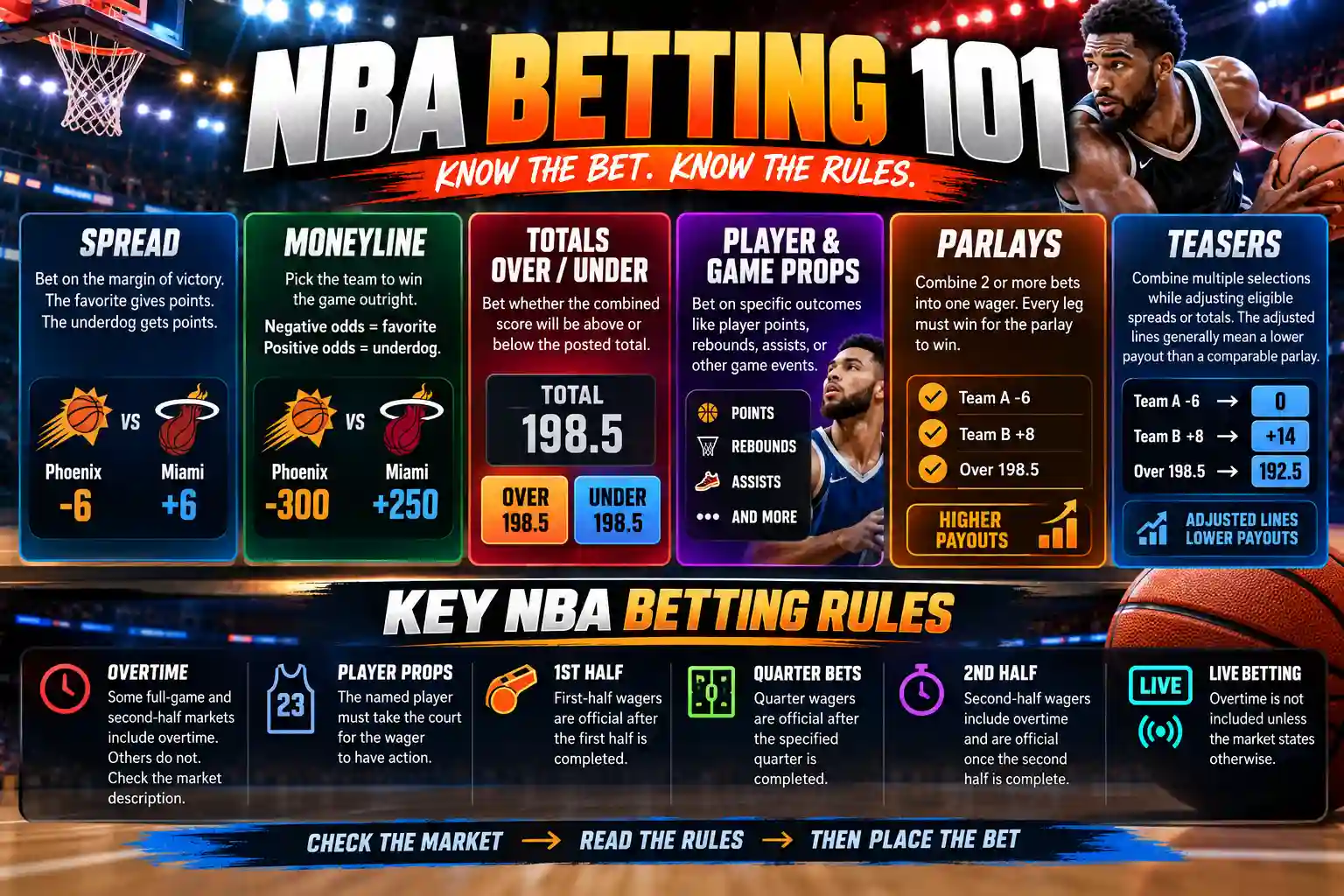
No NBA market is reliably profitable on its own. Moneylines, point spreads, totals, and player props answer different questions, so choose the market that best expresses your specific matchup view.
NBA Betting Market Comparison
Moneyline:
Compare your estimated win probability with the price for the outright winner.
Point Spread:
Compare your projected winning margin with the posted spread and odds.
Total:
Compare your projected combined score with the posted over/under.
Player Prop:
Compare your projected player production with the posted line and price.
| Market | Main Question | Key Inputs |
|---|---|---|
| Moneyline | Who wins? | Win probability, matchup, injuries, price |
| Point Spread | Who covers? | Projected margin, pace, efficiency, price |
| Total | How many points? | Possessions, efficiency, lineup changes, scoring profile |
| Player Prop | What will a player produce? | Minutes, usage, role, matchup, game script |
Moneyline: Who wins?
A moneyline pays based on the outright winner. Compare your estimated win probability with the odds after accounting for the sportsbook’s margin. A team can be your most likely winner without offering a worthwhile moneyline price.
Point spread: By how much?
An NBA point spread adjusts the score for betting purposes. At -4.5, the favorite must win by at least five points to cover; at +4.5, the underdog covers if it wins or loses by four or fewer. Study how likely each winning margin is, not just which team you expect to win. MyBookie’s NBA point spread explanation covers the mechanics and settlement examples.
Total: How many combined points?
An over/under asks whether the teams will combine for more or fewer points than the posted number. Start with expected possessions and points per possession, then consider lineup changes, shot profile, turnovers, and late-game fouling. A recent run of overs is not, by itself, a reason to bet the next over. Review how NBA totals work before comparing totals prices.
Player props: What happens in one player’s role?
Points, rebounds, and assists props depend heavily on playing time and opportunity. Project minutes first, then examine usage, potential assists or rebound chances, the opponent’s defensive approach, and likely game script. A favorable matchup loses much of its appeal if the player’s minutes are uncertain.
How to Spot Value Using NBA Line Movement
Record the opening number, the time of each change, the current number, and the odds attached to it. Then ask what new information could explain the move. Sportsbook lines may change because of injury news, limits, respected wagers, broader market adjustments, or a book’s own risk management. A line move is a prompt to investigate, not proof of “sharp money.”
For example, if an underdog moves from +4.5 to +5.5, the market has moved against that underdog. The extra point may improve the bet at the new price, but only if your analysis still supports it. If a favorite moves from -4.5 to -3.5, the market has moved toward the opponent; the favorite now needs to win by less to cover. In either case, determine why the line changed before acting.
Visual Model: Read the Number Before the Story
Key Insight
⚙ Concept:
A line move changes the price or number attached to the same underlying matchup.
Why it matters:
The new number may create a different betting opportunity, but only if your projection still supports it.
What is reverse line movement?
Reverse line movement describes a line moving opposite the side that reportedly has more public bets. It can suggest that larger or more influential wagers landed elsewhere, but public-betting datasets vary in coverage and may arrive late. Compare multiple timestamps and sources. Never label a move “sharp” solely because it differs from a public percentage.
What are steam moves and closing line value?
A steam move is a rapid change across multiple books. By the time you see it, the original price may be gone. Closing line value (CLV) compares the line or price you took with the market near tipoff. Consistently beating the closing price can help you review your decisions over many bets, though CLV does not guarantee that an individual wager will win.
How Does the NBA Injury Report Affect Betting Lines?
An injury changes more than one player’s expected points. Replacements alter ball handling, shot volume, defensive assignments, rebounding, and sometimes the game’s pace. Ask who absorbs the missing minutes and whether the sportsbook has already priced in the likely lineup.
Separate a confirmed absence from a questionable designation. If your pick depends on a player’s status, define the price you would accept in each scenario and wait for reliable news when necessary. The NBA injury handicapping guide goes deeper on translating availability into market adjustments.
| Change | Possible Projection Impact |
|---|---|
| Missing scorer | Shot volume may shift to other players |
| Missing ball handler | Touches and creation responsibilities may change |
| Missing defender | Opponent shot quality or matchup assignments may change |
| Replacement player | Minutes, efficiency, spacing, and rotation depth may change |
| Minutes restriction | A player can be active without providing a normal workload |
Injury Check
What Matchup Insights Matter Most for NBA Picks?
Start with team efficiency and expected pace, then examine how each team creates and allows shots. A fast team does not automatically produce an over against a slower opponent; the relevant question is how many possessions this particular matchup is likely to generate and how efficiently each side can use them.
Look at likely starting lineups and bench units, rim protection, three-point attempt quality, turnovers, offensive rebounds, and free-throw rates. For player props, consider whether the defender and team scheme change a player’s minutes, touches, or shot locations. Basketball has wings and guards rather than a single “defensive back” assignment.
Be cautious with small samples. A three-game shooting surge can reflect hot shooting instead of a lasting change in offensive efficiency. Explain why you expect a trend to continue or regress before using it to justify a pick.
Which NBA Schedule Spots Are Worth Checking?
Back-to-backs, travel, time between games, and a stretch of road games can affect rotations and effort. They are inputs to a projection, not automatic bets against a team. Check whether key players actually logged heavy minutes, whether the team traveled, and whether the line already reflects the scheduling disadvantage.
Motivation and rotation patterns can also change across the season. Preseason minutes, regular-season rest, and playoff rotations require different assumptions. For broader schedule context, read why the NBA season’s length matters for betting.
How Can You Find a Projection Gap in NBA Totals?
Estimate possessions and scoring efficiency for both teams. Compare the resulting combined score with the posted total, then test the assumptions driving the gap. If your projection is 224 and the market total is 220.5, ask whether injury news, a likely rotation change, or unusually high recent shooting explains the difference. A mathematical gap only becomes useful when the model’s inputs hold up.
Account for the price as well as the number. Over 220.5 at -120 and over 221.5 at -105 involve different tradeoffs. MyBookie’s NBA totals projection-gap guide develops this approach in more detail.
Visual Model: NBA Total Projection Gap
Should You Fade Public Money on NBA Games?
Not automatically. A popular team may attract casual bets, but the public can also be on the correct side, and a well-followed game may be priced efficiently. “Public fading” is a hypothesis to test against your projection and the available number, not a stand-alone NBA betting strategy.
Bet percentages count tickets; money percentages estimate wager volume. Neither reveals every wager across every sportsbook. If a source reports a split, record its coverage and timestamp before treating it as evidence of market behavior.
Use the MyBookie betting odds calculator to check implied probability when comparing an NBA betting price with your projection.
NBA Implied Probability Calculator
Enter American odds to estimate the break-even probability before considering your own projected probability.
How Do Betting Odds and Expected Value Change a Pick?
American odds of -110 imply a break-even win rate of approximately 52.38% before considering your own uncertainty. If you estimate a bet’s true chance at 55%, a $110 stake to win $100 has an estimated value of $5.50: (0.55 × $100) − (0.45 × $110). If your probability estimate is wrong, that apparent edge disappears.
Line shopping matters because the same opinion can produce different expected values at different prices. Record the odds you actually obtain rather than reporting only the best number that appeared earlier in the day. For definitions of bet types, implied probability, and sportsbook lines, use the MyBookie Betting Academy.
What Is a Practical NBA Picks Checklist?
- Identify the market and record its current line and odds.
- Build a matchup projection without relying on the current line as your answer.
- Confirm player availability, expected minutes, and the schedule spot.
- Compare the opening line, current line, and available prices; investigate meaningful changes.
- Estimate whether the probability gap is large enough to justify the sportsbook’s price and your model uncertainty.
- Set a maximum acceptable price. Pass if the line moves beyond it.
- Record your reasoning and review the result against the closing line over a meaningful sample.
Before placing an online betting wager, check the MyBookie rules for the market’s grading and settlement terms. Those details are especially relevant to partial-game wagers, props, and bets affected by overtime.
NBA Picks Value Workflow
Do NBA Picks Change During the Playoffs?
Yes. Teams may shorten rotations, repeat the same matchup, and make tactical adjustments between games. Revisit your regular-season assumptions rather than carrying them forward unchanged. A single playoff result can also draw attention without proving that the next game should be priced the same way.
Game spreads, series outcomes, and futures involve different time horizons. See how NBA series betting works and the NBA playoff wagering guide when your analysis extends beyond one game.
How Should You Handle Volatility and Bet Size?
Even sound picks lose frequently. Keep stakes within a predetermined bankroll plan, avoid increasing a wager simply to recover a loss, and account for bets that depend on the same game or injury assumption. Placing a spread, an over, and a scorer prop from one matchup can concentrate risk rather than diversify it.
Same $200 Bankroll, Different NBA Bet Exposure
The wager size changes how much of the bankroll is exposed to each NBA betting decision.
How Do Market Depth and Payment Methods Affect NBA Betting?
The same process of checking market depth and the available price applies when you bet on sports beyond the NBA. If you compare basketball with smaller or less-covered markets, MyBookie’s guide to wagering on non-marquee sports explains some of the different market considerations.
For bitcoin betting or crypto betting, treat the funding method as separate from the quality of the pick. Confirm the displayed wager amount, betting odds, payment terms, and applicable rules before submitting a bet.
NBA Picks FAQ
Does NBA line movement tell me which team to pick?
No. It tells you that the market price changed. Check when it moved, what news was available, and whether the current number still offers value against your projection.
How often should I check NBA betting lines?
Check when you first analyze a game and again near any relevant injury or lineup update. Recheck immediately before betting because both the line and its price can change.
What does an NBA spread moving from +4.5 to +5.5 mean?
The underdog is receiving one more point than before. That improves its spread at the same odds, but the move may reflect unfavorable news. Investigate the cause before calling it value.
Are player props easier to beat than NBA spreads?
Neither market is automatically easier. Props can react sharply to minutes and role changes; spreads reflect the whole team. Use the market your research supports and compare the available price.
What is the difference between a good NBA prediction and a good bet?
A prediction describes what you think will happen. A good bet requires odds that compensate you for the chance that your prediction is wrong.
Should I bet every game on the NBA slate?
No. If your projection and the available sportsbook lines are too close, or important lineup information is unresolved, passing protects your bankroll for clearer opportunities.
NBA Picks: How to Find Value in Betting Lines
- Build your own projection: Estimate the matchup before letting the current sportsbook line determine your view.
- Compare projection with price: Check the spread, total, moneyline, or player prop against your estimated probability or expected outcome.
- Investigate the gap: Account for injuries, minutes, rotations, pace, efficiency, rest, travel, and other matchup factors.
- Track line movement: Compare the opening number with the current price, but treat movement as evidence to investigate rather than proof of a winning side.
- Set a price limit: If the market moves beyond the number that supports your projection, passing is part of the process.
The core idea is simple: a good NBA pick is not just about predicting what happens; it is about deciding whether the available betting price adequately reflects your estimated probability.
NEXT STEP
Put Every NBA Pick Through a Price Check
Before placing a wager, compare your matchup projection with the current line, confirm the latest player information, and check whether the available odds still fit your target price. For the broader fundamentals behind lines, probabilities, and bet types, visit the MyBookie Betting Academy.
Learn MoreMyBookie: Bet On Anything. Anywhere. Anytime.
Important: Sports betting involves risk. No strategy guarantees results, and managing exposure is essential.

About the Author

David Strauss is a veteran sportsbook professional with more than 20 years of experience in online gaming, bookmaking, proposition wagering, security, and risk management. Writing from an operator’s perspective, he analyzes betting odds, line movement, sportsbook risk, market behavior, and long-term value. His work emphasizes implied probability, disciplined bankroll management, and determining whether the available price justifies the risk.
Sportsbook Bonuses
Read requirements in the Bonus page. However, if you want to take a deep knowledge, go to MyBookie Bonus Rules and How to