English
Last updated: September 2026
NBA odds show both the outcome a sportsbook is pricing and the return attached to that price. To find value in NBA moneylines, point spreads, or live bets, compare the listed betting odds with your own estimate of how often the wager should win. A bet has theoretical value only when your estimated probability is higher than the break-even probability implied by the price after accounting for the sportsbook margin.
That means the favorite, the biggest underdog, or the line moving fastest is not automatically the best bet. The useful question is: Is this price better or worse than the probability supported by player availability, projected rotations, pace, efficiency, rest, and matchup?
MyBookie displays NBA betting odds and sportsbook lines for available games and markets. Use the process below to compare NBA moneyline odds, NBA spread odds, and NBA live betting odds; interpret NBA line movement; and evaluate each price without treating any outcome as guaranteed.
Quick Answer: Where Is the Value in NBA Odds?
Value is the gap between a sportsbook price and your estimate of the wager’s true probability. Convert the American odds into break-even probability, build a matchup-based estimate, compare the two, and bet only when the difference is large enough to cover uncertainty and vig. A more attractive payout is not necessarily a better wager if the chance of winning is lower than the price implies.
How Do You Read NBA Betting Odds?
NBA betting lines normally present a market, a selection, and a price. The market defines what must happen. The selection is the side you choose. The price shows the potential return and the break-even rate needed before the wager can have positive expected value.
With American odds, a minus sign identifies how much must be risked to win $100 in profit, while a plus sign identifies the profit on a $100 stake. At -150, a $150 winning stake earns $100 in profit. At +150, a $100 winning stake earns $150 in profit. Your original stake is also returned when the bet wins.
| American Odds | Break-Even Probability | $100 Stake: Profit if Bet Wins |
|---|---|---|
| -150 | 150 / (150 + 100) = 60.00% | $66.67 |
| -110 | 110 / (110 + 100) = 52.38% | $90.91 |
| +120 | 100 / (120 + 100) = 45.45% | $120.00 |
| +150 | 100 / (150 + 100) = 40.00% | $150.00 |
For negative odds, calculate |odds| / (|odds| + 100). For positive odds, calculate 100 / (odds + 100). This implied probability includes the sportsbook’s margin, so it is a break-even threshold rather than a pure prediction of the outcome.
How Do NBA Moneyline Odds Work?
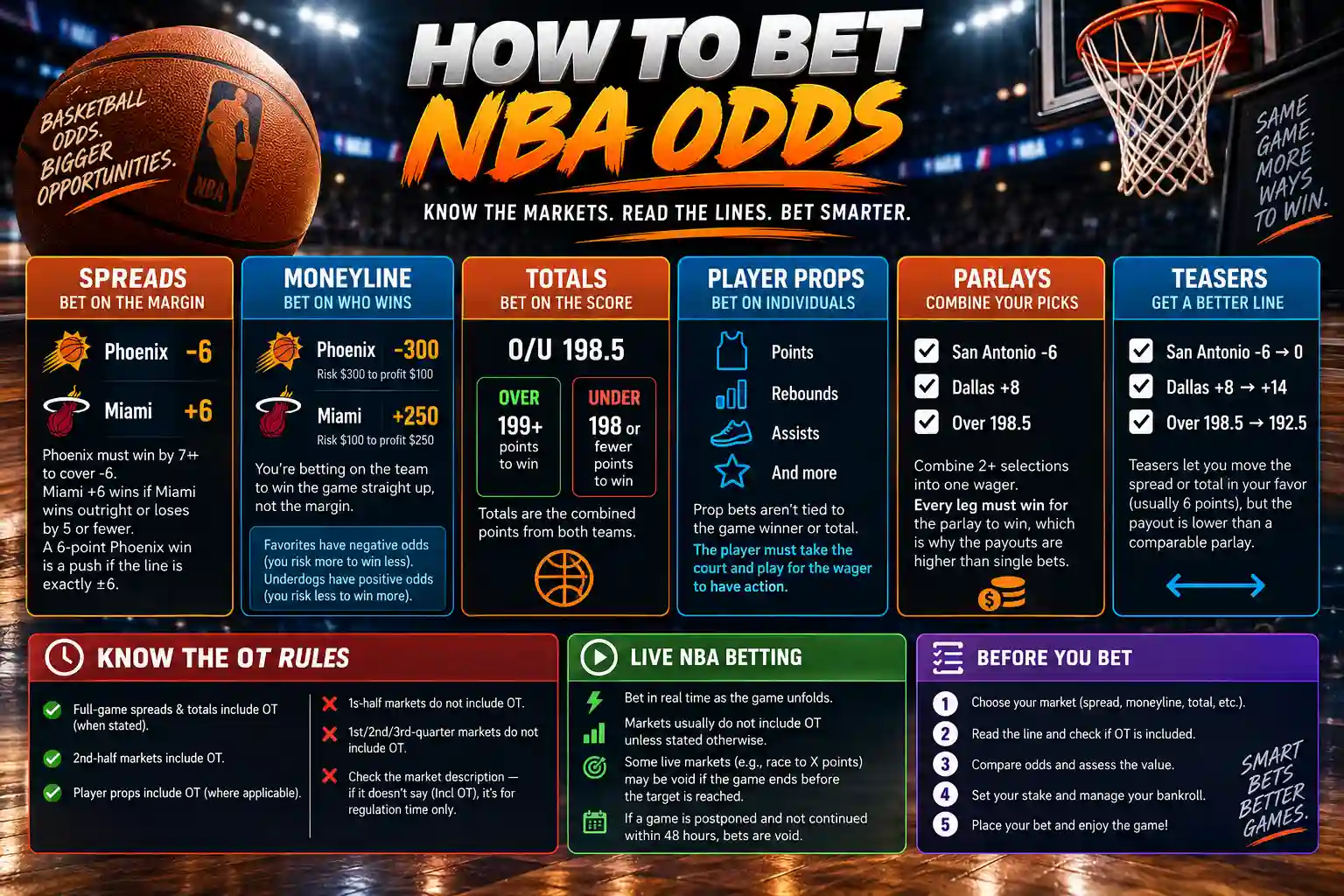
An NBA moneyline bet asks only which team will win the game. The point margin does not matter. Favorites have negative prices and underdogs usually have positive prices, although the exact NBA moneyline odds can change as information and market action enter the sportsbook.
Suppose Team A is -150 and Team B is +130. The listed break-even probabilities are 60.00% and 43.48%, totaling more than 100% because both prices contain margin. If your analysis gives Team B a 47% chance to win, +130 may offer theoretical value: its 43.48% break-even threshold is below your estimate. The estimate still needs to be strong enough to survive model error, late lineup news, and normal game variance.
Do not choose an underdog only because the payout is larger, and do not call a favorite “safe.” A strong team can be a poor moneyline bet when the price requires it to win more often than a reasonable projection supports.
How Do NBA Point Spreads Work?
NBA point spread betting adds a handicap to the final score for grading purposes. A favorite at -4.5 must win by at least five points to cover. An underdog at +4.5 covers by winning outright or losing by four points or fewer. The half-point prevents a tie against the spread. For a complete breakdown of favorites, underdogs, pushes, and spread prices, see this NBA point spread betting guide.
If the spread is a whole number, such as -4, a four-point margin can produce a push under standard grading and the stake is returned. Always check the posted market terms because settlement depends on the sportsbook’s rules and the exact wager.
Spread value is not simply a prediction of who wins. It is an estimate of the likely scoring margin compared with the offered number and price. If your fair spread is Team A -6 but the market offers Team A -4.5 at an acceptable price, the favorite may have value. If your fair spread is only -3, the underdog may be the stronger side of the same matchup.
When Should You Bet an NBA Moneyline Instead of the Spread?
Use the moneyline when your edge is mainly about win probability. Use the spread when your edge concerns the expected margin. An underdog that keeps games close but has a limited chance to win may be more attractive at +points than on the moneyline. A favorite expected to win often but not separate from its opponent may be better evaluated on the moneyline than against a large spread.
Compare both markets rather than deciding by habit. Convert the moneyline to implied probability, project the scoring margin, and ask which price expresses the matchup advantage with less dependence on an uncertain assumption.
Single-game moneylines should not be confused with playoff series prices. A game moneyline covers one matchup, while an NBA series wager remains open until one team advances under the posted terms. Bettors comparing postseason markets can review how NBA series betting works before deciding whether their projection applies to one game or the entire series.
How Do Totals and Player Props Add Context to NBA Odds?
An NBA total asks whether the combined score will finish over or under a posted number. The guide to how NBA totals betting works explains how the number, price, overtime, and push possibilities affect an over/under wager. Pace, offensive and defensive efficiency, shot profile, transition frequency, turnover rate, offensive rebounding, free-throw rate, and expected lineups can all influence a total. Raw points per game can mislead because teams play at different speeds.
Player props price individual outcomes such as points, rebounds, assists, or three-pointers. The strongest prop analysis begins with expected minutes and role, then considers usage, potential assists, rebound chances, matchup, foul risk, and the probability of a one-sided game changing the rotation. A recent scoring average alone is not enough.
Availability varies by event and timing. Confirm that the market is posted, then read the listed terms before submitting the wager. MyBookie search demand also shows that bettors ask whether player props are available, so the live market page—not a general article—should be treated as the source of truth for what can currently be bet.
How Do You Find Value in NBA Moneylines and Spreads?
Finding value requires a repeatable process. Start with a probability or fair line before looking for a reason to support the sportsbook price. This reduces the temptation to build a story around the side you already want to bet. A structured NBA betting strategy framework can help organize matchup research, projections, price comparisons, and final betting decisions.
- Define the market. Separate full-game moneylines, spreads, totals, quarters, halves, and player props because each wager depends on different assumptions.
- Confirm availability. Check injuries, starting lineups, minutes limits, suspensions, rest, and likely rotation changes.
- Estimate possessions and efficiency. Project pace and expected points per possession using opponent-adjusted performance rather than recent scores alone.
- Create a fair number. Turn the matchup estimate into a fair moneyline, spread, total, or prop line.
- Compare the price. Measure your estimate against the available NBA odds and calculate the break-even probability.
- Allow for uncertainty. Demand a larger edge when the injury news is unresolved, the player role is unstable, or the market has low limits.
- Record the result and closing line. Review whether your prices beat the close over a meaningful sample instead of judging the process from one win or loss.
NBA Expected-Value Example
Assume an underdog is +120 and you estimate a 48% win probability. A $100 stake would produce $120 in profit when correct and lose $100 when wrong:
Expected value = (0.48 × $120) – (0.52 × $100) = $5.60 per $100 staked.
The result is positive only if the 48% estimate is well calibrated. Expected value is a long-run mathematical estimate, not a promise that the next bet will win.
Why Does Line Shopping Matter for NBA Betting Value?
Line shopping means comparing the same market, selection, and rules before placing a wager. Small differences matter. A price of -105 has a 51.22% break-even probability, while -110 requires 52.38%. Over many wagers, repeatedly accepting the worse price raises the win rate required to break even.
Compare like with like. A spread of -3.5 at -105 is not automatically better than -3 at -120 because both the number and price changed. The best available price is the option with the most favorable relationship between your projected probability and its break-even threshold.
This is the practical connection between NBA odds comparison and value. In online betting, the visible payout is only one part of the decision; the line, price, market rules, and timing must all match.
Why Do NBA Betting Lines Move?
NBA line movement can reflect confirmed lineup news, injury-status changes, rest information, market action, limit increases, or a sportsbook adjusting toward the wider market. A move does not prove that someone has inside information, and it does not tell you by itself which side is correct.
Track the opening line, current line, time of movement, and news available at that moment. A move from -4 to -6 after a star is ruled out has a different explanation from a gradual move without public news. The key decision is not whether the line moved; it is whether value remains at the new number.
Opening Line vs. Closing Line
The opening line is an early market price. The closing line is the final price before the game begins. Consistently securing numbers better than the close can be evidence that your process identifies useful information, but closing line value is a diagnostic—not proof that every wager was correct or profitable.
Which NBA Factors Should You Compare Before Betting?
The most useful NBA betting indicators explain possessions, scoring efficiency, player role, and uncertainty. No single trend should control the decision.
- Player availability: who is out, questionable, returning, or playing under a minutes restriction.
- Starting lineup and rotation: expected combinations, bench roles, stagger patterns, and closing units.
- Pace: expected possessions rather than points per game alone.
- Efficiency: opponent-adjusted offensive efficiency, defensive efficiency, and net rating.
- Shot profile: rim frequency, three-point volume, free-throw rate, and the opponent’s ability to concede or prevent those attempts.
- Possession control: turnover rate and offensive rebounding, which create or remove scoring opportunities.
- Schedule: back-to-backs, travel, altitude, time-zone changes, and rest advantage.
- Matchup: size, switching, rim protection, transition defense, and how likely each team is to exploit the other’s weaknesses.
- Market price: whether the basketball insight is already reflected in the moneyline, spread, total, or prop.
Injuries affect more than a player’s average production. They can change usage, ball-handling, spacing, rebounding, defensive assignments, bench minutes, pace, and late-game execution. Reprice those connected effects instead of simply subtracting the missing player’s points per game.
How Do Live NBA Betting Odds Work?
Live NBA betting odds update after tipoff as the score, game clock, possession, pregame expectations, and in-game information change. Available markets may include a live moneyline, live spread, live total, team total, period line, or player market. See the currently offered MyBookie live sports betting markets for actual availability.
A team falling behind early is not automatically undervalued. The new price may correctly reflect poor play, foul trouble, an injury, or a rotation problem. Compare what changed with what did not change. If the score changed but the underlying pace, shot quality, and expected rotations remain close to your pregame assumptions, the adjustment may deserve further review.
Live NBA Betting Checklist
- Confirm the score, quarter, game clock, and possession before betting.
- Check foul trouble, injuries, timeouts, and which players are currently on the court.
- Separate sustainable changes from short shooting streaks.
- Estimate remaining possessions and likely rotation patterns.
- Read the exact live line and price; both can update before acceptance.
- Verify the accepted wager on the bet slip instead of relying on the number first displayed.
Live markets move quickly and allow less time for analysis. Set decision rules and a separate budget before the game. Chasing a loss or betting every momentum swing is not a value strategy.
How Do NBA First-Half, Halftime, and Second-Half Lines Work?
NBA first-half odds grade only the first half. At halftime, NBA second-half lines price what happens after the break as a separate period rather than asking which team wins the full game. A team can cover the second-half spread while still losing the game, or win the game after failing to cover the second-half number.
Do not confuse a second-half bet with an adjusted full-game live bet. The displayed market name and settlement period matter. Quarter, first-half, second-half, and full-game markets may also treat overtime differently, so review the posted MyBookie sportsbook rules before betting. The specific market label and rules control grading.
At halftime, reassess foul trouble, injuries, rotation changes, pace, shot quality, turnover pressure, and coach adjustments. Avoid assuming that an unusually high or low shooting percentage must immediately reverse; regression is a probabilistic expectation, not a schedule.
How Do You Remove the Vig to Estimate Fair NBA Odds?
Sportsbook margin is visible when the implied probabilities on all sides of a market total more than 100%. If both sides of a spread are -110, each implies 52.38%, for a combined 104.76%.
One simple no-vig estimate divides each side’s implied probability by the combined total. In a balanced -110/-110 market, each side becomes 50%. If prices differ, normalize each implied probability the same way. This produces a market-based estimate of fair probability, not an independent prediction.
Use the no-vig market as a benchmark. Your edge is the difference between your estimated probability and the fair market probability, evaluated alongside the price you can actually bet.
Do Bitcoin Betting or Crypto Betting Change NBA Odds?
Bitcoin betting and crypto betting describe how an account may be funded, not a different method for evaluating NBA markets. Whether a bettor uses cryptocurrency or another available payment method, the same break-even probability, vig, line-shopping, and expected-value calculations apply.
Before using any payment option, review availability, fees, processing terms, rollover requirements, and withdrawal rules. The ability to bet on sports with a particular method does not make the odds for sports more favorable and does not reduce the risk of the wager itself.
What Mistakes Hide the Value in NBA Odds?
- Betting a team instead of a price: a good team can still be overpriced.
- Using recent scores without context: pace, opponent quality, shooting variance, and player availability can distort short samples.
- Treating every line move as a signal to follow: the new price may have removed the original edge.
- Ignoring vig: a prediction must clear the break-even rate, not merely be more likely than the alternative.
- Comparing different markets as if they were identical: full-game, half, quarter, live, and prop bets have different conditions.
- Chasing live action: more available bets do not create more value.
- Overreacting to one result: process quality requires a meaningful sample and accurate recordkeeping.
How Can You Build a Disciplined NBA Betting Process?
Set a bankroll, define a consistent unit size, and cap your total exposure before reviewing the slate. Record the market, line, price, stake, closing line, result, and reason for the bet. This makes it possible to separate a sound decision that lost from a poor decision that happened to win.
A betting system should define how information becomes a price; it should not claim to eliminate uncertainty. MyBookie’s guide to the NBA 33 betting system is one example of a named approach, but any strategy should be tested for sample size, price sensitivity, changing market conditions, and realistic execution.
If you are new to sports betting, learn market terms and grading before risking money. The MyBookie Betting Academy provides additional explanations for sportsbook lines and betting concepts. Wager only if you are 21 or older and in a legal jurisdiction, and never risk money needed for essential expenses.
NBA Odds FAQ
How does NBA betting work?
Choose an available NBA market, read the line and price, select a side, enter a stake, and confirm the wager. The market rules determine what must happen for the bet to win. Moneylines grade the game winner, spreads apply a point handicap, totals evaluate combined scoring, and props cover specified player or game outcomes.
How often do NBA odds change?
NBA odds can change whenever a sportsbook updates its price, including after injury reports, lineup confirmation, market action, or in-game events. There is no fixed schedule. Live odds may update repeatedly within seconds.
What do plus and minus mean in NBA spread betting?
The minus sign identifies the favorite giving points, while the plus sign identifies the underdog receiving points. A -5.5 favorite must win by at least six to cover; a +5.5 underdog covers by winning or losing by five or fewer.
Is an NBA moneyline safer than a point spread?
No wager is automatically safe. A favorite moneyline may win more often, but its price requires a higher win rate and can produce a larger loss relative to potential profit. Compare probability and price rather than using “safe” as the decision rule.
How do injuries or roster changes affect NBA betting lines?
They can change projected minutes, usage, shot creation, spacing, defense, rebounding, pace, and bench roles. Sportsbooks and bettors reprice those effects, so both the line and price may move after news.
Which statistics matter most for NBA betting strategies?
Start with expected lineups, pace, opponent-adjusted offensive and defensive efficiency, shot profile, turnover rate, offensive rebounding, free-throw rate, rest, and matchup. The importance of each indicator depends on whether you are pricing a side, total, or player prop.
Can you bet on NBA player stats during the game?
Live player markets may be offered for selected games, but availability can change. Check the current live board and read the market terms before placing the bet.
Are NBA second-half lines the same as live full-game lines?
No. A second-half line grades only the second half, while a live full-game line uses the final game result under that market’s terms. Confirm the market label before submitting the wager.
What is the best NBA bet?
There is no universally best market or guaranteed selection. The strongest opportunity is the available wager where a well-supported probability estimate exceeds the price’s break-even threshold by enough to justify the uncertainty.
NBA odds become useful when you treat them as prices rather than predictions. Define the market, estimate the probability, compare sportsbook lines, account for vig, and pass when the edge is too small. That same discipline applies to moneylines, spreads, totals, props, and live NBA betting.
NBA BETTING ODDS
Compare NBA Odds Today
Review the latest moneylines, point spreads, totals, and live betting options before placing your wager.
View NBA OddsMyBookie: Bet On Anything. Anywhere. Anytime.

About the Author

David Strauss is a veteran sportsbook professional with more than 20 years of experience in online gaming, bookmaking, proposition wagering, security, and risk management. Writing from an operator’s perspective, he analyzes betting odds, line movement, sportsbook risk, market behavior, and long-term value. His work emphasizes implied probability, disciplined bankroll management, and determining whether the available price justifies the risk.
Sportsbook Bonuses
Read requirements in the Bonus page. However, if you want to take a deep knowledge, go to MyBookie Bonus Rules and How to