English


Last updated: July 2026
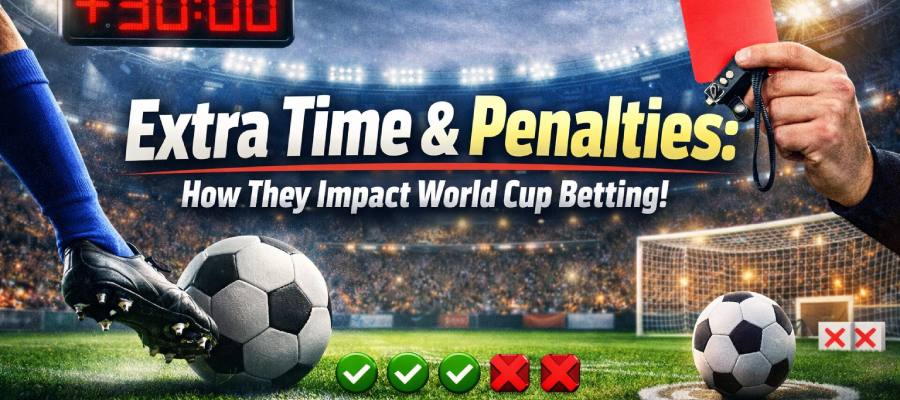
World Cup matches do not always end after 90 minutes. Once the tournament reaches the knockout rounds of the FIFA World Cup, games that finish level after regulation move into extra time and potentially a penalty shootout, a shift driven by tournament structure that is explained in this breakdown of the 48-team World Cup format.
Common question: Do penalty shootouts count for soccer bets? In most cases they only affect wagers such as team to qualify or specific penalty shootout prop bets.
Quick Answer: How Extra Time and Penalties Affect World Cup Betting
Most World Cup soccer bets are graded after 90 minutes plus stoppage time. Extra time and penalty shootouts only count for specific markets such as team to qualify, lift the trophy, and select knockout-stage prop bets.
2026 FIFA World Cup Update
With the group stage now complete, the 2026 FIFA World Cup has entered the knockout rounds, where every match must produce a winner. This is the stage when extra time, penalty shootouts, and team to qualify betting markets become part of every bettor’s decision-making process. If you’re betting on the Round of 32, Round of 16, quarterfinals, semifinals, or the Final, understanding how sportsbooks grade regulation-time bets versus qualification markets is more important than ever.
Table of Contents
- Why Sportsbooks Separate 90-Minute and Qualification Markets
- Soccer Betting 90 Minutes Rule Explained
- 💡 Extra Time & Penalty Betting — Key Takeaways
- ⏱ What Is the 90-Minute Rule in Soccer Betting?
- ⏳ When Does Extra Time Occur in the World Cup?
- Why Extra Time Awareness Matters More for the 2026 World Cup
- 📊 How Sportsbooks Grade World Cup Betting Markets and FIFA Betting Odds
- When Extra Time Is Used in the World Cup
- ⚖ 90-Minute Betting vs “To Qualify” Betting
- 90-Minute Bets vs Full Match Betting
- 🥅 How Do World Cup Extra Time Betting Markets Work?
- How Extra Time Impacts FIFA World Cup Betting Odds and Betting Lines
- 🎯 Penalty Shootout Betting Explained
- 📈 Why Extra Time Changes Betting Odds
- 🧩 How Extra Time Affects Parlays and Accumulators
- 🏆 How Penalty Shootouts Impact World Cup Futures
- ⚠ Common Mistakes Bettors Make With Extra Time Betting
- Why Tournament Soccer Produces More Extra Time Matches
- ⚽ Why World Cup Betting Differs From Domestic Soccer Betting
- 🏆 Why Extra Time Matters More in Modern World Cups
- 🔎 How to Compare World Cup Betting Markets
- Why Do Sportsbooks Offer Different Odds for the Same World Cup Match?
- ✅ Final Thoughts
Why Sportsbooks Separate 90-Minute and Qualification Markets
Sportsbooks price regulation-time bets and team to qualify markets differently because they measure different probabilities. A 90-minute market only considers what happens during regulation plus stoppage time, while qualification betting also accounts for extra time and penalty shootouts. That additional uncertainty changes implied probability, sportsbook lines, and betting odds, which is why the same World Cup match can have multiple prices depending on how the wager is settled.
Soccer Betting 90 Minutes Rule Explained
For bettors, this creates an important distinction: most soccer betting markets are graded based only on the first 90 minutes plus stoppage time. Extra time and penalties are treated as separate outcomes depending on the wager type.
📝 What Does the 90-Minute Rule Mean?
Understanding the soccer betting 90 minutes rule is essential when wagering on international tournaments. Markets like moneylines, totals, and Both Teams to Score (BTTS) typically settle after regulation, while other wagers such as “to qualify” bets include extra time and penalties.
- ✅ Match result bets usually settle after 90 minutes.
- ✅ Totals and BTTS markets are typically regulation-only wagers.
- ⏱ Extra time only applies to specific betting markets.
- 🏆 Qualification bets include extra time and penalties.
📊 Comparing Regulation vs Qualification Markets
If you compare current tournament markets on the MyBookie soccer betting odds page, you will see multiple versions of the same matchup — each priced differently depending on whether the wager covers 90 minutes or the full match including extra time.
| Betting Market | Includes Extra Time? |
|---|---|
| Match Result (1X2) | No |
| Over/Under Goals | No |
| Both Teams to Score | No |
| Double Chance | No |
| Team to Qualify | Yes |
| Tournament Futures | Yes |
⚽ Where to Compare World Cup Betting Markets
You can also review current tournament pricing, futures markets, and match lines directly on the FIFA World Cup betting odds page.
Understanding whether a market settles after regulation or includes extra time is one of the most important concepts in World Cup betting because the same match can have multiple odds based on different grading rules.
World Cup Extra Time and Penalty Rules for Betting
Understanding how sportsbooks grade extra time, penalty shootouts, and qualification markets is essential for successful World Cup betting.
📘 Key Definition
In soccer betting, most wagers settle based on the result after 90 minutes plus stoppage time. Extra time and penalty shootouts only count for specific markets such as team to qualify, lift the trophy, or penalty shootout props.
| Market | Includes Extra Time & Penalties? |
|---|---|
| Match Result (1X2) | No |
| Totals (Over/Under) | No |
| Both Teams to Score | No |
| Team to Qualify | Yes |
| Lift the Trophy | Yes |
| Penalty Shootout Props | Yes |
✅ Important Betting Takeaways
- ⏱ Most soccer bets settle after regulation time.
- 🏆 Qualification markets continue through extra time and penalties.
- ⚽ Penalty shootouts are often offered as separate prop markets.
- 📊 The same match can have multiple betting markets with different grading rules.
📖 Learn More About World Cup Betting
If you’re new to tournament wagering, our complete guide to how FIFA World Cup betting works explains group stage markets, knockout pricing, and futures betting strategies.
To understand how these grading rules connect across different markets, odds formats, and global competitions, explore our complete soccer betting guide.
💡 Extra Time & Penalty Betting — Key Takeaways
- Most soccer bets settle after 90 minutes plus stoppage time
- Extra time only applies to knockout matches
- “To Qualify” markets include extra time and penalties
- Penalty shootouts are considered separate betting markets
- Understanding grading rules prevents common betting mistakes
⏱ What Is the 90-Minute Rule in Soccer Betting?
The soccer betting 90 minutes rule means that the majority of wagers are graded using only the result after regulation time.
Important rule: In soccer betting, unless a market specifically says “to qualify,” “after extra time,” or “lift the trophy”, the wager is settled based only on the score after 90 minutes plus stoppage time.
Regulation consists of:
- Two 45-minute halves
- Added stoppage time at the end of each half
If the match is tied after this period, many bets are already settled regardless of what happens next.
What Counts as 90 Minutes in Soccer Betting?
In soccer betting, “90 minutes” includes both 45-minute halves plus all stoppage time added by the referee. Extra time periods are treated separately and only apply to certain betting markets.
For example, if a knockout match finishes 1-1 after 90 minutes:
- A Draw bet wins
- Team A or Team B moneyline bets lose Totals such as Over/Under goals markets are graded
Example scenario: If Brazil and Spain are tied 1-1 after 90 minutes, a draw bet wins, but a Brazil to qualify bet would remain active because extra time and penalties still determine which team advances.
Even if one team later wins during extra time or penalties, those outcomes do not change the result of bets graded after regulation.
This rule applies across most sportsbooks because it ensures consistency in soccer betting markets and aligns with how bookmakers price odds globally.
Sportsbooks use the 90-minute grading rule because regulation-time pricing behaves differently from full-match probability. Odds for extra time and penalties introduce additional variance, which is why bookmakers separate standard match betting from qualification and advancement markets.

Many bettors ask: Does extra time count in soccer betting? The answer depends entirely on the betting market you choose.
⏳ When Does Extra Time Occur in the World Cup?
Extra time only occurs in the knockout stages of the FIFA World Cup tournament. The group stage never uses extra time because draws are allowed during that phase.
⚽ Group Stage vs Knockout Stage
During the group stage, teams accumulate points through wins and draws, which is explained in our World Cup group stage betting guide.
| Tournament Stage | Extra Time Allowed? |
|---|---|
| Group Stage | No — draws are accepted results |
| Round of 16 | Yes — a winner must advance |
| Quarterfinals | Yes |
| Semifinals | Yes |
| Final | Yes |
🏆 Why Extra Time Starts in the Knockout Rounds
Once the tournament reaches the elimination rounds, every match must produce a winner. That requirement fundamentally changes how sportsbooks build betting markets because matches can extend beyond regulation into extra time and penalty shootouts.
📅 Why the Knockout Stage Changes Everything
| Knockout Feature | Betting Impact |
|---|---|
| Winner required | Extra time and penalties become possible. |
| No draws allowed | Qualification markets replace simple group-stage outcomes. |
| Tournament progression | Rest, scheduling, and future opponents gain importance. |
📅 Knockout Scheduling Matters
Reviewing the FIFA World Cup schedule and match calendar betting guide provides useful context for understanding knockout sequencing, rest periods, and how tournament progression influences betting markets as the competition advances.
| Scheduling Factor | Why Bettors Care |
|---|---|
| 📅 Match sequence | Determines each team’s path through the bracket. |
| 🛏 Recovery time | Can affect fatigue and squad rotation. |
| ✈ Travel demands | May influence preparation and performance. |
📊 Markets That Grow in Importance
- ✅ Qualification betting replaces simple win-or-draw thinking.
- ⏱ Extra-time and penalty scenarios become realistic outcomes.
- 🏆 Tournament advancement affects futures and outright markets.
- 📈 Sportsbooks adjust pricing as elimination pressure increases.
⚽ Betting Strategy Through the Knockout Rounds
This shift is explored in greater detail in our World Cup knockout round betting guide, which explains how sportsbooks adjust prices once every match becomes win-or-go-home.
- 🔹 Opening knockout matches: Learn how to bet the FIFA World Cup Round of 32 knockout, where qualification markets and extra-time scenarios first become part of the tournament.
- 🔹 First elimination stage: See how to bet the Round of 16 in the FIFA World Cup to understand regulation-time betting, qualification markets, and penalty-shootout strategy.
- 🔹 Later knockout rounds: Understanding how to bet the FIFA World Cup Quarter-finals helps explain why tighter matchups, stronger defenses, and increased extra-time probability create a different betting environment.
⏱ Extra Time Format Explained
When a knockout match is tied after regulation, FIFA uses a standardized extra-time format:
- ➕ Two additional 15-minute periods
- ❌ No golden goal rule
- ⇆ Teams switch sides between extra-time halves
If the score remains level after these 30 minutes, the match proceeds to a penalty shootout.
📊 Betting Impact
Extra time introduces additional uncertainty into knockout-stage betting. Sportsbooks often create specialized markets for extra-time outcomes, qualification betting, and penalty shootouts that do not exist during the group stage.
Why Extra Time Awareness Matters More for the 2026 World Cup
As the 2026 FIFA World Cup approaches, bettors are spending more time preparing for knockout-stage betting scenarios where extra time and penalty shootouts become major factors. Understanding how sportsbooks grade these markets before the tournament begins can help bettors avoid costly mistakes later in the competition.
🏆 More Knockout Matches Mean More Extra-Time Scenarios
The expanded tournament format creates more knockout matches than previous World Cups, increasing the number of situations where bettors must distinguish between regulation-time wagers and qualification markets that include extra time and penalties.
- ⏱ More elimination matches create additional extra-time opportunities.
- ✅ Qualification markets become more important later in the tournament.
- 📊 Bettors must understand how different markets are graded.
☀ Heat and Match Conditions Can Influence Betting Markets
Environmental conditions can become more relevant as the tournament progresses. In matches played under extreme heat, bettors often monitor cooling breaks and hydration stoppages because they can affect match tempo, player fatigue, substitution strategies, and expectations surrounding scoring opportunities during regulation and extra time.
| Factor | Potential Betting Impact |
|---|---|
| Extreme Heat | Higher fatigue and slower match tempo |
| Cooling Breaks | Interrupt momentum and alter game flow |
| Hydration Management | Influences player endurance in later stages |
📅 Scheduling and Recovery Become Critical
Scheduling also becomes increasingly important once the tournament enters the knockout stages. Rest periods between matches, travel demands, recovery time, and fixture congestion can all influence team performance and betting markets.
Bettors preparing for elimination-round wagering should understand how World Cup scheduling impacts betting odds because scheduling advantages may affect both qualification probability and extra-time expectations.
- ✈ Travel demands can increase fatigue.
- 🛏 Short recovery windows may impact performance.
- 📊 Fixture congestion can affect lineup decisions.
- ⚽ Fatigue often becomes more noticeable during extra time.
Scheduling and Knockout Betting
World Cup knockout matches are influenced by more than team quality alone. Recovery time, travel schedules, and match sequencing can affect fatigue levels, tactical approaches, and the likelihood of matches remaining level after regulation.
June 2026 Betting Preparation
- ⏱ Learn which markets settle after 90 minutes.
- ✅ Understand how team-to-qualify bets are graded.
- ⚽ Review extra-time and penalty shootout rules before knockout rounds begin.
- 📊 Compare regulation odds with qualification odds for the same match.
- 🏆 Recognize how tournament pressure increases extra-time probability.
Many bettors focus heavily on team strength and match predictions, but understanding settlement rules is equally important. A bettor can correctly predict which team advances and still lose a regulation-time wager if the match is tied after 90 minutes.
📊 How Sportsbooks Grade World Cup Betting Markets and FIFA Betting Odds
Sportsbooks offer multiple ways to bet the same World Cup match, and each market follows its own settlement rules. Regulation betting, qualification markets, extra-time props, and tournament futures may all produce different outcomes even though they involve the same teams.
💡 Why This Matters
- ✅ The same match can have multiple betting markets.
- ✅ Each market follows its own grading rules.
- ✅ Knowing how wagers settle helps avoid costly betting mistakes.
⚽ Common World Cup Betting Formats
Sportsbooks build these markets using standard soccer betting formats such as three-way moneylines (1X2), Asian handicaps, totals betting, and qualification markets. Each covers a different portion of the match and therefore has different settlement rules.
⏱ Which Markets Include Extra Time?
The biggest distinction is whether the wager ends after regulation or continues through extra time and penalty shootouts.
| Market | Includes Extra Time? |
|---|---|
| Moneyline (3-way) | ❌ No — 90 minutes only |
| Totals (Over/Under) | ❌ No — 90 minutes only |
| Both Teams to Score | ❌ No — 90 minutes only |
| Double Chance | ❌ No — 90 minutes only |
| Team to Qualify | ✅ Yes — includes extra time & penalties |
| Lift the Trophy | ✅ Yes — full tournament outcome |
📈 Why Qualification Odds Are Different
Because qualification markets include extra time and penalty shootouts, sportsbooks assign them different probabilities than regulation-only wagers.
- ⚽ Elite defensive matchups often increase the likelihood of extra time.
- ⏱ Low-scoring expectations can shorten qualification prices relative to standard match odds.
- 🏆 Teams with strong penalty-shootout records may be more likely to advance even when regulation odds are nearly even.
When Extra Time Is Used in the World Cup
Round of 16
First knockout round where tied matches go to extra time.
Quarterfinals
Higher stakes often lead to defensive matches and extra time.
Semifinals
Teams frequently play conservatively due to the importance of reaching the final.
World Cup Final
If tied after regulation, the final also proceeds to extra time and penalties.
Extra time is only used in knockout matches where a winner must be determined.
⚖ 90-Minute Betting vs “To Qualify” Betting
One of the most misunderstood concepts in soccer wagering is the difference between 90-minute betting markets (regulation-time betting) and qualification betting.
90-Minute Markets
These wagers settle after regulation time.
Examples:
- Match result (Team A / Draw / Team B)
- Over/Under goals
- Both Teams to Score
- Asian handicap markets
If the match goes to extra time, these bets are already finalized.
Team to Qualify Markets
These bets cover the full match outcome including extra time and penalties, including:
- Extra time
- Penalty shootouts
For example:
If France and Argentina are tied 2-2 after regulation but France wins on penalties, a France to qualify bet wins even though the match result market settled as a draw.
🚫 Common Bettor Confusion Example
A bettor can correctly predict which team advances and still lose a standard moneyline wager. If a team wins after penalties but the match was tied after 90 minutes, regulation-time bets are still graded as a draw.
This market structure is common across all major soccer tournaments.
90-Minute Bets vs Full Match Betting
| Bet Type | Ends After 90 Minutes? | Includes Extra Time? |
|---|---|---|
| Match Result (1X2) | Yes | No |
| Over / Under Goals | Yes | No |
| Both Teams to Score | Yes | No |
| Asian Handicap | Yes | No |
| Team to Qualify | No | Yes |
| Win Tournament | No | Yes |
Always verify whether a bet is graded after regulation time or includes extra time and penalties.
🥅 How Do World Cup Extra Time Betting Markets Work?
Knockout matches introduce betting markets that are unavailable during the group stage. Because every elimination match must produce a winner, sportsbooks offer additional markets covering extra time, penalty shootouts, and tournament advancement.
⚽ Which Markets Become Available in the Knockout Stage?
Unlike regulation betting, these markets account for what happens after the initial 90 minutes if the match remains tied.
| Market | What It Covers |
|---|---|
| Match Result (90 Minutes) | Score after regulation plus stoppage time. |
| Team to Qualify | Includes extra time and penalty shootouts. |
| Penalty Shootout Props | Specific outcomes related to the shootout. |
| Tournament Futures | Advancement through the knockout bracket. |
📊 What Do Sportsbooks Consider When Pricing These Markets?
Sportsbooks adjust knockout betting lines using more than overall team strength. They also evaluate match conditions that increase or decrease the likelihood of extra time.
- ✅ Defensive organization and expected scoring.
- ✅ Tournament pressure and elimination stakes.
- ✅ Squad depth and substitution options.
- ✅ Fatigue, recovery, and fixture congestion.
- ✅ Overall matchup parity between both teams.
💡 Why Are Extra Time Markets Different?
These markets answer different betting questions than a traditional moneyline. Instead of focusing only on who wins in regulation, bettors can evaluate whether a match is likely to reach extra time, whether penalties become a realistic outcome, or which team has the better chance of advancing regardless of when the winning goal is scored.
🎯 Why Bettors Watch Extra Time Markets
- ➤ Identify matches with a higher probability of extra time.
- ➤ Compare regulation odds with qualification markets.
- ➤ Understand how knockout pressure changes tactics.
- ➤ Find opportunities beyond standard moneyline betting.
- ➤ Evaluate probability instead of relying only on team reputation.
How Extra Time Impacts FIFA World Cup Betting Odds and Betting Lines
Knockout matches are priced differently because sportsbooks must estimate not only which team is stronger, but also the likelihood that the match remains level after 90 minutes and continues into extra time or a penalty shootout.
📊 Why Do Extra Time Expectations Change Betting Odds?
When sportsbooks expect a closely contested match, they adjust multiple betting markets instead of relying only on the favorite’s strength. Matches with balanced teams, disciplined defenses, or conservative tactical approaches often receive pricing that reflects a greater chance of requiring extra time.
- ✅ Lower draw odds usually indicate a higher probability of extra time.
- ✅ Defensive matchups often create tighter betting lines.
- ✅ Tournament pressure encourages more cautious play.
- ✅ Qualification markets are priced separately from regulation markets.
📄 Regulation Odds vs Qualification Odds
| Market | What It Prices |
|---|---|
| 90-Minute Match Result | Only the score after regulation plus stoppage time. |
| Team to Qualify | Includes extra time and penalty shootouts. |
| Tournament Futures | Advancement through every knockout round. |
Because these markets measure different outcomes, sportsbooks assign different implied probabilities and betting odds—even though they involve the same World Cup match.
💡 Reading World Cup Betting Lines
- ➤ Lower draw odds generally suggest a greater chance of extra time.
- ➤ Qualification odds always include extra time and penalties.
- ➤ Regulation markets settle after 90 minutes plus stoppage time.
- ➤ Tight defensive matchups often shorten draw prices.
- ➤ Knockout pressure can increase the probability of extra time.
⏱ When Do Extra-Time Markets Become Available?
Most extra-time betting markets only appear once the FIFA World Cup enters the knockout stage. Because every elimination match must produce a winner, sportsbooks expand their offerings to include qualification betting, extra-time props, and penalty-shootout markets.
🏆 Knockout Rounds That Use Extra Time
| Tournament Stage | Extra Time Available? | Additional Betting Markets |
|---|---|---|
| Round of 32 | ✅ Yes | Qualification and penalty markets |
| Round of 16 | ✅ Yes | Extra-time props and team-to-qualify bets |
| Quarterfinals | ✅ Yes | Expanded knockout betting options |
| Semifinals | ✅ Yes | Higher emphasis on qualification odds |
| World Cup Final | ✅ Yes | Full range of championship markets |
📊 Why These Markets Matter More Later in the Tournament
As the competition narrows, tactical caution and elimination pressure can increase the probability of extra time and penalty shootouts. Sportsbooks respond by adjusting qualification prices and introducing additional betting options.
- ⏱ Matches become more conservative as the stakes increase.
- 🎯 Qualification odds begin to diverge from regulation markets.
- ⚽ Penalty-shootout scenarios become more relevant.
- 📈 Squad depth and fatigue play a larger role.
🏅 Betting the Final Stages of the Tournament
Bettors preparing for those matchups should understand how to bet FIFA World Cup semi-finals, since qualification markets and penalty scenarios often play a larger role than during earlier knockout rounds.
Similar considerations also apply when betting on the tournament’s final consolation match. Learning how to bet the FIFA World Cup third-place match can help bettors evaluate how squad rotation, player motivation, and extra-time rules influence sportsbook pricing.
Bettors looking ahead to the championship match should also understand how to bet the FIFA World Cup Final, where extra-time rules, penalty shootouts, and the pressure of a winner-take-all match can create betting dynamics that differ from earlier knockout rounds.
🎥 How Can VAR Affect Knockout Betting?
Video review can reshape knockout betting markets within seconds. A reviewed penalty, disallowed goal, or late red card may significantly increase the chances of extra time while causing qualification odds to move immediately.
To better understand these situations, see how VAR can influence extra-time events in World Cup matches.
🎯 Penalty Shootout Betting Explained
If the match remains tied after extra time, the winner is determined through a penalty shootout.
Penalty shootout markets are considered separate betting options.
Common markets include:
- Will the match go to penalties?
- Team to win on penalties
- Total penalties scored
- First penalty taker
Because penalty shootouts involve high randomness, sportsbooks often treat these wagers as higher-variance props.
Factors bettors sometimes consider include:
- Goalkeeper save percentages
- Historical penalty conversion rates
- Team experience in shootouts
However, the sample size for penalty data in international tournaments is relatively small, which increases unpredictability.
Even elite national teams can lose penalty shootouts despite controlling possession, shots, or expected goals during regulation. Because shootouts involve a limited number of attempts under extreme pressure, sportsbooks typically price these markets with elevated volatility.
📈 Why Extra Time Changes Betting Odds
When a match approaches the end of regulation time with the score level, sportsbooks rapidly adjust odds.
Odds calculator: Convert soccer betting odds into implied probability and potential payout to understand how sportsbooks price matches.
Soccer Odds and Payout Calculator
Convert betting odds into implied probability and potential payout. This helps bettors understand how sportsbooks price World Cup betting markets.
Implied Probability: —
Total Payout: —
Profit: —
From a probability perspective, sportsbooks recalculate the likelihood of extra time, sudden goals, or penalties as regulation time approaches, which is why live betting odds can change rapidly in the final minutes. Understanding how these price adjustments occur is closely related to the concept of closing line value in soccer betting, which measures whether bettors secured better odds than the final market price.
Several dynamics influence pricing:
Match events such as cards can significantly impact these shifts — yellow and red cards can rapidly alter team strength, tempo, and live betting odds during World Cup matches, while also influencing player prop markets tied to bookings and disciplinary actions.
- Fatigue levels
- Substitution availability
- Defensive strategy adjustments
- Probability of penalties
Live betting markets may include options such as:
- Next team to score
- Goal in extra time
- Penalty shootout occurrence
- Qualification odds after extra time begins
During critical moments such as penalties, VAR reviews, or the start of extra time, sportsbooks may temporarily suspend live betting markets while recalculating probability and exposure.
Because the remaining time window is shorter, odds can shift quickly during these moments.
⚠ Live Betting Warning
During knockout matches, live sportsbooks may display both regulation-only markets and full-match qualification odds simultaneously. Bettors should always verify whether a live wager settles after 90 minutes or includes extra time and penalties.
Extra time calculator: Estimate the probability that a knockout match goes to extra time using draw odds.
Extra Time Probability Calculator
Estimate the probability that a World Cup knockout match goes to extra time based on the draw odds after 90 minutes.
Probability Match Goes To Extra Time: —
Potential Draw Profit: —
🧩 How Extra Time Affects Parlays and Accumulators
Extra time grading rules also affect parlays, accumulators, and same-game combinations. If a bettor includes a regulation-time market in a parlay, that selection settles after 90 minutes regardless of what happens during extra time or penalties.
This becomes especially important during knockout matches where bettors may accidentally combine regulation bets with qualification markets that follow different settlement rules.
Before placing multi-leg wagers, bettors should verify whether each selection applies to regulation only or the full match outcome.
🏆 How Penalty Shootouts Impact World Cup Futures
Penalty shootouts can dramatically influence long-term betting markets such as World Cup futures bets, including tournament winner and final appearance markets.
- World Cup winner futures
- To reach the final
- To win the tournament
A single shootout victory can eliminate or advance a team regardless of overall performance in regulation play.
Advancement also affects individual player markets because additional knockout matches create more scoring opportunities. Bettors evaluating top-scorer futures should understand how tournament progression influences World Cup Golden Boot betting odds, especially when comparing players from teams expected to make deep runs in the competition.
This introduces additional volatility into futures markets during knockout rounds.
Teams known for disciplined defensive play often reach shootouts more frequently, which can indirectly affect futures odds.
⚠ Common Mistakes Bettors Make With Extra Time Betting
Many casual bettors misunderstand how sportsbooks settle wagers when matches extend beyond regulation.
The most frequent mistakes include:
- Assuming extra time counts for standard match bets
- Confusing “to qualify” markets with match result wagers
- Overestimating the predictability of penalty shootouts
- Ignoring the 90-minute grading rule
Understanding the difference between these markets helps bettors avoid costly errors when wagering on major tournaments.
Comparing Online World Cup Betting Markets Correctly
Whether placing wagers through a traditional sportsbook or using modern online World Cup betting platforms, bettors should always verify which time frame a market covers before making a selection.
Many newer bettors assume that every World Cup wager automatically includes extra time and penalties. In reality, most online FIFA World Cup betting markets settle after regulation, while qualification and tournament futures markets continue through knockout resolution.
Understanding this distinction helps bettors compare pricing more accurately, identify value opportunities, and avoid situations where they correctly predict the advancing team but still lose a regulation-time wager.
Why Tournament Soccer Produces More Extra Time Matches
International tournaments often produce tighter matches compared to domestic leagues.
Several factors contribute to this:
- Teams prioritize defensive structure
- High stakes encourage conservative tactics
- Evenly matched national teams reduce scoring variance
- Lower expected goals (xG) environments increase draw probability
Because of these conditions, knockout matches frequently remain close throughout regulation.
This makes World Cup extra time betting an important concept for bettors analyzing tournament markets.
Extra Time Frequency in World Cup Knockout Matches
⚽ Why World Cup Betting Differs From Domestic Soccer Betting
Unlike domestic league matches where draws are acceptable results, World Cup knockout matches require a team to advance. This creates additional betting layers involving extra time, penalty shootouts, and qualification markets that do not exist in most regular-season soccer fixtures.
Because of this structure, bettors must evaluate both regulation-time probability and full-match advancement probability separately during tournament play.
🏆 Why Extra Time Matters More in Modern World Cups
Modern World Cup knockout matches have become increasingly tactical, especially when elite national teams face opponents of similar quality. As defensive organization, positional discipline, and game management continue to improve, sportsbooks must account for a greater probability of matches remaining level after 90 minutes.
⚽ Why Knockout Matches Are More Cautious
Unlike league soccer, knockout matches create a completely different risk environment. A single mistake can eliminate a team from the tournament, encouraging more conservative tactics throughout regulation.
- 🔒 Defensive organization often takes priority over attacking risk.
- ⏱ Coaches manage the game with extra time in mind.
- 🏆 Elimination pressure discourages unnecessary risks.
- 🔄 Substitutions are frequently used to preserve energy for possible extra time.
📊 Why Extra Time Becomes More Likely
- 🔒 Elite teams often prioritize defensive structure.
- ⏱ Tournament pressure encourages conservative decision-making.
- ⚽ Evenly matched opponents create tighter probability distributions.
- 🏆 Elimination stakes increase caution during late-match situations.
- 📈 Sportsbooks adjust draw and qualification pricing accordingly.
📈 Why Betting Markets Change
These tactical adjustments directly affect how sportsbooks price knockout matches. Regulation-time betting, qualification markets, draw odds, and extra-time props all respond differently once elimination pressure becomes the dominant factor.
| Market | Primary Focus |
|---|---|
| Regulation betting | ⏱ Score after 90 minutes. |
| Team to qualify | ✅ Includes extra time and penalties. |
| Draw market | 📊 Reflects the likelihood of extra time. |
💡 Tournament Structure Shapes the Odds
Qualification betting behaves differently because it measures advancement rather than the regulation result. As the tournament progresses, bracket position, elimination scenarios, and potential extra time all become part of the pricing model.
For a deeper explanation of how these factors influence sportsbook pricing throughout the competition, see how tournament structure changes FIFA World Cup odds.
🔎 How to Compare World Cup Betting Markets
One of the biggest mistakes in World Cup betting is assuming every market is priced and graded the same way. In reality, sportsbooks often offer multiple versions of the same matchup, each built around a different outcome, settlement rule, or time frame.
A team may be favored to qualify but not favored to win in regulation. Likewise, draw odds, extra-time props, and qualification markets can all tell a different story about how sportsbooks expect a knockout match to unfold. Understanding these differences helps bettors compare prices more accurately and avoid betting the right team in the wrong market.
💡 Betting Tip
If you expect a knockout match to remain tight late into regulation, comparing draw odds with “to qualify” pricing can help identify whether sportsbooks expect extra time or penalties to play a major role in the outcome.
Before placing a wager, bettors should verify whether the market applies to:
Although most major sportsbooks follow standard soccer grading rules, settlement wording and market labels can vary slightly between operators. Reviewing official sportsbook house rules before betting knockout matches helps avoid confusion.
- 90 minutes only
- Full match including extra time
- Qualification outcome
These distinctions can change the implied probability and pricing of a wager.
Reviewing the available markets on the MyBookie soccer betting odds page allows bettors to see how sportsbooks price each option.
Different betting formats exist for the same match depending on how the wager is structured.
Why Do Sportsbooks Offer Different Odds for the Same World Cup Match?
Many bettors notice that the same FIFA World Cup match can have different betting odds depending on the market selected. This happens because sportsbooks price separate outcomes rather than a single result.
For example, a Match Result (90 Minutes) market only evaluates the score after regulation plus stoppage time, while a Team to Qualify market includes extra time and penalty shootouts. Since those markets cover different events, they require different probability models and therefore different sportsbook lines.
Understanding this distinction helps bettors compare odds correctly, interpret market movement, and avoid confusing regulation wagers with knockout advancement bets.
Compare World Cup Betting Markets
View live odds, knockout match prices, and tournament futures to see how sportsbooks price extra time and qualification markets.
View Soccer Betting OddsWorld Cup Extra Time Betting FAQs
Does extra time count in soccer betting?
In most soccer betting markets, wagers are settled after the first 90 minutes plus stoppage time. Extra time only counts for specific bets such as team to qualify, tournament winner futures, or special extra time prop bets.
Will extra time be more important in the 2026 World Cup?
Yes. Because the expanded tournament creates a larger knockout bracket, bettors will encounter more matches where extra time and penalty shootouts can influence qualification and futures betting markets.
Do penalty shootouts count for soccer bets?
Penalty shootouts usually do not affect standard match bets like moneyline, totals, or Both Teams to Score. Shootouts only determine the winner for markets such as team to qualify or lift the trophy.
What happens if a World Cup match goes to extra time?
If a knockout match is tied after 90 minutes, the game moves to two 15-minute extra time periods. If the score remains tied after extra time, the match is decided by a penalty shootout.
What does “team to qualify” mean in soccer betting?
A team to qualify bet means wagering on which team advances to the next round of the tournament. This market includes extra time and penalty shootouts when determining the winner.
Why are draw odds important in knockout soccer betting?
Draw odds reflect the probability that a match will be tied after 90 minutes. In knockout tournaments like the World Cup, a draw after regulation means the match proceeds to extra time and possibly penalties.
Does stoppage time count in soccer betting?
Yes. Standard soccer betting markets include all stoppage time added at the end of each 45-minute half. Only extra time periods played after regulation are excluded from most wagers.
Why do FIFA World Cup betting odds differ between regulation and qualification markets?
Regulation markets settle after 90 minutes plus stoppage time, while qualification markets include extra time and penalty shootouts. Because they measure different outcomes, sportsbooks create separate FIFA World Cup betting odds and betting lines for each market.
2026 FIFA World Cup Match Calendar
Track every stage of the tournament, monitor scheduling spots, and prepare for group-stage, knockout-round, and futures betting opportunities throughout the 2026 FIFA World Cup.
Use the full tournament calendar to track match flow, betting momentum, and market movement across every stage of the World Cup.
Quick Betting Rule Summary
- Most soccer bets settle after 90 minutes plus stoppage time.
- Extra time only counts for qualification and tournament outcome markets.
- Penalty shootouts determine which team advances but do not change 90-minute match bets.
✅ Final Thoughts
Extra time and penalty shootouts are defining moments in knockout tournament soccer, but they do not apply to every betting market.
The key rule to remember is that most soccer bets are graded after 90 minutes plus stoppage time. Only specific wagers — such as team to qualify or certain prop bets — include extra time and penalties.
Understanding these grading rules is essential for navigating World Cup extra time betting, evaluating penalty shootout markets, and avoiding confusion when matches extend beyond regulation.
Many costly World Cup betting mistakes casual bettors make happen because bettors misunderstand how sportsbooks grade matches that go beyond 90 minutes.
If you want to see how sportsbooks currently price knockout matches, compare live markets and tournament odds on the MyBookie soccer betting page.
Understanding how these markets work is one of the most important steps toward making more informed soccer wagers.
MyBookie: Bet On Anything. Anywhere. Anytime.
Important: Sports betting involves risk. No strategy guarantees results, and managing exposure is essential.

About the Author

Henry Watkins is a Sports Writer at MyBookie. Originally from Scotland and currently residing in Metro Atlanta with his wife, Penny, Henry covers competitive and professional sports as well as the business of sports. In addition to his sports writing, he is an author of horror fiction, including Karaoke Night, Crueller, and Off The Grid.
Sportsbook Bonuses
Read requirements in the Bonus page. However, if you want to take a deep knowledge, go to MyBookie Bonus Rules and How to


🔍 Explore Everything you Need to Know aboout your Licensed, Trusted Home For Casino and Sports Since 2014
👉 Gamble responsibly—must be 21+ and in a Legal Jurisdiction | Get Help at 1-800-Gambler