English



Last updated: October 2026
If you are wondering what ATS means in college football betting, ATS stands for Against the Spread. An ATS bet is graded by whether your selected team covers the sportsbook’s posted point spread, not simply by whether it wins the game.
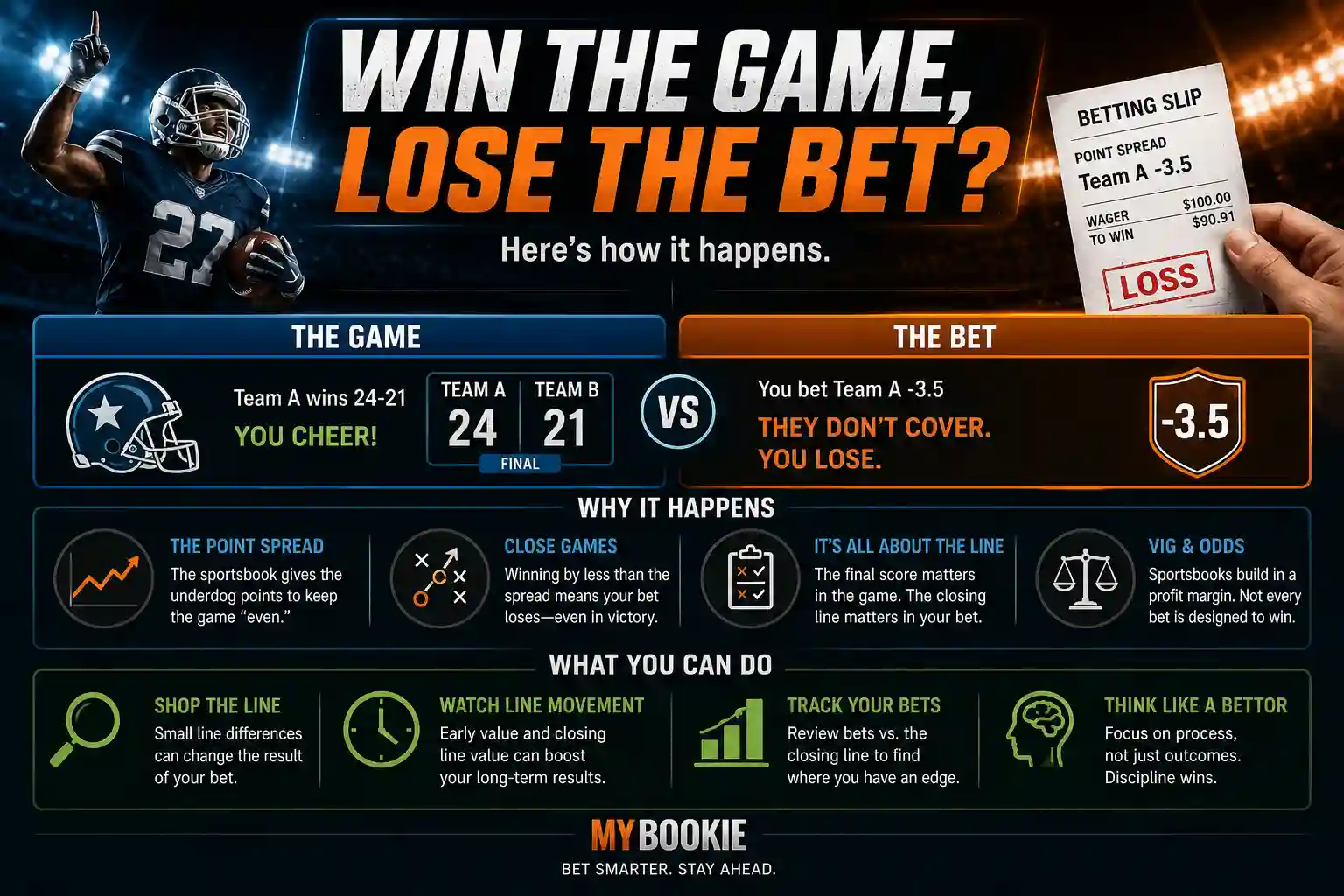
A favorite can win but fail to cover if it does not win by enough points. An underdog can lose but cover by staying within the spread or winning outright.
Quick Answer: What Does ATS Mean in College Football Betting?
ATS means Against the Spread. A favorite with a -6.5 spread must win by at least 7 points to cover. An underdog at +6.5 covers by winning outright or losing by 6 points or fewer. A whole-number spread can result in a push if the final margin matches the spread exactly, subject to the sportsbook’s rules.
What Does ATS Mean in College Football Betting?
The ATS meaning in college football is Against the Spread. The spread gives the favorite a negative handicap and the underdog a positive handicap for grading purposes. Your selection wins when it covers the posted college football point spread.
Consider this example:
State A -6.5 (-110) vs. State B +6.5 (-110)
State A is the favorite. If you wager on State A -6.5, it must win by 7 or more points to cover. State B is the underdog. A wager on State B +6.5 covers if State B wins outright or loses by 6 points or fewer. The actual margin of victory determines the ATS result.
The spread is a market price for the matchup and often functions as an estimate of the expected scoring margin. It is not a guaranteed score prediction. Sportsbooks can move the number in response to new information, market participation, price discovery, and risk exposure.
That distinction is the foundation of ATS betting: first identify the spread, then determine what margin your selection needs to cover. From there, the price, line movement, and matchup determine whether the available number is worth evaluating.
| Final Score | Game Margin | State A -6.5 | State B +6.5 |
|---|---|---|---|
| State A 31, State B 24 | State A by 7 | ATS win | ATS loss |
| State A 28, State B 24 | State A by 4 | ATS loss | ATS win |
| State B 24, State A 21 | State B by 3 | ATS loss | ATS win |
Quick Answers
Does ATS mean a team won the game? No. ATS describes how a team performed relative to the spread, so the straight-up and ATS results can be different.
Is ATS the same as betting the underdog? No. You can make an ATS wager on either the favorite or the underdog.
How Do You Determine Whether a College Football Team Covered the Spread?
A simple way to grade a spread bet is to add the team’s spread to its final score, then compare the adjusted score with the opponent’s score:
Adjusted score = Team’s final score + Team’s point spread
Using State A -6.5 in a 31-24 win, the adjusted score is 31 – 6.5 = 24.5. Because 24.5 is higher than State B’s 24, State A covers. State B +6.5 would have an adjusted score of 30.5, which is lower than State A’s 31, so State B fails to cover.
Use the calculator below to check an example, or use MyBookie’s betting odds calculator when you need to convert American, decimal, or fractional betting odds.
College Football ATS Result Calculator
Enter the favorite’s final score, the underdog’s final score, and the favorite’s negative spread. The tool identifies which side covered or whether the result pushed.
How Do Favorites and Underdogs Cover the Spread?
When you back the favorite, you are laying the points. When you back the underdog, you are taking the points. The minus sign identifies the favorite’s handicap, while the plus sign identifies the underdog’s advantage for grading.
Suppose State A is -17.5 against State B +17.5:
- If State A wins 31-10, its 21-point margin covers -17.5.
- If State A wins 28-17, its 11-point margin does not cover -17.5, so State B +17.5 covers.
- If State B wins outright, State B +17.5 also covers.
This is why understanding how ATS betting works matters before entering the spread market. The favorite being more likely to win straight up does not automatically make the favorite the better spread selection.
What Happens When an ATS Bet Wins, Loses, or Pushes?
An ATS win occurs when your selection covers the point spread on your accepted ticket. An ATS loss occurs when it fails to cover. A push can occur when a whole-number spread matches the final margin exactly.
For example, if State A is -7 and wins 27-20, the margin is exactly 7. The adjusted result is tied, so the wager normally pushes and the original stake is returned according to the sportsbook’s betting rules. A half-point such as -7.5 is often called the hook; it removes the possibility of a push on that number.
State A -7: Three Possible ATS Results
What Does a College Football ATS Record Mean?
A college football ATS record shows how often a team covered, failed to cover, or pushed against the posted spread during the selected period. A record of 7-3-1 ATS means the team covered seven times, failed to cover three times, and pushed once.
The ATS record is separate from the team’s straight-up win-loss record. A team can finish 10-2 straight up and still post a losing record against the spread if the market repeatedly required it to win by large margins.
| ATS Result | Count | Meaning |
|---|---|---|
| ATS wins | 7 | The team covered the posted spread seven times. |
| ATS losses | 3 | The team failed to cover three times. |
| Pushes | 1 | The adjusted result landed exactly on the spread once. |
When pushes are excluded, the ATS cover percentage is usually calculated as covers divided by covers plus losses. In this example, 7 / (7 + 3) = 70%. Confirm the data provider’s convention before comparing ATS standings or statistics.
You may also see ATS plus/minus, which generally measures how far a team finished above or below the spread. Definitions can vary by provider, especially regarding whether opening or closing spreads are used. Historical ATS performance can describe what happened, but it does not prove what will happen next.
How Is ATS Different From Straight-Up, Moneyline, and Over/Under Betting?
ATS vs. straight-up college football results can diverge because the two wagers answer different questions. A moneyline asks who wins. A spread asks whether the selected team beats the posted handicap. An Over/Under asks whether the combined score finishes above or below a total. College football also offers markets focused on individual player performance, such as college football player props, which use different winning conditions from ATS wagers. If you want to understand how multiple college football selections can be combined into one wager, see this guide to how college football parlays work.
| Market | What You Are Predicting | Example Winning Condition |
|---|---|---|
| ATS / Point spread | Performance relative to a handicap | State A -6.5 wins by 7 or more |
| Moneyline / Straight up | The outright winner | State A wins by any margin |
| Over/Under | The combined points scored | State A and State B combine for more than 55.5 points |
Imagine a 10-point favorite wins 27-21. A moneyline wager on the favorite wins because the team won the game. A spread wager on the favorite -10 loses because the six-point victory did not cover. A spread wager on the underdog +10 wins. Another market focuses on how many points one team scores rather than the margin between both teams; see college football team totals for that distinction.
How Do You Read College Football Sportsbook Lines and -110 Betting Odds?
A college football betting line may appear as State A -6.5 (-110). The two numbers serve different purposes, and understanding both is essential when reading college football odds:
- -6.5 is the point spread and determines the margin State A must cover.
- -110 is the American odds price and determines the risk-to-profit relationship.
At -110, a $110 winning stake produces $100 in profit and returns the $110 stake, for a total return of $210. The break-even win rate associated with -110 is approximately 52.38%: 110 / (110 + 100).
That 52.38% is the break-even rate for one -110 price, not proof that the selection has a 52.38% true chance of covering. If both sides are listed at -110, their raw implied probabilities total about 104.76%. That excess is the market’s overround; the sportsbook’s realized hold depends on actual wagers and results.
Understanding that distinction makes college football betting lines easier to read: the spread tells you what must happen for the wager to cover, while the attached odds tell you the price you are paying for that outcome. Both can change as the market develops.
Why Do College Football Point Spreads Move?
The college football point spread at kickoff may differ from the opening number. Sportsbook lines can move because of quarterback news, injuries, suspensions, weather, roster availability, venue information, limits, influential wagers, broader betting activity, or a market-wide reassessment of the matchup. The college football line movement timeline explains how those adjustments can develop between the opening number and kickoff.
What Causes a College Football Betting Line to Move?
Key Line-Movement Factors
⚿ Player News:
Quarterback changes, injuries, suspensions, and roster availability can alter the expected margin.
☁ Weather:
Wind, rain, heat, and other conditions can influence scoring, pace, and execution.
📈 Betting Activity:
Influential wagers, market participation, limits, and broader betting activity can contribute to movement.
⚙ Market Reassessment:
New information can cause the market to adjust its expected scoring margin.
How Does Line Movement Affect an ATS Bet?
For example, a line may move from -6.5 to -7.5, crossing the key number 7. A seven-point win covers -6.5 but fails to cover -7.5. The number on an accepted ticket normally remains in place after the market moves, unless the wager is voided under an applicable rule.
Visual Model: Why Half a Point Can Matter
What Is Closing Line Value?
That difference is why bettors track closing line value (CLV). If you bet State A -6.5 and the market closes State A -7.5 at a comparable price, you captured a better spread than the closing number. CLV measures the quality of the line or price captured; it does not guarantee that one wager will win.
Live markets can also be affected by game delays. Football rules indicate that during delays such as rain or darkness, markets remain unsettled and trading can continue when the game resumes. This is another reason to check the applicable market conditions rather than assuming every live wager follows the same settlement window.
Live betting also depends on accurate game information. The rules allow for betting to be voided in certain circumstances when an incorrect score has a significant impact on the offered prices. That makes checking the displayed score and accepted ticket particularly important for live wagers.
Why Do Key Numbers Matter in College Football ATS Betting?
Key numbers are common final margins created by football scoring patterns. Numbers such as 3 and 7 receive particular attention because field goals and touchdowns frequently shape final margins. Other numbers, including 10 and 14, can also matter.
What Makes a Number a Key Number?
| Number | Why It Can Matter |
|---|---|
| 3 | A common margin because of field-goal scoring. |
| 7 | A frequent margin because touchdowns and extra points can create a seven-point difference. |
| 10 | Can appear through combinations of touchdowns and field goals. |
| 14 | Can develop from two-touchdown margins and other scoring combinations. |
Why Does -6.5 vs. -7.5 Matter?
College football has wider scoring distributions than professional football, so the practical value of any key number depends on the teams, total, pace, and market. Even so, crossing from -6.5 to -7.5 changes how a seven-point result is graded.
Key Insight
▲ Better Spread:
Getting -6.5 instead of -7.5 gives the favorite an extra half-point of protection.
$ Price Matters:
Buying or selling points changes the odds price, so the added protection comes with an additional cost.
When comparing different numbers, consider both the spread and the attached odds rather than assuming every half-point has the same value.
Use a betting odds calculator when you need to compare American, decimal, or fractional odds and understand how the price affects the wager.
Does Overtime Count in College Football ATS Betting?
For standard full-game college football spreads, overtime generally counts unless the market wording or applicable rules state otherwise. A game tied after regulation can therefore produce an ATS win or loss based on the overtime score.
Check the market description before betting. MyBookie’s football rules indicate that markets including overtime are identified as (Incl overtime). If the market does not carry that designation, the applicable rules determine whether the wager is graded on regulation time only.
Overtime Check
✓ Full-Game ATS:
Football rules indicate that full-game handicap markets include overtime.
⚠ Check the Market:
Other betting markets can have different grading windows, so review the market description before placing the wager.
How Does Overtime Affect Different Betting Markets?
| Market | Grading Window | Overtime |
|---|---|---|
| Full-game ATS | Entire game | Includes overtime when the market is designated accordingly. |
| 1st-half betting | Quarters 1 & 2 | Does not include overtime. |
| 2nd-half betting | Quarters 3 & 4 | Can include overtime under the applicable market rules. |
| Quarter betting | Specified quarter | Generally excludes overtime, but check the market description. |
Market completion also matters. Football rules state that a quarter must be completed for quarter wagers to stand, while the applicable half must be completed for half-market wagers to stand. This is separate from whether overtime is included.
Why Should You Check the Market Rules?
Different markets can follow different grading windows. First-half and quarter bets, for example, may exclude overtime, while other markets may include it. Before placing a wager, review the applicable MyBookie betting rules to understand how the selected market is settled.
Quick Check Before Betting
✓ Full game: Confirm whether overtime is included.
✓ Derivative market: Check the exact grading period.
✓ Accepted ticket: Verify the market, spread, price, and settlement conditions.
Why Should You Check the Market Rules?
Always check the listed market and MyBookie’s sportsbook and wagering rules before placing a wager.
Once you can identify the spread, price, grading window, and potential line movement, you have the information needed to read an ATS market correctly before deciding whether to place a wager.
How Do You Bet ATS in College Football?
Once you understand the market, placing a college football ATS wager follows a short process:
- Open the college football sportsbook and choose a matchup.
- Locate the point spread rather than the moneyline or game total.
- Identify the favorite by the minus sign and the underdog by the plus sign.
- Review both the spread and its attached betting odds, then select a side.
- Enter the stake, review the accepted line and price on the bet slip, and submit only if the terms match your intended wager.
Where Can You Learn More About College Football Betting?
If you want to build your understanding of college football betting terminology, odds, and markets, visit the MyBookie Betting Academy for additional educational resources before exploring different wager types.
For the complete market and bet-slip process, see MyBookie’s guide on how to bet on college football. You can then review the available college football odds and lines before selecting an ATS market. The same grading rules apply whether you use conventional online betting funds, Bitcoin betting, crypto betting, or another accepted deposit method.
Which Factors Matter Most When Evaluating College Football Against the Spread?
College football creates specific challenges because teams can vary sharply in pace, talent, depth, coaching, schedule strength, and late-game behavior. A useful ATS analysis connects the matchup to the current number instead of asking only which team is better.
| Factor | Why It Can Affect the Spread |
|---|---|
| Quarterback and roster availability | A change at a high-impact position can alter efficiency, play calling, and the market’s expected margin. |
| Pace and play volume | More possessions can create more scoring opportunities and a wider range of possible margins. |
| Explosiveness and finishing drives | Teams that create big plays or convert scoring chances may separate more quickly than raw yardage suggests. |
| Opponent and schedule strength | Statistics produced against weak competition may not translate to a stronger matchup. |
| Home, road, travel, and venue | Environment, altitude, surface, travel, and crowd conditions can affect preparation and execution. |
| Coaching and game state | Fourth-down decisions, tempo changes, substitutions, and late-game strategy can influence the final margin. |
| Weather | Wind, rain, heat, or cold can affect passing, kicking, ball security, pace, and scoring variance. |
If you are wondering why this matters, it is because an ATS opinion is incomplete until it is compared with the current number and price.
How Should You Use College Football ATS Records and Betting Trends?
ATS records and college football betting trends can provide context, but they need a clear sample, timeframe, and opponent profile. A 7-3 ATS run may reflect strong performance, favorable closing numbers, an easier schedule, market underreaction, or ordinary short-term variance.
Before using a trend, ask:
- Was the record measured against opening or closing spreads?
- Does the sample involve the current coach, quarterback, and roster?
- Were the opponents and game locations comparable?
- Is the sample large enough to be meaningful?
- Has the current sportsbook line already adjusted for the trend?
From a betting perspective, experienced bettors treat historical ATS performance as one input, then compare matchup information with the available line and price. A trend is evidence about the past, not a reason by itself to wager.
What Is a Good ATS Record in College Football?
There is no universal cutoff because profitability depends on the odds paid, the treatment of pushes, and the sample size. At a standard -110 price, a bettor needs to win more than approximately 52.38% of decided wagers to move above the mathematical break-even point before considering any other costs.
A team with a 55% ATS cover rate may look strong, but a small sample can be noisy and may not predict future performance. A better question is whether the current line underprices the team’s chance of covering after accounting for the matchup and the price.
How Do Alternate Spreads Change an ATS Bet?
An alternate spread lets you choose a different handicap from the main line in exchange for a different odds price. Moving an underdog from +6.5 to +10.5 provides more points but normally requires a less favorable price. Moving the same team to +3.5 provides fewer points but may offer a larger potential return.
Alternate spreads do not eliminate risk. Compare the new winning condition, the new price, and your estimated probability before deciding whether the tradeoff improves the wager.
What Mistakes Should You Avoid When Betting College Football ATS?
- Confusing a game winner with an ATS winner: A favorite can win outright and still fail to cover.
- Ignoring the odds price: -6.5 at -110 is not the same value proposition as -6.5 at -125.
- Using trends without context: ATS records can hide changes in opponents, quarterbacks, coaches, and market expectations.
- Chasing line movement: A move does not automatically reveal the correct side; determine whether the new number still offers value.
- Assuming every market includes overtime: Confirm the grading window and house rules.
- Overlooking the accepted ticket: Verify the spread, price, stake, matchup, and market before submitting.
- Treating the spread as a guaranteed prediction: The line is a market price, and the game remains uncertain.
It is important to note: Injuries, turnovers, officiating, weather changes, overtime, and game-state decisions can affect the final margin in ways no model can fully predict. For a broader review of errors that can undermine a betting decision, read our guide to common mistakes for college football wagering.
>How Does ATS Fit Into Online Sports Betting at MyBookie?
At MyBookie, college football ATS appears within the point-spread market for an available matchup. The spread sets the grading condition, while the attached odds set the payout terms. The same line-versus-price distinction applies broadly across sports betting and helps bettors interpret odds for sports without assuming that every number serves the same purpose. College football also includes specialized markets beyond standard ATS wagers, including college football championship betting, where the winning condition and timeframe are different.
How Do Payments and Promotions Relate to ATS Betting?
If you are learning how to bet on sports, start by identifying the market, winning condition, price, stake, and settlement window. Funding through Bitcoin betting or crypto betting may change the deposit or withdrawal method, but it does not change how an accepted ATS wager is graded. Bettors who prefer cryptocurrency can also learn more about using Bitcoin at online sportsbooks and casinos and how the payment method fits into online betting.
Promotions are separate from the ATS winning condition itself. If you plan to use one while betting college football, review the available MyBookie bonus offers and their applicable terms before deciding how the promotion fits your wager.
College Football ATS FAQ
What does ATS stand for in college football?
ATS stands for Against the Spread. It measures whether a team covered the sportsbook’s posted point spread.
Can an underdog lose and still cover?
Yes. If the underdog loses by fewer points than its positive spread allows, it loses the game but wins ATS.
Can a favorite win and fail to cover?
Yes. A favorite must win by more than its negative spread to cover; winning by a smaller margin produces an ATS loss.
What does 7-3 ATS mean?
It means the team covered the spread seven times and failed to cover three times during the measured period.
Is ATS the same as point spread betting?
The terms are closely connected. Point spread betting is the market, while ATS describes betting or performance relative to that spread.
What is a push in spread betting?
A push occurs when the adjusted result lands exactly on an eligible whole-number spread. The stake is generally returned under the applicable sportsbook rules.
What does -6.5 mean in college football betting?
A team at -6.5 is favored by 6.5 points and must win by at least 7 for its spread bet to cover.
What does +6.5 mean in college football betting?
A team at +6.5 covers by winning outright or losing by no more than 6 points.
What happens if the score lands on the spread?
A whole-number spread may push when the final margin equals the line. Half-point spreads cannot land exactly on a football score margin.
Does overtime count for college football spread bets?
Overtime generally counts for standard full-game spreads unless the market wording or house rules state otherwise.
Does crypto change how an ATS bet is graded?
No. Bitcoin betting, crypto betting, or another accepted funding method does not change the spread’s winning condition or settlement rules.
Is ATS better than moneyline betting?
Neither market is automatically better. The choice depends on which winning condition and odds price offer value for your assessment of the matchup.
College Football ATS Summary
- ATS means Against the Spread and focuses on the margin relative to the posted line.
- The favorite covers by winning by more than the negative spread.
- The underdog covers by winning outright or losing by fewer points than the positive spread.
- A whole-number spread can push when the final margin equals the line.
- ATS records describe historical results and should not be treated as guarantees.
- The spread determines the winning condition; the odds price determines risk and return.
NEXT STEP
Put the ATS Meaning Into Practice
Now that you know how favorites, underdogs, pushes, prices, and line movement affect an ATS wager, compare that framework with the current college football odds and lines. Check the spread and attached price before deciding whether the available number fits your analysis.
View College Football OddsFinal Thoughts: What Should You Remember Before Betting ATS?
So, what does ATS mean in college football betting? It means Against the Spread: you are wagering on a team’s performance relative to a posted point spread rather than only picking the outright winner. A favorite must win by enough points to cover, while an underdog can cover by winning outright or staying within the allowed margin.
Before placing an ATS wager, separate the spread from the odds price, confirm whether overtime counts, review the accepted ticket, and understand the sportsbook’s grading and settlement rules. Use ATS records, line movement, matchup analysis, and closing line value as context—not as promises of what will happen. Those same principles can help you understand the market when evaluating postseason opportunities such as college football playoff betting.
The key takeaway is that ATS betting is about the relationship between your projection and the available number, not prediction alone. A sound process identifies what must happen for the bet to win, evaluates whether the price justifies the risk, and passes when the market does not offer a clear reason to wager.
Important: Sports betting involves risk. No strategy guarantees results, and managing exposure is essential.
MyBookie: Bet On Anything. Anywhere. Anytime.
Important: Sports betting involves risk. No strategy guarantees results, and managing exposure is essential.

About the Author

Since 2008, D.S. Williamson has written about sports and sports handicapping. His philosophy is value-based, meaning statistics and other handicapping factors are only useful when compared with the available wagering odds. He believes bankroll management and consistently making value-based wagers are the most important factors separating successful sports bettors from unsuccessful bettors.
About the Author

Henry Watkins is a Sports Writer at MyBookie. Originally from Scotland and currently residing in Metro Atlanta with his wife, Penny, Henry covers competitive and professional sports as well as the business of sports. In addition to his sports writing, he is an author of horror fiction, including Karaoke Night, Crueller, and Off The Grid.
Sportsbook Bonuses
Read requirements in the Bonus page. However, if you want to take a deep knowledge, go to MyBookie Bonus Rules and How to


🔍 Explore Everything you Need to Know aboout your Licensed, Trusted Home For Casino and Sports Since 2014
👉 Gamble responsibly—must be 21+ and in a Legal Jurisdiction | Get Help at 1-800-Gambler