English


Last updated: September 2026
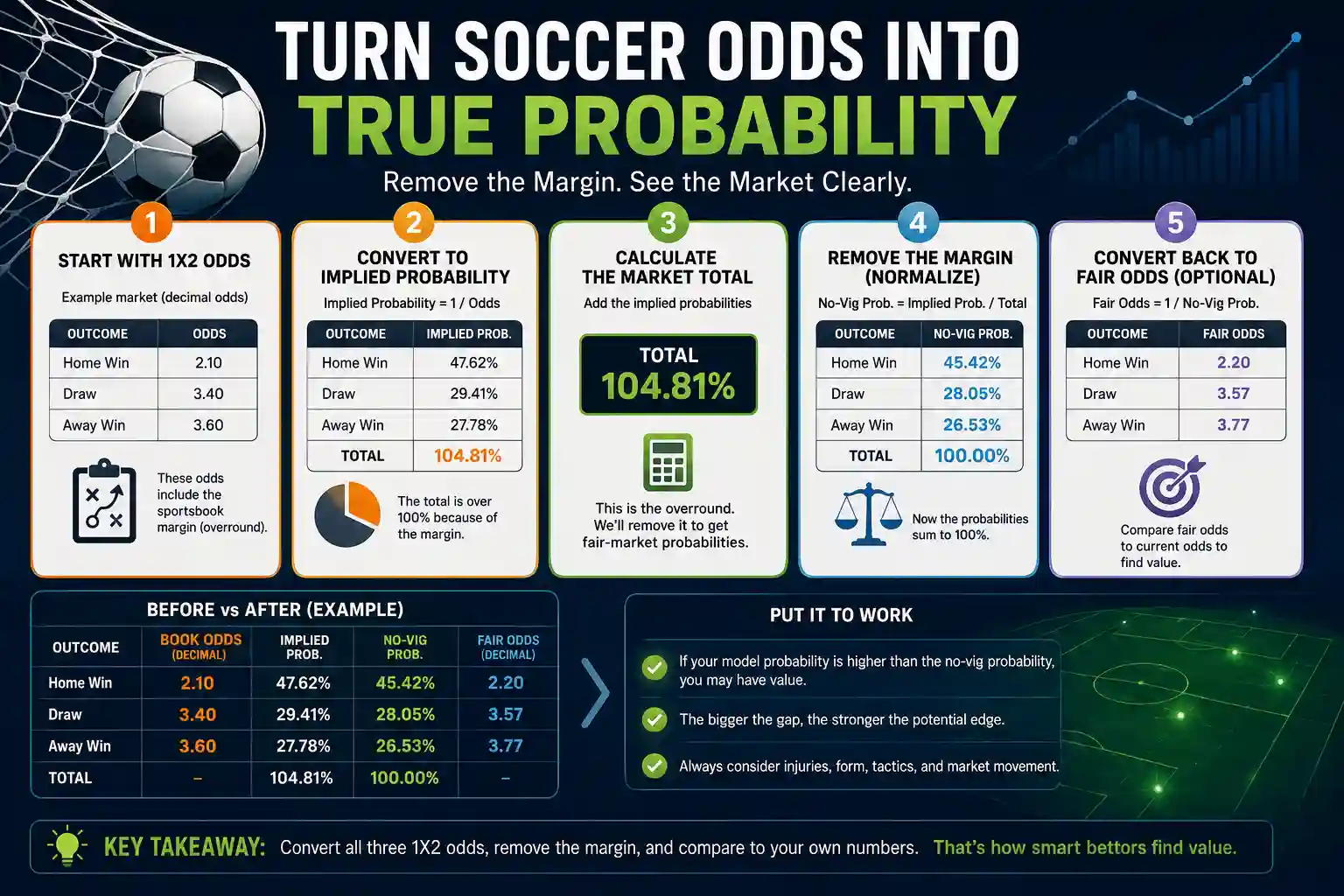
To convert soccer odds into true probability, turn the home, draw, and away prices into implied percentages, add them together, then divide each one by that combined total. This removes the sportsbook’s margin proportionally and leaves you with no-vig probabilities that add up to 100%.
The percentage you get from a single betting line on its own is implied probability, not true probability. At MyBookie, a standard soccer 1X2 moneyline covers the home win, draw, and away win after 90 minutes plus injury or stoppage time, unless stated otherwise. All three prices in that market need to be normalized together before you can estimate a fair-market probability.
Quick Answer: How to Convert Soccer Odds Into True Probability
How do you convert soccer odds into true probability? Convert the home, draw, and away odds from the same 90-minute 1X2 market into implied probabilities, add the three percentages, and divide each probability by that total. The normalized results total 100% and represent proportional no-vig, or fair-market, probabilities.
Table of Contents
- What Does “True Probability” Mean in Soccer Betting?
- How Do Betting Lines Work in Soccer?
- How Are Soccer Betting Lines Set and Why Do They Move?
- How Do You Convert Soccer Betting Odds Into Implied Probability?
- How Can You Calculate Implied Probability From One Price?
- Why Do Soccer Implied Probabilities Add Up to More Than 100%?
- How Do You Remove the Vig From Three-Way Soccer Odds?
- How Can You Calculate No-Vig Probability for a 1X2 Market?
- How Do You Convert Fair Probability Back Into Fair Soccer Odds?
- How Can You Compare Fair Odds With Sportsbook Lines?
- Which Soccer Leagues Can You Use This Probability Method For?
- Do Bitcoin Betting or Crypto Betting Change the Probability?
- What Mistakes Should You Avoid When Calculating Soccer Probability?
- FAQ
- Final Thoughts: How Should You Use True Probability Before Betting Soccer?
What Does “True Probability” Mean in Soccer Betting?
In soccer betting, “true probability” commonly refers to an estimated probability after the sportsbook margin has been removed. The more precise terms are no-vig probability or fair-market probability, because removing the margin produces a market-based estimate rather than an independently proven chance of winning.
What Does a 1X2 Market Look Like Before Margin Removal?
Consider a 1X2 market before the sportsbook margin has been removed:
| Outcome | Decimal Odds | Implied Probability |
|---|---|---|
| Home win | 2.10 | 47.62% |
| Draw | 3.40 | 29.41% |
| Away win | 3.60 | 27.78% |
| Market total | All outcomes | 104.81% |
Why Does the Market Total Exceed 100%?
The extra 4.81 percentage points represent the market overround. There are three separate probability concepts to keep in view: the original implied probability contained in the sportsbook odds, the no-vig probability produced by normalizing the market, and your own independently modeled probability.
Three Probability Layers
① Implied probability:
The break-even percentage encoded in one listed price, with the sportsbook margin still included.
② No-vig probability:
A normalized market estimate created by removing the margin from every mutually exclusive outcome.
③ Modeled probability:
Your independent estimate based on team strength, expected goals, injuries, tactics, venue, and other relevant information.
How Should You Use the Three Probability Layers?
In simple terms: Sportsbook odds show implied probability, proportional margin removal estimates no-vig probability, and sports betting statistical analysis may produce an independently modeled probability. Bettors who want to create their own estimate can learn how to build a simple soccer betting model before comparing its output with the market.
One possible modeling approach is to estimate scoring probabilities from expected goal rates. Understanding how to use the Poisson distribution in soccer betting can help explain how projected goals are converted into estimated match-result probabilities, although no statistical model can guarantee an outcome.
How Do Betting Lines Work in Soccer?
Soccer betting lines translate market prices into potential payouts and implied probabilities. The MyBookie soccer betting hub provides broader coverage of soccer markets, odds, picks, and wagering concepts. At MyBookie, a standard three-way moneyline—also called a 1X2 market—prices three outcomes: the home team wins, the match ends in a draw, or the away team wins after 90 minutes plus injury or stoppage time.
Extra time and penalty shootouts do not count toward the standard 1X2 result unless the market states otherwise. There is also no push on a soccer 1X2 moneyline because the draw is offered as a separate betting outcome.
Which Soccer Odds Belong in a 1X2 Probability Calculation?
The calculator in this guide is designed specifically for a standard home-draw-away market. Other soccer markets may contain two prices, overlapping selections, refunds, or different settlement periods and should not be entered as though they were 1X2 outcomes.
| Soccer Market | How It Is Settled | Use in This 1X2 Calculator? |
|---|---|---|
| Three-way moneyline or 1X2 | Home win, draw, or away win after 90 minutes plus stoppage time. | Yes. Enter all three prices from the same market. |
| Draw No Bet | Only the two teams are priced; a draw normally results in no action and the stake is refunded. | No. It is not a three-outcome 1X2 market. |
| Double Chance | Each selection covers two possible match results, so the available selections overlap. | No. The selections are not three mutually exclusive outcomes. |
| To qualify | The team advancing is what matters, so extra time and penalties may count. | No. Do not mix qualification prices with 90-minute 1X2 odds. |
| Goal line or total | The wager is settled against a specified handicap or goals line. | No. Use a calculation designed for that exact two-way line and its settlement rules. |
Calculation rule: Use only the home, draw, and away prices displayed together under the same 90-minute three-way moneyline. Do not combine 1X2 odds with Draw No Bet, Double Chance, goal-line, totals, or qualification prices.
The same probability principles can also be applied to two-way markets, but every calculation must reflect the complete set of possible outcomes. Bettors examining over and under prices can explore the math behind modeling soccer totals to see how scoring expectations connect with totals lines.
How to Read Soccer Betting Lines
Shorter odds:
Indicate a higher implied probability and a smaller potential profit relative to the stake.
Longer odds:
Indicate a lower implied probability and a larger potential profit if the wager wins.
The draw line:
Represents a separate outcome and must remain in any complete 1X2 probability calculation.
For bettors looking for soccer betting odds explained simply, the central relationship is inverse: when decimal odds rise, implied probability falls; when decimal odds fall, implied probability rises. This relationship does not change across a traditional sportsbook, a bitcoin betting platform, or a crypto betting interface.
How Are Soccer Betting Lines Set and Why Do They Move?
Sportsbook lines may begin with model-based estimates and then change as new information, market activity, injuries, confirmed lineups, weather, tactical expectations, and risk exposure develop. Markets tend to react to information rather than remain fixed from opening to kickoff.
From Opening Line to Current Price
① Opening assessment:
Initial odds reflect available data, model output, expected demand, and the sportsbook’s pricing approach.
② Information arrives:
Lineups, injuries, scheduling, weather, and team news can change the estimated probabilities.
③ Market response:
Bettor activity and competing prices can contribute to line movement.
④ Updated market:
The latest odds encode a new set of implied probabilities and a potentially different overround.
Understanding how soccer betting lines are set helps explain why a no-vig calculation is time-specific. If one price moves, calculate the complete market again. Reusing the other two probabilities from an earlier snapshot can create a false comparison.
How Do You Convert Soccer Betting Odds Into Implied Probability?
The formula depends on the odds format. Decimal, American, and fractional odds can all be converted into the same implied win probability, allowing bettors to compare odds for sports on a common percentage scale.
| Odds Format | Formula | Example | Implied Probability |
|---|---|---|---|
| Decimal odds | 1 ÷ decimal odds × 100 | 1 ÷ 2.10 × 100 | 47.62% |
| Positive American odds | 100 ÷ (odds + 100) × 100 | 100 ÷ (150 + 100) × 100 | 40.00% |
| Negative American odds | |odds| ÷ (|odds| + 100) × 100 | 150 ÷ (150 + 100) × 100 | 60.00% |
| Fractional odds | Denominator ÷ (numerator + denominator) × 100 | 2 ÷ (3 + 2) × 100 for 3/2 | 40.00% |
Quick Answer
What probability do +150 and -150 imply? Positive American odds of +150 imply 40%, while negative American odds of -150 imply 60%.
What probability do decimal odds of 2.10 imply? Divide 1 by 2.10 and multiply by 100 to get 47.62%.
Regardless of whether a sportsbook uses decimal odds or American lines, the resulting percentage is the approximate break-even probability required at that price. Bettors who want to build a stronger foundation can use the MyBookie Betting Academy to learn more about betting odds, probability, and sportsbook markets. If a bet at 2.10 wins more often than 47.62% over a sufficiently large and comparable sample, it may outperform its listed break-even rate before other costs and modeling errors are considered.
It is important not to treat the posted odds as pure predictions. Sportsbook lines may reflect statistical models, market information, risk controls, bettor demand, and price adjustments. The number tells you the market price available for a wager; it does not certify the final outcome.
How Can You Calculate Implied Probability From One Price?
An implied probability calculator provides the percentage encoded in a single betting price. This is the first step in learning how to convert odds into true probability, but margin removal still requires every outcome from the same market.
You can also use the MyBookie betting odds calculator to compare betting odds and probability formats before evaluating the full market.
Decimal Odds to Implied Probability Calculator
Enter one decimal price to calculate its implied probability and break-even percentage.
What This Calculator Does and Does Not Do
It does:
Translate one decimal price into its implied probability and break-even rate.
It does not:
Remove the vig, evaluate all three 1X2 outcomes, or create an independent match prediction.
Why Do Soccer Implied Probabilities Add Up to More Than 100%?
Soccer implied probabilities commonly exceed 100% because the sportsbook builds a margin into the prices. In the example market, the calculation is 47.62% + 29.41% + 27.78% = 104.81%, leaving 4.81 percentage points above a fair 100% book.
Market Percentage Visual
You may see this cost discussed as overround, vig, vigorish, juice, hold, or sportsbook margin. Bettors unfamiliar with this vocabulary can review the MyBookie gambling terms guide for additional definitions. These terms are related, but they are not always mathematically interchangeable. Overround specifically describes how far the combined implied probabilities exceed 100%, while realized hold depends on the wagers accepted and the final result.
| Term | Practical Meaning |
|---|---|
| Overround | The combined implied probability above 100% in a complete market. |
| Vig, vigorish, or juice | Common betting language for the cost or commission embedded in the offered prices. |
| Sportsbook margin | The pricing advantage built into sportsbook odds or lines. |
| Hold | The share of accepted stakes retained after bets are settled; actual hold can differ from the theoretical margin. |
If you’re wondering why this matters, it’s because a probability that still contains margin is not directly comparable with a vig-free model.
How Do You Remove the Vig From Three-Way Soccer Odds?
The proportional method is a straightforward way to remove vig from soccer odds. First convert the home, draw, and away lines into implied probabilities. Then add the probabilities and divide each individual result by the total.
Three-Step 1X2 Margin-Removal Framework
① Convert every outcome:
Home 2.10 = 47.62%, draw 3.40 = 29.41%, and away 3.60 = 27.78%.
② Calculate the total:
Add the three percentages to get a 104.81% market total.
③ Normalize the market:
Divide each implied probability by 104.81% so the adjusted results total approximately 100%.
| Outcome | Calculation | No-Vig Probability |
|---|---|---|
| Home win | 47.62 ÷ 104.81 | 45.43% |
| Draw | 29.41 ÷ 104.81 | 28.06% |
| Away win | 27.78 ÷ 104.81 | 26.50% |
| Normalized total | 45.43 + 28.06 + 26.50 | 99.99% after rounding |
After rounding, the total is approximately 100%. What you now have is an estimated no-vig market probability. All three outcomes must be calculated together because they are mutually exclusive results in the same 90-minute 1X2 soccer market, including injury or stoppage time.
Ignoring the draw would distort the calculation because MyBookie’s standard soccer moneyline does not use a push when the match is tied. Even when you believe a draw is unlikely, it remains a separately priced result and must be included. Once all three lines are normalized, you have a proportional estimate of the market’s fair probability for each outcome.
Quick Answer
Do you need to include the draw? Yes. Home win, draw, and away win must be normalized together when calculating fair probabilities for a standard 1X2 market.
Should the no-vig probabilities total exactly 100%? They should total 100% before rounding; displayed figures may total 99.99% or 100.01% because of decimal rounding.
How Can You Calculate No-Vig Probability for a 1X2 Market?
A three-way no-vig calculator applies the proportional method to all outcomes at once. Enter decimal prices from the same sportsbook, match, market, and point in time; mixing unrelated lines produces a result that does not represent a coherent market.
1X2 No-Vig Probability Calculator
Enter the home, draw, and away decimal odds to calculate the overround, normalized probabilities, and fair decimal odds.
NEXT STEP
Turn the No-Vig Probability Into a Fair Price
Once the home, draw, and away probabilities total 100%, convert each result back into fair decimal odds. That gives you the pricing baseline needed to evaluate the available sportsbook line.
How Do You Convert Fair Probability Back Into Fair Soccer Odds?
Once you have calculated no-vig soccer probability, divide 1 by each fair probability expressed as a decimal. This converts the normalized percentages back into estimated fair decimal odds.
Fair-Odds Formula
Fair decimal odds = 1 ÷ fair probability expressed as a decimal
Home:
Home calculation: 1 ÷ 0.4543 = 2.20
Draw:
Draw calculation: 1 ÷ 0.2806 = 3.56
Away:
Away calculation: 1 ÷ 0.2650 = 3.77
| Outcome | Offered Decimal Odds | Fair Decimal Odds | What Changed? |
|---|---|---|---|
| Home win | 2.10 | 2.20 | Removing the margin produces a longer fair price. |
| Draw | 3.40 | 3.56 | The margin-free payout price increases. |
| Away win | 3.60 | 3.77 | A higher fair price results after the adjustment. |
How Should You Interpret the Difference?
If the available odds are higher than your supported fair price, the wager may offer value because its break-even probability is lower. If the available odds are shorter than the fair price, the sportsbook line does not meet that probability baseline. To take the analysis one step further, learn what expected value means in soccer betting and how EV can help compare your estimated probability with the available price.
In this example, decimal odds of 2.28 are higher than the estimated fair price of 2.20. That creates a potential pricing advantage, but it is only meaningful if the fair-probability estimate is reliable and both prices represent the same market and settlement conditions.
What Are the Limits of Proportional Fair Odds?
Proportional vig removal provides estimated no-vig fair odds. It does not guarantee an accurate prediction because it assumes the margin is distributed proportionally across the market. Other de-vigging methods can produce slightly different estimates, especially in markets with heavily unbalanced prices.
It’s important to note: Fair soccer odds are a pricing baseline, not proof that a team will win, lose, or draw.
How Can You Compare Fair Odds With Sportsbook Lines?
Once fair odds have been calculated, compare them with the current soccer odds and lines available through online betting markets. Suppose your fair-market calculation produces decimal odds of 2.20, while an available sportsbook line offers 2.28 on the same outcome and settlement conditions. The higher price offers a larger potential return for the same stake.
| Price | Implied Probability | Interpretation |
|---|---|---|
| Calculated fair odds: 2.20 | 45.45% | Proportional market baseline after margin removal. |
| Available odds: 2.28 | 43.86% | Longer price and lower break-even requirement. |
| Difference | 1.59 percentage points | A price advantage that deserves further evaluation, not an automatic bet. |
When Does a Longer Price Offer Potential Value?
This comparison can help identify a potential betting edge, but a longer price is not enough on its own. Market movement, information quality, market efficiency, model uncertainty, liquidity, and line shopping all affect whether the comparison is meaningful.
Learning the art of evaluating betting prices means considering the strength of the underlying probability estimate instead of automatically choosing the longest available odds.
Why Must the Settlement Conditions Match?
Settlement conditions must match before two prices can be compared correctly. Review the applicable sports betting rules to confirm whether a soccer wager covers the standard 90 minutes plus stoppage time, qualification, or another defined result.
A “to qualify” price may include extra time and penalties, so it should never be compared directly with a regulation-time 1X2 price.
How Are Friendly Matches Different?
Friendly matches may be graded according to the result when the match finishes, excluding extra time, even when the full 90 minutes are not completed. Always verify the displayed market terms before treating two sets of odds as equivalent.
Price-Comparison Checklist
① Match the market:
Compare 90-minute 1X2 with 90-minute 1X2, not qualification or extra-time markets.
② Match the timing:
Fast-moving odds from different moments may reflect newly available information.
③ Check the break-even rate:
Convert the available price into probability before deciding whether the difference is meaningful.
④ Challenge the model:
A no-vig estimate reflects the market; an independent projection must justify why its probability should be more accurate.
From a betting perspective, experienced bettors focus on the price required to bet on sports rather than treating the most likely winner as the only relevant decision. A strong team can still be priced too short, while a less likely outcome can offer a more favorable line.
Which Soccer Leagues Can You Use This Probability Method For?
The margin-removal method can be used across domestic leagues and international soccer competitions whenever the sportsbook offers home, draw, and away prices for the same 1X2 market. The league may change, but the process remains the same: convert all three odds into implied probabilities, calculate the market total, and normalize each result.
Always confirm that the prices cover the same settlement period. In knockout competitions, a standard 90-minute moneyline and a “to qualify” market are different wagers and must not be combined.
Where Does the 1X2 Method Apply?
The following leagues and competitions commonly offer three-way match-result markets. Apply the calculation only when the home, draw, and away prices belong to the same regulation-time market.
| League or Competition | Where the Method Applies | What to Verify |
|---|---|---|
| FIFA World Cup | Home, draw, and away odds for regulation-time matches. | Do not mix 90-minute prices with qualification markets that include extra time or penalties. |
| UEFA Champions League | Three-way moneylines during the league and knockout stages. | Confirm whether the market covers 90 minutes or which team qualifies. |
| UEFA Europa League | Standard home-draw-away markets for individual matches. | Keep regulation-time and advancement prices separate. |
| UEFA Nations League | Complete 1X2 markets containing all three regulation-time outcomes. | Use odds from the same match, market, and point in time. |
| English Premier League | Home, draw, and away prices for regular league matches. | Use all three displayed prices when calculating the market overround. |
| LaLiga | Standard three-way match-result markets. | Confirm that every price uses the same regulation-time settlement conditions. |
| Bundesliga | Home-draw-away markets for individual Bundesliga matches. | Do not combine prices from different sportsbooks or market snapshots. |
| Serie A | Regulation-time 1X2 odds containing three mutually exclusive outcomes. | Keep the draw in the calculation even when one team is a substantial favorite. |
| Ligue 1 | Complete match-result markets with home, draw, and away prices. | Avoid rounding individual probabilities before removing the margin. |
| Liga MX | Regular-season and playoff match 1X2 markets. | Distinguish the match winner from the team advancing in a playoff series. |
| MLS | Home-draw-away lines for regulation-time MLS matches. | During the playoffs, confirm whether the market covers 90 minutes or qualification. |
What Changes Across Soccer Competitions?
The calculation does not become more or less accurate simply because it is applied to a different league. What can change is the sportsbook margin, market liquidity, information available, and efficiency of the prices, so each complete 1X2 market must be evaluated independently.
When comparing leagues, focus on the relationship between the offered odds and the normalized probabilities rather than assuming that a familiar competition automatically provides better value.
COMPARE 1X2 MARKETS
Apply the Method to Current Soccer Lines
Choose a match, record the home, draw, and away prices from the same market, and remove the sportsbook margin before comparing the available line with your fair-value estimate.
View Soccer Odds and LinesDo Bitcoin Betting or Crypto Betting Change the Probability?
No. Bitcoin betting, crypto betting, and conventional payment methods do not change the mathematics encoded in a price. Decimal odds of 2.10 always imply 47.62%, regardless of how an account is funded.
| Betting Context | Decimal Price | Implied Probability | What May Differ? |
|---|---|---|---|
| Traditional online betting | 2.10 | 47.62% | Deposit, withdrawal, verification, or transaction procedures. |
| Bitcoin betting | 2.10 | 47.62% | Network timing, wallet process, or asset-price considerations. |
| Crypto betting | 2.10 | 47.62% | Supported currency, conversion, or transaction conditions. |
The payment rail and the probability calculation answer different questions. A sports betting bonus can affect account funds, rollover conditions, or the practical return from a promotion, but it does not change the probability implied by the underlying odds. Always evaluate the offered betting odds, market rules, and all mutually exclusive outcomes independently of the deposit method.
What Mistakes Should You Avoid When Calculating Soccer Probability?
The most damaging errors come from using an incomplete market, mixing unlike sportsbook lines, or treating a market estimate as a guaranteed forecast. The calculation is reliable only when its inputs belong together.
| Mistake | Why It Distorts the Result | Correction |
|---|---|---|
| Ignoring the draw | A 1X2 market becomes incomplete. | Calculate home, draw, and away together. |
| Treating implied probability as an independent prediction | The listed price still includes margin and market influences. | Separate implied, no-vig, and independently modeled probabilities. |
| Assuming overround equals guaranteed sportsbook profit | Actual hold depends on betting volume, price distribution, and results. | Use overround as a theoretical pricing measure. |
| Combining prices from different markets | The outcomes may not be mutually exclusive under the same settlement rules. | Use one sportsbook, match, market type, and market snapshot. |
| Rounding too early | Small errors can compound during normalization. | Keep full precision until the final displayed result. |
| Mixing 90-minute and qualification odds | Extra time and penalties change the definition of a winning outcome. | Verify the market label and settlement period before calculating. |
Calculation Integrity Check
- Use every mutually exclusive outcome from the same market.
- Confirm that the market total exceeds 100% before standard proportional margin removal.
- Normalize using unrounded figures.
- Confirm that the adjusted probabilities total 100% before converting them back into fair odds.
- Compare only equivalent lines with identical settlement rules.
It’s important to note: unpredictable match events, model error, rapidly changing information, and market volatility mean that no probability estimate can eliminate uncertainty.
Summary: Odds, Lines, and True Probability
- Converting one price produces implied probability, not an independently verified true probability.
- A standard soccer 1X2 calculation requires the home, draw, and away odds.
- The amount above 100% is the market overround.
- Dividing each implied probability by the market total produces proportional no-vig probabilities.
- Fair odds are a market-based reference point that can be compared with current sportsbook prices and personal projections.
FAQ
These concise answers address the most common questions about implied probability, no-vig lines, fair odds, and three-way soccer markets.
What is true probability in soccer betting?
True probability commonly means an estimated probability after removing the sportsbook margin. A no-vig probability reflects a normalized market and is not a certain prediction.
How do you convert soccer odds into a percentage?
For decimal odds, divide 1 by the price and multiply by 100. Decimal odds of 2.00 therefore imply a 50% break-even probability.
How do you remove the bookmaker margin from soccer odds?
Convert every outcome into implied probability, add the percentages, and divide each individual probability by the market total. The normalized home, draw, and away probabilities should total 100% before rounding.
Why do soccer probabilities add up to more than 100%?
Sportsbooks incorporate a margin into their prices. The combined implied probabilities exceed 100%, and the excess is known as the market overround.
How do you calculate fair odds for a 1X2 soccer market?
Normalize the implied probabilities for home, draw, and away so they total 100%, then divide 1 by each fair probability expressed as a decimal.
Is overround the same as vig?
The terms are often used in similar contexts, but overround specifically measures how far a complete market’s combined implied probabilities exceed 100%.
Are no-vig odds the actual chance of a team winning?
Not necessarily. No-vig odds estimate the market price without margin; they are not the same as an independently calculated statistical forecast.
Does removing the vig reveal a value bet?
Not automatically. It creates a fair-market baseline, but expected value depends on whether your probability estimate is more accurate than the available price suggests.
Can you remove the vig from moneyline and totals markets?
Yes, but the calculation must match the market structure and settlement rules. The three-way calculator in this guide should only be used with home, draw, and away odds from the same 90-minute 1X2 market.
Do you need to include the draw when calculating soccer fair odds?
Yes, for a standard three-way 1X2 market. Leaving out the draw makes the market incomplete and distorts the result.
Is a draw a push in a soccer moneyline bet?
No. A standard soccer three-way moneyline offers the draw as a separate outcome, so a tied result after regulation is not a push.
Do extra time and penalties count in soccer 1X2 betting?
Not in a standard 90-minute 1X2 market unless otherwise stated. Extra time and penalties may count in qualification or trophy-winner markets.
What probability do positive and negative American odds imply?
For positive odds, divide 100 by the odds plus 100. Negative odds require dividing the absolute price by that number plus 100. As an example, +150 implies 40%, while -150 implies 60%.
Do Bitcoin betting or crypto betting change implied probability?
No. The payment method does not change the mathematics of a betting line, although transaction and account conditions may differ.
Important: Sports betting involves risk. No probability model, fair-odds calculation, or line-shopping method guarantees a winning outcome, and managing exposure is essential.
Final Thoughts: How Should You Use True Probability Before Betting Soccer?
The most accurate way to evaluate a standard 1X2 soccer market is to convert all three odds into implied probabilities, calculate the overround, and normalize the home, draw, and away results together. This produces a fair-market comparison rather than a prediction.
Use that no-vig baseline to understand what the market is pricing, then compare it with the sportsbook line and your own evidence-based probability. A potential edge exists only when the available price requires a lower break-even rate than your well-supported estimate—and even then, the bet can lose.
Final Decision Rule
Convert the complete market, remove the margin, compare equivalent prices, and bet only when your evidence supports a probability advantage at the available line.
The key takeaway is that probability work improves price discipline, not certainty. Converting odds, removing margin, matching settlement rules, and comparing complete markets can make a betting decision more informed. The strongest use of true probability is knowing what price you need, why your estimate differs from the market, and when the available line does not justify a wager.
Ready to apply the calculation? Review the current soccer sportsbook odds and lines, confirm that you are using the 90-minute three-way moneyline, and record the home, draw, and away prices displayed together. Calculate the margin-removed probabilities before deciding whether the available price meets your fair-value estimate.
APPLY THE CALCULATION
Compare the Full 1X2 Market Before You Bet
Convert every outcome, remove the sportsbook margin, compare the fair price with the available line, and wager only when the numbers and your supporting analysis justify the decision.
MyBookie: Bet On Anything. Anywhere. Anytime.
Important: Sports betting involves risk. No strategy guarantees results, and managing exposure is essential.

About the Author

Henry Watkins is a Sports Writer at MyBookie. Originally from Scotland and currently residing in Metro Atlanta with his wife, Penny, Henry covers competitive and professional sports as well as the business of sports. In addition to his sports writing, he is an author of horror fiction, including Karaoke Night, Crueller, and Off The Grid.
Sportsbook Bonuses
Read requirements in the Bonus page. However, if you want to take a deep knowledge, go to MyBookie Bonus Rules and How to


🔍 Explore Everything you Need to Know aboout your Licensed, Trusted Home For Casino and Sports Since 2014
👉 Gamble responsibly—must be 21+ and in a Legal Jurisdiction | Get Help at 1-800-Gambler