English


NFL Spreads for Dummies is a crash course in reading odds like a pro, one that turns every point on the board into a potential edge.
Point spreads can feel like a foreign language when you’re new to NFL betting. But once you understand how they work, betting on football gets a lot more structured and strategic.
NFL betting isn’t really about picking winners. It’s about predicting margins. If you want a stronger handle on NFL betting markets, it helps to study how spreads, line movement, matchup dynamics, and public perception interact over the course of a season. That foundation matters even more once the schedule kicks off, which is why a lot of bettors also check out how to bet the NFL regular season before placing weekly wagers.
Quick Answer: NFL Spreads for Dummies
NFL point spread betting means wagering on whether a team will perform better or worse than the margin set by the sportsbook—not simply whether they win the game. Favorites must win by more than the spread, while underdogs can either win outright or lose by fewer points than the line.
Your First Bet Starts Here: Understanding NFL Spreads Like a Pro
This article is your go-to NFL point spread betting guide. We break down everything from what a spread is to how to place your first smart bet. By the end, you’ll be able to confidently navigate NFL betting and understand how odds actually work. If you’re just getting started, exploring the broader sports betting guide will give you a complete foundation beyond spreads.
At its core, the NFL spread is a pricing tool. Sportsbooks aren’t just predicting outcomes—they’re setting expectations designed to balance action on both sides. Understanding this shift—from prediction to pricing—is what separates casual bettors from disciplined ones.
This guide focuses on helping you interpret those expectations, identify where they might be wrong, and make decisions based on probability instead of instinct.
Key Insight
📊 Concept:
The spread is designed to balance teams, not predict winners.
Why it matters:
You win bets by beating expectations—not just picking the better team.
What’s a Point Spread, Anyway?
Let’s get straight to the point—literally. A point spread is a type of bet used to level the playing field between two NFL teams. The winner of the game doesn’t matter—what matters is who covers the spread.
A point spread transforms a mismatch into a decision. Instead of asking “Who will win?”, you’re asking “By how much will they win—or not win?” That shift is what makes spread betting both more challenging and more profitable.
Every number on the board represents an opinion shaped by data, market behavior, and risk management. Your job isn’t to accept it—it’s to evaluate whether it’s accurate.
Understanding how these numbers are built becomes easier when you break down the mechanics behind them, which is exactly what you’ll see in a deeper explanation of how NFL point spreads work and how sportsbooks adjust lines in real time.
Quick Answer: To win a spread bet, you’re not picking who wins the game—you’re predicting whether a team will outperform expectations set by the line. If a favorite is -7, they must win by more than 7. If an underdog is +7, they can lose by up to 6 and still cover.
Simple Decision Framework: If you believe the favorite will dominate → back the negative spread. If you expect a close game → take the underdog and the points. If the spread sits on a key number like 3 or 7 → timing and line value matter more than the pick itself.
Spread Breakdown
Cowboys -7:
Must win by 8+ points.
Giants +7:
Win outright or lose by 6 or fewer.
Push:
Win by exactly 7 → refund.

| Bet Type | What Has to Happen to Win |
|---|---|
| Cowboys -7 | Win by 8+ points |
| Giants +7 | Win or lose by ≤6 |
| Push | Exactly 7 → refund |
Visual Model
Betting Against the Spread (ATS)
ATS means “Against The Spread.” A team might lose games but still be profitable versus the spread.
ATS performance is one of the clearest indicators of hidden value. Teams that consistently outperform expectations often go overlooked by casual bettors focused only on wins and losses.
This is where inefficiencies appear—because the market tends to overreact to headlines, not underlying performance.
These inefficiencies don’t just exist in spreads—they also show up in player markets, which is why many bettors combine ATS analysis with insights from tools like the WR props cheat sheet or identify warning signs using the RB prop red flag report.
ATS Explained
Straight Up (SU):
Win/loss record.
ATS Record:
Performance vs expectations.
| Tip | Description |
|---|---|
| Matchups | Exploit offense vs defense mismatches |
| Form | Hot teams outperform spreads |
| Underdogs | Point cushions create value |
Factors That Move the Line
Lines don’t move randomly—they react to information and money. Understanding why a spread shifts is often more valuable than the number itself.
Sharp bettors track movement patterns to identify where professional money is landing, and where the public might be inflating a line beyond its true value.
Recognizing these patterns is essential if you want to move beyond guessing and into structured betting, especially when combining spreads with other approaches like arbitrage wagering or understanding how totals markets behave. Bettors who want to evaluate one offense independently of the full-game score can also study the NFL team totals betting guide to learn how injuries, matchups, pace, and game scripts affect a team’s projected points.
Line Movement Drivers
Matchups:
Scheme advantages shift expectations.
Home Field:
Worth ~2–3 points.
Injuries:
Key absences reshape spreads instantly.
Key Numbers:
3 and 7 are critical margins.
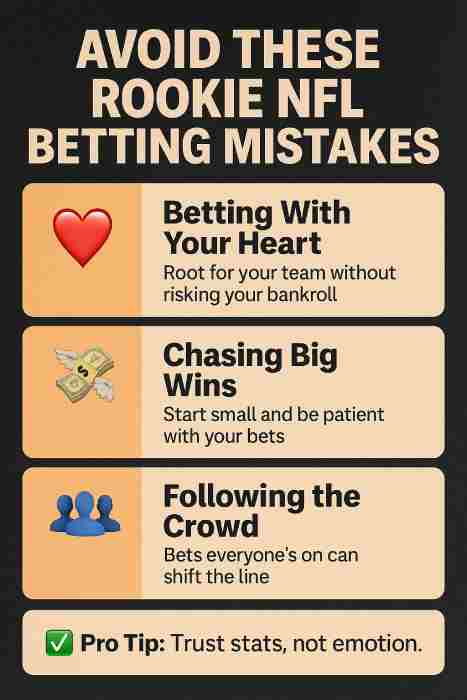
Avoiding Rookie Mistakes
Most early losses come from process mistakes, not bad luck. New bettors tend to focus on outcomes instead of decision quality, which leads to inconsistent results over time.
Building a repeatable approach—based on data, discipline, and line awareness—is what turns short-term guesses into long-term strategy. That process also includes recognizing when sportsbooks may be undervaluing competitive teams, which is why many bettors study additional NFL underdog betting strategies alongside spread analysis and line movement.
That approach becomes even more important when evaluating situational angles, like knowing when to back value with underdogs or identifying profitable scenarios outlined in road favorite betting strategies.
Common Mistakes
Emotion:
Betting favorite teams blindly.
Chasing:
Overextending early.
Public Bias:
Ignoring sharp money signals.
Beyond Simple Spreads
Once you understand spreads, the real edge comes from combining them with context. Advanced bettors don’t just place bets—they consider game scripts, market timing, and correlated outcomes.
Expanding Your Spread Strategy
Spread analysis becomes more useful when you understand how the betting market changes as a game develops. For example, the first half can reshape expectations and create new numbers after halftime, making NFL second-half betting lines a natural extension of spread analysis.
- 📊 Game script: Consider how the score and pace can influence later betting opportunities.
- ⏱ Market timing: Compare when a number is available rather than treating every spread as equally valuable.
- 📈 Correlated outcomes: Look for connections between spreads, game scripts, and other markets.
Combining Spreads With Other Markets
As you expand your approach, many bettors combine spreads with correlated markets and player-focused wagers.
- 💰 Parlays: Explore NFL parlay betting when multiple outcomes connect to the same game script.
- 🎯 Player props: Use resources covering popular NFL props to explore player-driven angles.
- 📝 Prop strategy: Review NFL player props guides for a more structured approach.
- 🎉 Touchdown markets: NFL anytime touchdown scorer bets can help connect expected game scripts with a player’s scoring opportunities.
| Market | What to Consider |
|---|---|
| Spreads | Expected margin and line value |
| Second-Half Lines | Game flow and halftime adjustments |
| Parlays | Connections between game outcomes |
| Player Props | Individual performance and game script |
The goal isn’t to use every market at once. These tools don’t replace fundamentals—they give you more ways to evaluate the same game when the underlying context supports it.
Advanced Options
Teasers:
Adjust spreads for lower risk.
Parlays:
Combine bets for higher payout.
Live Betting:
Exploit momentum shifts.
Buying Points:
Cross key numbers strategically.
Spread Margin Calculator
Check if your bet covers the spread.
Pro Insight: Most profitable bettors don’t guess winners—they track how often teams beat expectations versus the spread over time.
FAQ
What is a good spread to bet?
There is no universal “good” spread—value depends on matchup, form, and line movement.
What does +7 mean?
The team can lose by up to 6 points and still win the bet.
Why are 3 and 7 important?
They are the most common margins of victory in NFL games.
Summary
- Spreads measure margin—not winners
- ATS performance reveals true value
- Key numbers and timing matter most
Start Reading NFL Lines Like a Pro
Explore real-time odds and apply what you learned on the NFL betting board
View NFL OddsFinal Thoughts
You’ve moved beyond beginner territory. You now understand not only what a point spread is, but how sportsbooks shape expectations, how bettors create edges, and where most mistakes happen.
The real edge comes from discipline—tracking spreads, respecting key numbers, and avoiding emotional decisions. Over time, small advantages compound into long-term profitability.
Use this guide as your foundation, but treat every game as new data. The sharper your process becomes, the more consistent your results will be.
Ready to put it into action? Head over to MyBookie NFL odds and start identifying value instead of guessing outcomes. If you want to sharpen your edge even further, reviewing structured breakdowns like how to bet on NFL point spreads will help reinforce the concepts covered here.
MyBookie: Bet On Anything. Anywhere. Anytime.
Important: Sports betting involves risk. No strategy guarantees results, and managing exposure is essential.

About the Author

Since 2008, D.S. Williamson has written about sports and sports handicapping. His philosophy is value-based, meaning statistics and other handicapping factors are only useful when compared with the available wagering odds. He believes bankroll management and consistently making value-based wagers are the most important factors separating successful sports bettors from unsuccessful bettors.
Sportsbook Bonuses
Read requirements in the Bonus page. However, if you want to take a deep knowledge, go to MyBookie Bonus Rules and How to


🔍 Explore Everything you Need to Know aboout your Licensed, Trusted Home For Casino and Sports Since 2014
👉 Gamble responsibly—must be 21+ and in a Legal Jurisdiction | Get Help at 1-800-Gambler