English



Last updated: July 2026
The Kelly Criterion for NFL betting is a bankroll-allocation formula. It uses the available price and a bettor’s independent win-probability estimate to calculate how much of the current bankroll to risk. Full Kelly uses the complete formula result; fractional Kelly applies only a fixed portion, such as one-half or one-quarter.
That sounds precise, but the output is only as reliable as the inputs. Kelly does not predict an NFL winner, create an edge, or remove betting risk. It sizes an assumed edge after the bettor has assessed the market.
Quick Answer: What Is the Kelly Criterion for NFL Betting?
The Kelly Criterion calculates a suggested percentage of an NFL betting bankroll from the current odds and an independent estimate of the wager’s win probability. Full Kelly uses the entire result, while Half Kelly or Quarter Kelly reduces the stake to limit exposure and bankroll swings.
Table of Contents
- What Is the Kelly Criterion in NFL Betting?
- What Does an NFL Kelly Criterion Calculator Need?
- When Should NFL Bettors Use the Kelly Criterion—and When Should They Pass?
- How Should Bettors Estimate Win Probability Before Using Kelly?
- How Can NFL Bettors Test Whether Their Probability Estimates Are Calibrated?
- How Do You Calculate Kelly Criterion From American NFL Odds?
- How Do Break-Even Probability and Betting Edge Affect Kelly?
- What Is the Difference Between Expected Value, Betting Edge, and a Kelly Stake?
- Is Kelly Better Than Flat Betting or Unit Betting for NFL Bankroll Management?
- How Do Full and Fractional Kelly Affect Drawdowns and Risk of Ruin?
- What Happens When a Bettor Wagers More Than Full Kelly?
- What Is the Difference Between Full Kelly and Fractional Kelly?
- How Should Kelly Handle Pushes, Voids, Parlays, and Same-Game Parlays?
- Can Closing Line Value Help Validate a Kelly Betting Process?
- Should NFL Bettors Use Half Kelly or Quarter Kelly?
- Why Can a Small Probability Error Change the Kelly Stake So Much?
- Can Kelly Be Used for NFL Spreads, Moneylines, Totals, and Player Props?
- How Do You Read MyBookie NFL Odds Before Using Kelly?
- How Do Vig, Sportsbook Lines, and Line Movement Affect Kelly Bet Size?
- What Does a Zero or Negative Kelly Result Mean?
- How Should Bettors Size Multiple or Correlated NFL Bets?
- Does Online Betting, Bitcoin Betting, or Crypto Betting Change the Kelly Formula?
- What Are the Most Common Kelly Criterion Mistakes in NFL Betting?
- What Is a Repeatable Kelly Criterion NFL Betting Workflow?
- Kelly Criterion for NFL Betting FAQ
- Kelly Criterion NFL Betting Summary
- Sources and Methodology
- Final Thoughts: Is the Kelly Criterion Useful for NFL Betting?
What Is the Kelly Criterion in NFL Betting?
The Kelly Criterion is a stake-sizing formula designed to maximize a bankroll’s long-term growth over repeated bets. John L. Kelly Jr. introduced the underlying mathematics in the 1956 Bell System Technical Journal paper A New Interpretation of Information Rate.
🧮 What Does the Kelly Criterion Calculate?
In NFL betting, Kelly uses three inputs to calculate what percentage of the current bankroll should be risked:
- 💰 The bettor’s available bankroll.
- 🎯 The estimated probability that the wager wins.
- 📊 The sportsbook odds currently available.
For a broader explanation of the formula, bankroll requirements, and stake calculation, review how to use the Kelly Criterion before applying it to a specific NFL market.
✅ What Kelly Can and Cannot Do
| Kelly Can | Kelly Cannot |
|---|---|
| ✅ Convert an estimated edge into a bankroll percentage. | ❌ Predict which NFL team will cover the spread. |
| ✅ Adjust the stake when the odds or probability changes. | ❌ Determine whether a probability estimate is accurate. |
| ✅ Reduce the risk of staking too much on a perceived edge. | ❌ Guarantee profit or prevent normal losing streaks. |
| ✅ Support consistent bankroll management. | ❌ Replace handicapping, odds comparison, or market research. |
🛠 What Else Does an NFL Betting Process Need?
Kelly is one part of a complete betting strategy. Bettors still need a repeatable process for estimating probabilities, comparing prices, tracking line movement, reviewing results, and controlling total exposure.
- 🔍 Evaluate the matchup and specific NFL market.
- 📈 Estimate a defensible win probability.
- 💸 Compare odds across available sportsbook lines.
- 🧮 Calculate the recommended Kelly stake.
- 📝 Record the wager, result, and closing line.
- ⚠ Reduce the stake or pass when uncertainty is high.
The same principle applies to sports betting fundamentals more broadly: knowing the sport is not enough without understanding odds, line movement, bankroll management, and how wagers work.
🔎 Verify the Available Price First
Before calculating a stake, check the current sports betting market. The odds entered into the formula must match the price actually available for the wager because a line change can increase, reduce, or eliminate the estimated edge.
What Kelly Does and Does Not Do
Kelly does
Convert a quantified edge and available price into a suggested bankroll percentage.
Kelly does not
Predict the winner, prove the edge, remove variance, or guarantee bankroll growth.
The bettor supplies
The current bankroll, the actual sportsbook price, and an independent probability estimate.
What Does an NFL Kelly Criterion Calculator Need?
An NFL Kelly Criterion calculator needs four practical inputs: the current bankroll, the American odds, the estimated win probability, and the Kelly multiplier. The first three determine Full Kelly. The multiplier converts that result into Full, Half, or Quarter Kelly.
Kelly works only with a clearly defined bankroll. These tips for managing your bankroll explain why betting funds should be separated from money needed for other purposes before any stake is calculated.
| Input | Definition | Why it matters |
|---|---|---|
| Current bankroll | Money reserved for betting and affordable to lose | Converts the Kelly percentage into a dollar stake |
| Available American odds | The sportsbook price that can be accepted now | Determines the net profit factor and break-even probability |
| Estimated win probability | The bettor’s independent probability for the specific outcome | Determines whether the model claims an edge over the price |
| Kelly multiplier | 1.00 for Full, 0.50 for Half, or 0.25 for Quarter Kelly | Scales the qualifying stake without changing the estimated edge |
Do not use the posted implied probability as both the market price and the independent estimate. Doing so does not establish an advantage. The probability input must come from a separate handicapping process, model, or carefully calibrated assessment.
Kelly requires an independent handicapping process before stake sizing begins. Reviewing football handicapping techniques can help organize that assessment, but the resulting probability must still match the exact wager and current price.
When Should NFL Bettors Use the Kelly Criterion—and When Should They Pass?
NFL bettors should use the Kelly Criterion only when they have a defined bankroll, the exact available sportsbook price, and an independent win-probability estimate for that specific wager. If the probability has not been estimated independently, the line has changed, or the combined exposure is unclear, the appropriate decision is to recalculate or pass.
Kelly Use-or-Pass Decision Rule
Use Kelly
Use the calculation when the probability estimate is documented, the current betting odds are confirmed, and the wager produces a positive result.
Use Fractional Kelly
Apply Half or Quarter Kelly when the estimated edge qualifies but probability uncertainty or bankroll volatility supports less exposure.
Pass or Recalculate
Do not place the wager when Kelly is zero or negative, the sportsbook line has moved, or related NFL bets create excessive combined exposure.
When reviewing MyBookie NFL lines, use the exact market, selection, number, and American price shown for the intended ticket. Kelly can size an estimated edge at that price, but it cannot prove that the edge exists.
How Should Bettors Estimate Win Probability Before Using Kelly?
Bettors should estimate the probability of an NFL wager independently before entering it into a Kelly Criterion calculator. The percentage should represent how often the wager would win at the available sportsbook line, not how strongly the bettor feels about the pick.
📊 Build the Estimate From Wager-Specific Factors
A useful probability estimate combines information that directly affects the wager being evaluated. The relevant inputs and their importance can change between an NFL moneyline, point spread, team total, or player prop.
| Factor | What to Evaluate |
|---|---|
| 📈 Team Performance | Efficiency, recent form, opponent strength, pace, and matchup-specific advantages. |
| 🚑 Player Availability | Injuries, expected playing time, substitutions, quarterback rotations, and roster changes. |
| 🌤 Game Conditions | Weather, venue, travel, rest, short weeks, and other schedule-related conditions. |
| 🎯 Market Context | The available line, price movement, coaching tendencies, public expectations, and market type. |
🔍 Use Evidence That Matches the Market
Evidence should influence a probability estimate only when it directly affects the NFL market being priced. A factor that matters for a point spread may carry less weight for a player prop, moneyline, or team total.
| Evidence | How to Use It | Main Caution |
|---|---|---|
| 📊 Stats and Trends | Stats, trends, and other statistical tools can organize performance data and reveal relevant patterns. | Do not rely on historical trends that have no clear relationship to the specific wager. |
| 📅 Schedule Context | Schedule analysis and NFL point spread winners explains how rest, travel, opponent strength, and short weeks can affect a matchup. | Confirm that the schedule factor influences the market being evaluated before changing the probability. |
| 🏈 Coaching Tendencies | Coaching tendencies for smarter preseason bets can provide context about rotations, playing time, and game plans. | Preseason coaching patterns may not carry into the regular season or apply equally to every betting market. |
✅ Evidence Relevance Check
- ✅ Confirm that the evidence relates to the exact market and available line.
- ✅ Separate current information from outdated historical patterns.
- ✅ Account for differences between preseason and regular-season conditions.
- ✅ Adjust the estimate only when the evidence changes the expected outcome.
- ❌ Pass when the evidence does not support a defensible probability.
🏈 Adjust the Baseline for NFL Preseason Betting
Preseason needs a different baseline, since quarterback rotations, roster battles, and coaching priorities often matter more than actual team strength. Start with how NFL preseason betting works, then use these preseason wagering strategies to figure out which information actually applies to the market you’re looking at.
You can also prepare a preseason strategy before odds even post, by deciding ahead of time which reports, rotations, and market conditions you’ll track. But whether preseason betting is worth it still comes down to whether the price on offer supports a probability estimate you can defend.
✅ Probability Estimate Checklist
- ✅ Confirm the exact NFL market, selection, line, and price.
- ✅ Use factors that directly affect the wager being evaluated.
- ✅ Separate regular-season assumptions from preseason conditions.
- ✅ Account for injuries, rest, travel, weather, and coaching decisions.
- ✅ Recalculate when the sportsbook line or relevant information changes.
- ❌ Pass when uncertainty is too high to support a defensible estimate.
A long break between meaningful games can make older statistics and assumptions less reliable. Understanding the impact of downtime on sports wagering can help bettors decide which information still belongs in the probability estimate before Kelly sizes the wager.
Probability Estimation Process
1 Define the wager
Identify the exact side, total, moneyline, prop, price, and settlement conditions being evaluated.
2 Build an independent estimate
Use relevant data and documented assumptions to produce a fair win probability.
3 Compare it with the price
Convert the current betting odds into break-even probability and measure the difference.
4 Test uncertainty
Recalculate the stake with slightly lower probabilities to see whether the apparent edge remains usable.
| Input | Question to answer | Potential mistake |
|---|---|---|
| Team performance | Which efficiency measures predict the wager being evaluated? | Relying only on win-loss records or recent scores |
| Player availability | How does an absence or limitation change the matchup? | Counting injury news without adjusting its actual impact |
| Game conditions | Could weather, pace, venue, or rest affect the outcome? | Applying one condition equally to every betting market |
| Sportsbook lines | How does the available price compare with the fair estimate? | Copying the market’s implied probability as an independent forecast |
Market prices can provide a benchmark, but they do not automatically become the bettor’s true probability. Using the posted implied probability as both the forecast and the price comparison generally removes the independent edge Kelly needs.
Critical Limitation
Kelly cannot determine whether the probability estimate is accurate. It converts the estimate and available price into a stake. If the forecast is overconfident, the formula can recommend more exposure than the evidence supports.
How Can NFL Bettors Test Whether Their Probability Estimates Are Calibrated?
A probability model is calibrated when its predicted probabilities are consistent with observed results over a meaningful sample. If wagers assigned a 55% probability win approximately 55% of the time over a sufficiently large and representative dataset, that probability bucket may be reasonably calibrated.
Reliable testing begins with consistent records and comparable samples. This guide to using statistics in sports betting explains how quantitative evidence can support the analysis, while calibration testing determines whether recorded probability estimates match actual results over time.
Calibration should be tested on wagers that were not used to build or tune the model. This is called out-of-sample testing. Evaluating the same historical games used to create the system can make performance appear more reliable than it is.
Four-Part Calibration Review
1 Save every forecast
Record the probability, market, sportsbook price, timestamp, and result before the game begins.
2 Create probability buckets
Group similar forecasts, such as 50%–52%, 53%–55%, and 56%–58%.
3 Compare predictions with results
Measure the average forecast against the observed win rate in each bucket.
4 Review sample size
Treat small samples cautiously because short-term NFL results can differ sharply from the underlying probability.
| Validation measure | What it examines | What it cannot prove alone |
|---|---|---|
| Calibration gap | Difference between predicted probability and observed win rate | Whether a future probability will be correct |
| Brier score | Average squared error between a probability forecast and the result | Whether the betting price offered positive expected value |
| Out-of-sample performance | How the process performs on games excluded from model development | Whether the model will survive every market change |
| Closing line comparison | Whether accepted betting odds were generally better than the closing price | Guaranteed profitability or perfect probability calibration |
The Brier score for a binary forecast is calculated as the squared difference between the predicted probability and the observed result. Lower scores indicate smaller probability errors, but the score must be interpreted alongside calibration, sample size, market type, and the quality of the recorded data.
Model uncertainty should also influence stake selection. If two forecasting methods produce materially different probabilities, a bettor can test the more conservative estimate or use a smaller predetermined Kelly multiplier.
Bettors using automated models should also understand how AI and analytics are changing NFL betting. These tools can process more information, but they cannot eliminate model uncertainty, guarantee calibration, or prove that an apparent edge is real.
Do Not Invent a Track Record
Only publish calibration percentages, win rates, closing-line results, or sample sizes when they come from documented betting records. A hypothetical example can explain the process, but it should never be presented as actual MyBookie performance.
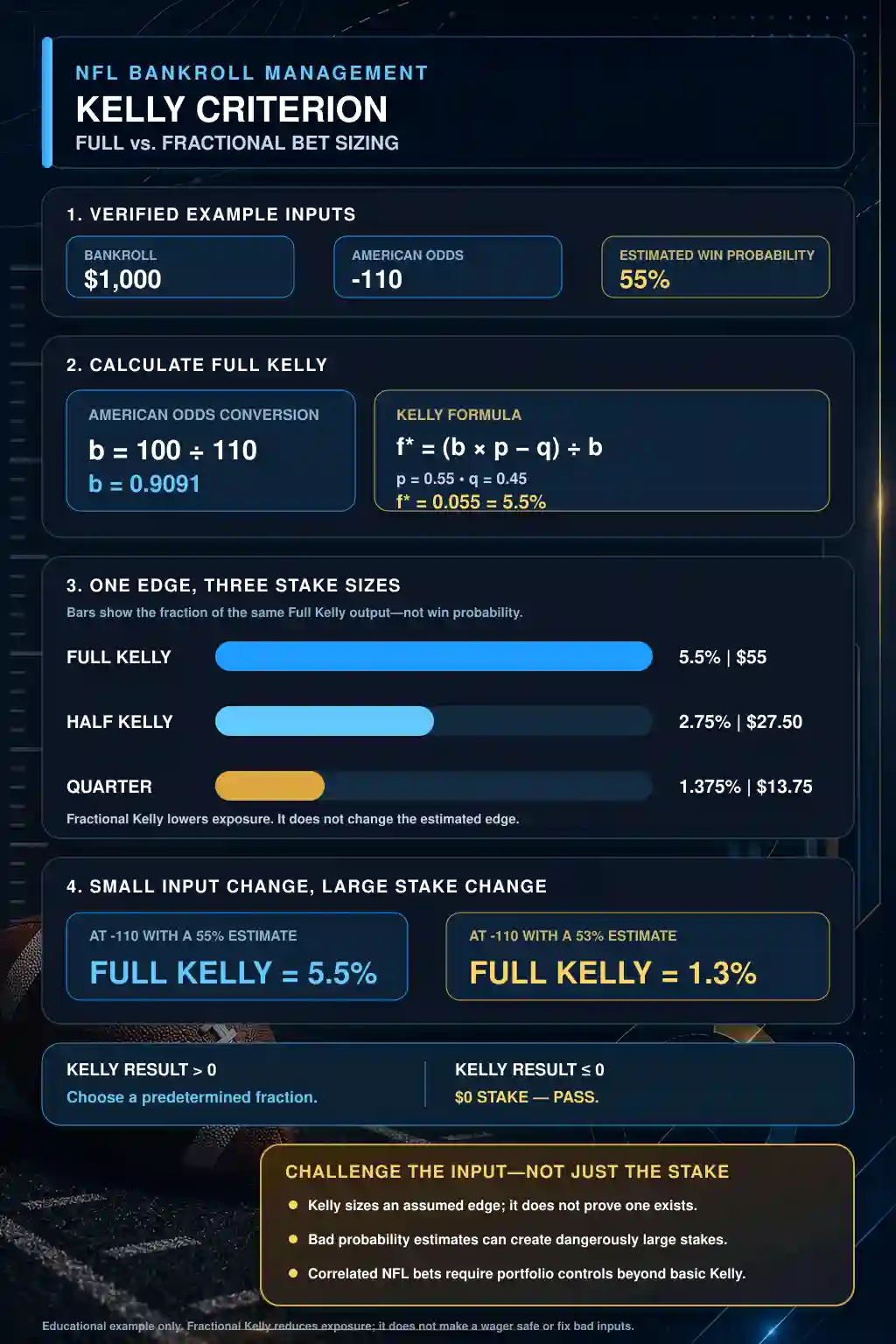
How Do You Calculate Kelly Criterion From American NFL Odds?
For negative American odds of -A, calculate the net profit factor as b = 100 ÷ A. For positive American odds of +A, use b = A ÷ 100.
Then set p equal to the estimated win probability, set q = 1 – p, and calculate:
Full Kelly fraction: f* = (b × p – q) ÷ b
Kelly Calculation Process
1 Convert the odds
Turn the American price into net profit per dollar risked, represented by b.
2 Enter probability
Use the estimated win probability as p and calculate q = 1 – p.
3 Find Full Kelly
Apply the formula to calculate the qualifying percentage of bankroll.
4 Apply the multiplier
Use 1.00, 0.50, or 0.25 and multiply the result by the current bankroll.
Assume a $1,000 bankroll, a current price of -110, and a 55% estimated win probability. The probability is an example input, not a prediction or NFL pick.
| Calculation item | Value | Meaning |
|---|---|---|
| Bankroll | $1,000 | Current betting bankroll |
| Net profit factor | b = 100 ÷ 110 = 0.9091 | Net profit per dollar risked at -110 |
| Win probability | p = 0.55 | Independent estimate |
| Loss probability | q = 0.45 | 1 – p |
| Full Kelly fraction | f* = 0.055 | 5.5% of bankroll |
| Full Kelly stake | $55 | $1,000 × 5.5% |
NFL Kelly Criterion Calculator
Enter the bankroll, current American odds, estimated win probability, and Kelly fraction. The result shows the implied probability, estimated edge, Full Kelly percentage, and applied stake.
The calculator performs arithmetic; it does not validate the probability estimate. Use the betting odds calculator to review odds formats and implied probability before applying an independent estimate.
How Do Break-Even Probability and Betting Edge Affect Kelly?
Break-even probability is the win rate required for a wager to have zero expected profit at the posted price, before considering other costs or errors. At -110, the implied break-even probability is approximately 52.38%. If the bettor estimates 55%, the claimed edge is 2.62 percentage points.
That edge is not established merely because the estimate is higher than the sportsbook number. It depends on whether the forecast is calibrated and whether the available betting odds are current. A model that regularly labels 55% outcomes should be correct close to 55% of the time across a sufficiently large, comparable sample.
The same price-versus-probability test applies when learning how to bet on NFL playoffs. Elimination pressure, injuries, rematches, and public attention can change the assumptions, but they do not automatically create value. These NFL postseason value-wagering tips can help frame the analysis before Kelly determines the qualifying exposure.
| Measure | Question answered | What it cannot establish alone |
|---|---|---|
| Implied probability | What win rate corresponds to the posted price? | Whether the wager has positive expected value |
| Estimated win probability | How often does the bettor believe the outcome will occur? | Whether the forecast is accurate or calibrated |
| Estimated edge | How far is the estimate above the break-even probability? | Whether the gap will persist in real results |
| Kelly percentage | What bankroll fraction follows from those inputs? | Whether the inputs deserve to be trusted |
What Is the Difference Between Expected Value, Betting Edge, and a Kelly Stake?
Expected value, betting edge, and Kelly stake describe connected but different parts of a sports betting decision. Expected value measures the average theoretical return produced by a probability and price. The betting edge describes the advantage implied by that comparison. Kelly uses the same inputs to calculate a bankroll percentage.
| Concept | Question answered | Typical output |
|---|---|---|
| Break-even probability | How often must the wager win to avoid a theoretical loss at this price? | Probability percentage |
| Betting edge | How far does the bettor’s estimate exceed the requirement created by the price? | Probability-point or value comparison |
| Expected value | What is the theoretical average profit or loss per amount wagered? | Currency or percentage return |
| Kelly stake | What percentage of the current bankroll does the formula allocate? | Bankroll percentage and stake amount |
Worked Example at -110
At -110, the net profit factor is approximately 0.9091 and the break-even probability is approximately 52.38%. If the independent win-probability estimate is 55%, expected value per $1 risked is:
(0.55 × 0.9091) − 0.45 = 0.05
That equals approximately $0.05 of theoretical expected profit per $1 wagered. Dividing that value by the net profit factor produces a Full Kelly allocation of approximately 5.5% of bankroll.
A positive expected value does not mean the next wager will win. It describes an average theoretical outcome across repeated comparable opportunities when the probability estimate is accurate.
Kelly does not create the edge. The estimated probability and available betting odds create the formula’s apparent edge; Kelly only translates that relationship into stake size.
Entity Relationship
Available sportsbook price + estimated win probability → expected value and betting edge → Kelly bankroll allocation.
Is Kelly Better Than Flat Betting or Unit Betting for NFL Bankroll Management?
Kelly is not automatically better for every NFL bettor. Kelly changes the stake according to the estimated edge and available price. Flat betting risks the same amount on every wager, while unit betting uses a predefined unit as the standard measure of exposure.
Stake sizing cannot create value by itself, but consistent pricing, recordkeeping, and exposure control support the broader tips that can help boost an NFL bankroll. Increasing stakes to recover losses does not serve the same purpose and can undermine the entire bankroll plan.
| Staking method | How the stake is determined | Primary advantage | Primary limitation |
|---|---|---|---|
| Full Kelly | Uses the complete formula output | Responds directly to the estimated edge and price | Can produce substantial volatility when estimates are uncertain |
| Fractional Kelly | Multiplies Full Kelly by a fixed fraction | Preserves edge-based sizing while reducing exposure | Still depends on an accurate probability estimate |
| Flat betting | Risks the same currency amount on each wager | Simple to follow and audit | Does not adjust automatically for bankroll changes or different estimated edges |
| Unit betting | Risks a predefined percentage or amount represented as one or more units | Makes performance and exposure easier to compare | Variable unit ratings can become subjective without fixed rules |
Fractional Kelly may suit a bettor who has documented probability estimates and wants stake size to respond to the strength of the estimated opportunity. Flat or fixed-unit betting may be easier to manage when probability inputs are unavailable, inconsistent, or not sufficiently tested.
Selection Checklist
- Use a consistent bankroll definition.
- Document how every stake is calculated.
- Do not increase unit ratings because of confidence, recent losses, or a perceived must-win game.
- Do not use Kelly without an independent probability estimate.
- Review combined exposure across related NFL wagers.
The best staking method is the one supported by the bettor’s data and applied consistently. Switching between Full Kelly, fractional Kelly, and unit betting in reaction to short-term results undermines the rules each method is supposed to enforce.
How Do Full and Fractional Kelly Affect Drawdowns and Risk of Ruin?
Full Kelly is designed to maximize expected logarithmic bankroll growth when the probability and payout inputs are accurate. That objective does not minimize short-term losses, prevent losing streaks, or guarantee a smooth bankroll path.
A drawdown measures how far a bankroll falls from a previous peak. NFL variance can create a material drawdown even when a bettor has a genuine long-term edge. Full Kelly generally produces larger stakes than Half or Quarter Kelly, so the bankroll may experience larger swings.
| Kelly approach | Relative stake | Expected practical effect |
|---|---|---|
| Full Kelly | 100% of the formula output | Highest exposure and greater sensitivity to probability error |
| Half Kelly | 50% of the formula output | Lower exposure and typically smaller bankroll swings than Full Kelly |
| Quarter Kelly | 25% of the formula output | More conservative exposure when model uncertainty is substantial |
| Zero Kelly | No wager | Avoids exposure when the supplied inputs do not show a positive allocation |
Fractional Kelly reduces the amount exposed to estimation error, but it does not remove the risk of ruin in every real-world situation. A bettor can still lose the bankroll by using inaccurate probabilities, ignoring correlated wagers, repeatedly exceeding the calculated stake, or adding money needed for other purposes.
A losing run should trigger a review of the probability process, not an automatic increase in stake size. Understanding the possible reasons behind an NFL losing streak can help separate ordinary variance from stale assumptions, poor prices, model errors, or inconsistent bankroll decisions.
Risk-Control Questions
- How large was the worst historical and out-of-sample drawdown?
- Would the selected fraction remain tolerable during a longer losing sequence?
- Are several open tickets exposed to the same NFL outcome?
- Is the probability model demonstrably calibrated?
- Is a maximum stake cap applied consistently?
Important Distinction
Fractional Kelly means less exposure, not a safe bet. No staking formula can eliminate uncertainty from online betting or guarantee bankroll growth.
What Happens When a Bettor Wagers More Than Full Kelly?
Wagering more than Full Kelly is overbetting relative to the formula. If the inputs are correct, Full Kelly represents the allocation that maximizes expected logarithmic bankroll growth under the formula’s assumptions. Increasing the stake beyond that point raises exposure while reducing the expected growth rate.
A larger wager may produce a larger profit when it wins, but it also creates a larger percentage loss when it fails. Because the next Kelly stake is calculated from the remaining bankroll, recovering from a large percentage loss requires a disproportionately larger percentage gain.
| Decision | Immediate effect | Long-term concern |
|---|---|---|
| Use the calculated Full Kelly stake | Accept the complete formula allocation | Substantial volatility remains possible |
| Use a predetermined Kelly fraction | Reduce the calculated stake consistently | Potential growth is exchanged for lower exposure |
| Exceed Full Kelly | Risk more than the formula supports | Expected logarithmic growth declines while drawdown risk increases |
| Increase the stake after a loss | Disconnect exposure from the current edge and bankroll | Loss chasing can compound bankroll damage |
Sufficient overbetting can make expected logarithmic growth negative even when the original wager has positive expected value. That is why a positive edge does not justify an unlimited stake.
Overbetting Warning
Full Kelly is not a minimum recommendation or a challenge to bet more. It is the formula’s upper growth-maximizing allocation under exact assumptions. Probability uncertainty is one reason bettors may select Half Kelly, Quarter Kelly, or a separate maximum-exposure cap.
What Is the Difference Between Full Kelly and Fractional Kelly?
Full Kelly uses 100% of the formula output. Fractional Kelly uses a predetermined portion of it. The estimated edge remains unchanged; only the amount risked becomes smaller.
| Kelly approach | Multiplier | Bankroll percentage | Stake | Tradeoff |
|---|---|---|---|---|
| Full Kelly | 1.00 | 5.5% | $55 | Uses the complete growth-optimal result and creates the greatest exposure of the three |
| Half Kelly | 0.50 | 2.75% | $27.50 | Cuts the formula stake in half |
| Quarter Kelly | 0.25 | 1.375% | $13.75 | Uses one-quarter of the formula stake |
Critical Limitation
Fractional Kelly reduces exposure, but it does not repair a bad probability estimate. If a bettor repeatedly claims edges that do not exist, a smaller fraction can slow the damage without turning the wagers into positive-expectation bets.
Research on practical sports-betting strategies has found fractional Kelly useful when the fraction reflects uncertainty, but that does not create one universal best multiplier for every bettor or model. See Optimal Sports Betting Strategies in Practice for an academic comparison of staking approaches.
How Should Kelly Handle Pushes, Voids, Parlays, and Same-Game Parlays?
The basic Kelly formula assumes one wager with two possible financial outcomes: a win or a loss. NFL wagers may also push, become void, contain several parlay legs, or depend on correlated outcomes. Those conditions must be represented before calculating the stake.
| Ticket type | Kelly consideration | Required information |
|---|---|---|
| Push | The returned stake produces no profit or loss | Win, loss, and push probabilities plus the settlement rule |
| Void wager | The stake is generally returned according to sportsbook rules | Exact void conditions and whether any portion remains active |
| Independent parlay | The calculation uses the complete ticket price and joint win probability | Probability that every leg wins and the final offered payout |
| Same-game parlay | Correlation changes the probability that all legs win together | A defensible joint probability that accounts for dependence |
| Bonus or free bet | The return structure may differ from a cash wager | Whether the original stake is returned and any promotional restrictions |
When a push returns the full stake, its bankroll-growth contribution is neutral. Bettors should not treat a possible push as a loss, but they also should not ignore it when estimating the probabilities of every settlement outcome.
For a parlay, multiplying individual leg probabilities is only appropriate when the legs are independent and the individual estimates are valid. Same-game parlays often contain positive or negative correlation, so multiplying standalone probabilities can materially misstate the ticket’s true win probability.
Big-event promotions do not remove that requirement. This guide to special parlays on big events can help bettors understand the available ticket types, but Kelly still requires the final payout and a defensible probability that the complete parlay wins.
Parlay Calculation Rule
Use the final parlay payout and the probability that the complete ticket wins. Do not add the individual Kelly percentages for each leg or apply a straight-bet Kelly result to the entire parlay.
Settlement rules can vary by sportsbook, market, and promotion. Confirm how the ticket handles pushes, void legs, ties, player inactivity, and stake-return conditions before calculating its value.
Free bets and free-play bonuses require separate evaluation because the promotional stake may not be returned after a win. Before applying any stake-sizing calculation, understand how to use free bets to your advantage and how to maximize a free-play bonus, including its eligible markets, payout structure, expiration date, and wagering restrictions.
Critical Challenge
A precise Kelly calculation does not make an uncertain parlay probability reliable. When dependence between legs cannot be estimated defensibly, passing or applying a stricter exposure limit may be more rational than forcing a formula output.
Can Closing Line Value Help Validate a Kelly Betting Process?
Closing line value, commonly called CLV, compares the betting odds accepted by a bettor with the market price near closing. Consistently obtaining a better price than the closing line can provide one signal that the selection and timing process is identifying useful numbers.
For example, accepting +120 before the market closes at +105 gives the bettor a higher potential return for the same winning outcome. On a point spread, taking +3.5 before the market closes at +3 may also represent useful closing line value because the accepted ticket holds the better number.
Wild Card markets can react quickly to injuries, weather, matchup narratives, and public playoff attention. An NFL Wild Card betting guide can help identify the market conditions that require review, while these tips for handicapping NFL Wild Card rounds provide additional context for building the probability estimate.
| CLV observation | Possible interpretation | Necessary caution |
|---|---|---|
| Better price than close | The bettor captured a more favorable payout or number | One wager does not validate the complete process |
| Repeated positive CLV | The selection or timing method may identify useful sportsbook lines | Market quality, sample size, and recorded timestamps still matter |
| Negative CLV | The bettor repeatedly accepted worse numbers than those available later | A later move does not automatically prove the original wager lacked value |
| Positive CLV with losses | Short-term outcomes can differ from the price-based signal | CLV does not pay the ticket or guarantee future profit |
Recommended Betting Log
- Record the NFL market and exact selection.
- Record the accepted sportsbook line and timestamp.
- Save the estimated win probability used for Kelly.
- Record the chosen Kelly multiplier and final stake.
- Capture a consistent closing-price source.
- Separate straight bets, props, live wagers, and parlays during review.
CLV should be reviewed with probability calibration, expected value, sample size, bankroll drawdown, and adherence to the staking rules. It can help evaluate whether a sports betting process is capturing competitive betting odds, but it does not independently prove that the probability model is accurate.
Final Answer
CLV is a diagnostic signal, not proof of profitability. It becomes more useful when it is measured consistently across a documented sample and evaluated alongside the probability estimates that produced each Kelly stake.
Should NFL Bettors Use Half Kelly or Quarter Kelly?
There is no universal answer. Half Kelly risks 50% of the Full Kelly result; Quarter Kelly risks 25%. The choice should reflect model calibration, probability uncertainty, tolerance for drawdowns, and total exposure across open bets.
A newer or weakly calibrated model gives the bettor less reason to trust a large result. A mature model can still be wrong when injuries, weather, lineup information, or a rapidly moving market changes the assumptions. Choose the multiplier before seeing the result and use it consistently rather than increasing it after wins or chasing losses.
Fraction Selection Checklist
Calibration evidence
Check whether past probability buckets have performed close to their stated rates.
Market stability
Recalculate when the line changes because the payout and break-even point have changed.
Drawdown tolerance
Use a fraction that keeps normal losing runs within an acceptable bankroll range.
Portfolio exposure
Review every open wager tied to the same team, player, or game script.
Why Can a Small Probability Error Change the Kelly Stake So Much?
Kelly responds directly to the size of the estimated edge. At -110, lowering the win estimate from 55% to 53% cuts Full Kelly from 5.5% to about 1.3%. A two-percentage-point change in the forecast reduces the stake by more than three-quarters.
Probability inputs should also be updated as the season develops. These tips on handicapping the NFL season’s second half explain why injuries, team development, schedule context, and changing market expectations can make an early-season estimate unreliable later in the year.
The transition into meaningful games requires another adjustment. A guide explaining how to bet NFL regular-season games can help define the markets and information that matter once team objectives stabilize, while these expert tips for the first weeks of the NFL season explain why small samples and uncertain team identities should be treated carefully.
| Estimated win probability | Estimated edge over 52.38% | Full Kelly result | Stake on $1,000 |
|---|---|---|---|
| 55% | 2.62 percentage points | 5.5% | $55 |
| 53% | 0.62 percentage points | About 1.3% | About $13 |
| 52.38% | 0 percentage points | 0% | $0 |
This sensitivity is why probability calibration matters more than the appearance of precision. Entering 55.0% instead of 53.0% is not a harmless rounding choice; it materially changes how much the formula tells the bettor to risk.
Can Kelly Be Used for NFL Spreads, Moneylines, Totals, and Player Props?
Yes, the binary Kelly formula can be applied when a wager has a defined price, two settlement outcomes for the calculation, and a credible win-probability estimate. That can include NFL spreads, moneylines, game totals, NFL team totals, and player props. Push rules, void conditions, and ties must be handled correctly rather than treated as ordinary losses.
The handicapping inputs must match the market being priced. Understanding the differences between sides and totals can help bettors separate matchup-based estimates from scoring-based estimates before applying the Kelly formula.
| NFL market | Probability to estimate | Primary modeling risk |
|---|---|---|
| Point spread | Probability the selected side covers the posted spread | Using a probability for a different spread or stale price |
| Moneyline | Probability the team wins under the market’s settlement rules | Confusing the implied probability with an independent fair estimate |
| Game total | Probability the final score finishes over or under the posted total | Ignoring weather, pace, injuries, or a moved number |
| Team total | Probability one team finishes over or under its posted number | Double-counting the same game-script edge across related bets |
| Player prop | Probability the player clears or stays below the posted threshold | Uncertain role, playing time, injury status, or correlated exposure |
For a current market example, review the available NFL team totals, record the exact number and price, and calculate the stake only from a probability estimate tied to that same line.
Kelly can also size an NFL win-total or division futures wager when the ticket price, settlement conditions, and fair probability are clearly defined. First review how to spot an NFL division win total bet, then calculate exposure using the exact available market rather than a general season forecast.
The same requirements apply to conference futures, but the longer settlement period and exposure to several playoff outcomes add uncertainty. Review this NFL conference futures betting guide before estimating the complete ticket’s probability and allocating bankroll with Kelly.
How Do You Read MyBookie NFL Odds Before Using Kelly?
To read MyBookie NFL odds for a Kelly calculation, identify the market, selection, line, and American price. The line describes the outcome being priced; the odds determine the potential net return and implied break-even probability.
For example, a spread of -3.5 at -110 means the selected team must cover -3.5 under the listed settlement rules, while -110 means $110 is risked to earn $100 in net profit. If the line moves to -4 or the price moves to -115, the original Kelly calculation is stale.
The attached GSC data shows existing visibility for question searches such as “how do I read the odds on MyBookie” and “how to read MyBookie odds.” This section answers those questions directly and connects them to the formula rather than using them as isolated keywords.
MyBookie NFL Price Check
Check the current MyBookie NFL lines and MyBookie NFL odds before every calculation. A change in the available price changes the net profit factor, implied probability, estimated edge, and Kelly stake.
How Do Vig, Sportsbook Lines, and Line Movement Affect Kelly Bet Size?
A sportsbook price includes margin. If both sides are -110, each side has a posted implied probability of approximately 52.38%, for a combined 104.76%. That does not mean both outcomes can be 52.38% likely. Removing the margin can create a market benchmark, but the resulting no-vig probability is still not automatically the bettor’s independent estimate.
| Market input | Role in the calculation | Required action |
|---|---|---|
| Posted price | Determines payout and implied probability | Use the price available when the ticket is being considered |
| Sportsbook margin | Causes the two posted implied probabilities to exceed 100% | Remove vig only when building a market benchmark |
| Line movement | Changes the outcome, payout, or both | Recalculate after the number or price changes |
| Independent estimate | Determines whether the formula identifies a positive edge | Keep it separate from the posted implied probability |
Comparing odds for sports is therefore part of the process. Better prices improve the payout factor, while worse prices reduce the claimed edge and the qualifying stake. Whether the searcher calls them NFL lines, NFL sportsbook odds, online NFL odds, MyBookie lines, or general sportsbook lines, Kelly must use the exact price attached to the intended wager.
PRICE CHECK
Confirm the NFL Number Before Sizing the Wager
Record the current line and American price, update the win estimate for that exact market, and rerun the Kelly calculation before deciding whether the wager qualifies.
What Does a Zero or Negative Kelly Result Mean?
A zero or negative Kelly result means the supplied probability and price do not produce a positive qualifying stake. The practical stake is $0.
Do not force a bet, round the result upward, or automatically play the other side. The opposite side requires its own current price and independent probability estimate. A no-bet decision is a valid output of a disciplined sports betting process.
| Formula result | Action | Reason |
|---|---|---|
| Positive | Apply the predetermined Kelly multiplier and exposure rules | The supplied inputs show a qualifying estimated edge |
| Zero or negative | Pass | The price and estimate do not support a positive Kelly stake |
| Changed line, price, or bankroll | Recalculate | The previous result no longer represents the current inputs |
The simple binary Kelly formula assumes one isolated wager. NFL tickets frequently share the same underlying outcome. A game over, a quarterback passing-yards over, and an opponent team-total over may all benefit from the same high-scoring game script.
Calculating each ticket separately and adding every suggested stake can understate the real concentration of risk. Identify the shared driver, set a combined exposure limit, and recalculate the available bankroll after accepted wagers. More advanced portfolio Kelly methods require joint probabilities and correlations that the basic calculator on this page does not estimate.
The same concentration risk applies when splitting a bankroll between first-half and second-half NFL bets. Before calculating each stake separately, determine whether both wagers depend on the same pace, matchup, injury, or game-script assumption.
Kelly determines the initial stake, while hedging changes the exposure after another position or new information enters the market. The hedge-wagering guide explains the risk-management concept, while this guide on how to hedge a bet covers the practical mechanics. Any hedge should be evaluated as part of the complete position rather than as an isolated wager.
Three-Step Correlation Check
1 Identify the common driver
Find the team result, player role, scoring environment, or game script shared by the tickets.
2 Cap combined exposure
Set the maximum bankroll amount tied to that shared outcome before placing the bets.
3 Recalculate
Update the available bankroll and current prices after each accepted wager.
Does Online Betting, Bitcoin Betting, or Crypto Betting Change the Kelly Formula?
No. Online betting, bitcoin betting, and crypto betting may use different funding or settlement methods, but the Kelly calculation still depends on bankroll, betting odds, and estimated win probability. The payment method does not create an edge or change the formula.
Bettors unfamiliar with the payment layer can begin with this explanation of crypto betting sites and this guide to how crypto betting mechanics work. Both concepts affect how funds enter and leave the sportsbook account, while the wager still depends on the offered price and estimated probability.
The same principle applies whenever someone chooses to bet on sports through an online sportsbook. If you bet on NFL football online, define the bankroll in one consistent unit, record the displayed line and price, account for any material conversion or transaction cost outside the formula, and size the wager from the actual price. Mixing dollars and cryptocurrency units without a consistent bankroll value can distort exposure even when the percentage calculation is correct.
Before moving a bankroll, bettors should understand how to use Bitcoin for online sportsbooks and casinos, including wallet transfers, confirmations, transaction costs, and withdrawal procedures. The MyBookie Bitcoin sportsbook provides the related Bitcoin betting information, but the bankroll should still be recorded in one consistent unit before Kelly determines exposure.
Transaction speed may improve access to a price before the market moves, but it does not make that price valuable automatically. A disciplined crypto betting strategy should account for funding speed, betting limits, conversion costs, and available sportsbook lines without increasing the Kelly stake simply because funds arrive faster.
What Are the Most Common Kelly Criterion Mistakes in NFL Betting?
| Mistake | What goes wrong | Better process |
|---|---|---|
| Using the sportsbook’s implied probability as the bettor estimate | No independent edge has been established | Build and validate a separate probability estimate |
| Using a stale line | The formula uses a payout or threshold that is no longer available | Confirm the current number immediately before calculating |
| Overestimating win probability | The formula recommends more exposure than the evidence supports | Measure calibration and challenge aggressive estimates |
| Treating fractional Kelly as protection from bad bets | A smaller stake is mistaken for a corrected edge | Separate stake reduction from probability validation |
| Ignoring correlated wagers | Several tickets create concentrated exposure to one outcome | Review the group as a portfolio and cap combined risk |
| Failing to update the bankroll | The next dollar stake is based on old capital | Recalculate from the current available bankroll |
| Chasing losses | The multiplier changes in reaction to results rather than evidence | Use a predetermined fraction consistently |
What Is a Repeatable Kelly Criterion NFL Betting Workflow?
A repeatable workflow separates market observation, probability estimation, stake calculation, and portfolio control. That structure is more useful than asking the calculator to make the betting decision.
A complete betting process also extends beyond the formula. These seven successful NFL betting tips provide broader context for research, line evaluation, discipline, and decision-making before Kelly converts an estimated edge into a stake.
NFL Kelly Sizing Workflow
1 Define the bankroll
Use money reserved for betting and affordable to lose.
2 Record the market
Capture the selection, line, price, and settlement rules.
3 Estimate probability
Use an independent, calibrated forecast for that exact outcome.
4 Calculate Full Kelly
Convert the odds and apply the binary Kelly formula.
5 Apply the fraction
Use the predetermined Full, Half, or Quarter Kelly multiplier.
6 Check portfolio exposure
Reduce or pass when related tickets make the combined risk too large.
7 Recheck the price
Recalculate if the line or odds changed before placement.
8 Bet or pass
Accept a positive result only when the inputs and exposure rules still qualify.
For anyone learning how to bet on NFL games, the broader NFL betting guide explains market types and bankroll discipline. For current NFL online wagering markets and betting on NFL games online, compare the live numbers at the MyBookie NFL sportsbook.
Kelly Criterion for NFL Betting FAQ
What is the Kelly Criterion in sports betting?
It is a stake-sizing formula that converts the current bankroll, available odds, and an independent win-probability estimate into a suggested bankroll percentage. It produces a positive stake only when the supplied estimate exceeds the break-even threshold implied by the price.
What is the difference between Full Kelly and fractional Kelly?
Full Kelly uses 100% of the formula result. Fractional Kelly uses a fixed portion, such as 50% for Half Kelly or 25% for Quarter Kelly, to reduce the amount of bankroll exposed.
How much should I bet on an NFL game using Kelly?
There is no universal dollar amount. Enter the current bankroll, actual American odds, and an independent probability estimate. Apply the chosen Kelly multiplier only if the result is positive and fits the bettor’s combined exposure limit.
How do you calculate Kelly Criterion using American odds?
Convert negative odds with b = 100 divided by the absolute odds, or positive odds with b = odds divided by 100. Then calculate f* = (b multiplied by p minus q) divided by b, where p is win probability and q equals 1 minus p.
Should NFL bettors use Half Kelly or Quarter Kelly?
Neither fraction is universally correct. The choice depends on probability calibration, uncertainty, drawdown tolerance, and combined exposure. The multiplier should be selected before seeing the result and applied consistently.
Can Kelly be used for NFL spreads, moneylines, totals, and props?
Yes, when the bettor has the exact price, understands the settlement rules, and can estimate the probability of the specific outcome. Pushes, voids, and correlated wagers require additional care.
What does a negative Kelly result mean?
It means the supplied price and probability do not produce a positive qualifying stake. The practical result is a $0 wager, not an instruction to force the opposite side.
Should Kelly stakes be recalculated after every NFL bet?
Recalculate whenever the bankroll, line, price, probability estimate, or portfolio exposure changes. An accepted wager or market move can make the previous stake stale.
Can a Kelly Criterion calculator prove that an NFL bet has value?
No. The calculator processes the probability entered by the bettor. It cannot verify the model, prove the edge, predict the winner, or correct an overconfident estimate.
Does the Kelly Criterion guarantee a profit?
No. Estimates can be wrong, positive-expectation wagers can lose, and bankroll drawdowns can be substantial. Kelly is a sizing framework, not a guarantee.
Kelly Criterion NFL Betting Summary
- Kelly sizes a wager; it does not select the winner.
- The calculation requires the current bankroll, available price, and an independent win-probability estimate.
- Full Kelly uses the complete result; Half and Quarter Kelly reduce the stake by fixed multipliers.
- At -110 with a 55% estimate, Full Kelly is 5.5%; at 53%, it falls to about 1.3%.
- A zero or negative result means a $0 stake.
- Line movement, probability error, and correlated tickets can materially change the correct exposure.
- Online betting and the use of dollars, Bitcoin, or another cryptocurrency do not change the Kelly formula.
Sources and Methodology
The formula and growth-rate context are based on John L. Kelly Jr.’s original 1956 paper published by Bell Labs. The practical discussion of fractional staking and uncertainty is informed by peer-reviewed and academic work on sports-betting allocation. All examples in this guide are hypothetical and were recalculated for mathematical consistency.
- Kelly, J. L. Jr. (1956), A New Interpretation of Information Rate
- Uhrín et al. (2021), Optimal Sports Betting Strategies in Practice
NFL BANKROLL CHECK
Match the Stake to the Current NFL Price
Confirm the bankroll, review the current number, calculate Full Kelly, apply the predetermined fraction, and pass when the result or combined exposure does not qualify.
Important: Sports betting involves risk. No Kelly fraction guarantees results. Only wager money set aside for betting and affordable to lose, and manage both individual stakes and combined exposure.
Final Thoughts: Is the Kelly Criterion Useful for NFL Betting?
The Kelly Criterion is useful when a bettor already has a defensible probability estimate and needs a consistent way to translate that estimate into stake size. Its discipline comes from using the current price, recalculating when conditions change, reducing exposure through a predetermined fraction, and accepting a $0 result.
Its weakness is equally important: an exact formula cannot make an uncertain forecast exact. The authority of an NFL Kelly process therefore comes from calibrated probabilities, transparent assumptions, current sportsbook prices, and portfolio-level risk control—not from the calculator alone.
MyBookie: Bet On Anything. Anywhere. Anytime.
Important: Sports betting involves risk. No strategy guarantees results, and managing exposure is essential.

About the Author

Since 2008, D.S. Williamson has written about sports and sports handicapping. His philosophy is value-based, meaning statistics and other handicapping factors are only useful when compared with the available wagering odds. He believes bankroll management and consistently making value-based wagers are the most important factors separating successful sports bettors from unsuccessful bettors.
Sportsbook Bonuses
Read requirements in the Bonus page. However, if you want to take a deep knowledge, go to MyBookie Bonus Rules and How to


🔍 Explore Everything you Need to Know aboout your Licensed, Trusted Home For Casino and Sports Since 2014
👉 Gamble responsibly—must be 21+ and in a Legal Jurisdiction | Get Help at 1-800-Gambler