Last updated: August 2026
Getting into sports betting sounds simple until you actually try it. So where do you start?
Most beginners already follow sports closely and assume that’s enough to start winning money. It helps, but it isn’t the whole picture. You also need to understand betting odds, sportsbook lines, bankroll management, and risk.
A good starting point is the MyBookie sports betting guide, followed by the habits covered in becoming a more successful sports wagering player. Worth knowing too: the different types of sports bettors. Recreational, analytical, and high-volume bettors don’t use information or manage risk the same way.
Before placing a bet, get familiar with how to start betting on sports and how an online betting account actually works. Sportsbooks set the lines and manage the wagers, so it’s worth reading how sportsbooks work before your first bet.
Editorial Note
This MyBookie guide explains sports betting basics, bankroll management, betting odds, value, research, online betting, bitcoin betting, and crypto betting. It is intended for educational purposes and does not guarantee winning outcomes, profits, or betting success.
Quick Answer
To start sports betting successfully, set aside a separate bankroll, risk only a small unit on each wager, learn how odds and bet types work, research one sport carefully, compare sportsbook lines, and track every result. A disciplined process improves decision quality, but no strategy can remove uncertainty or guarantee profit.
Table of Contents
- Editorial Note
- What Is Sports Betting and How Does It Work for Beginners?
- How Should a Beginner Set Up a Sports Betting Bankroll?
- Why Should You Bet With Your Head Instead of Your Heart?
- How Do Betting Odds and Sportsbook Lines Work?
- How Does a Point Spread Work in Sports Betting?
- What Is a Straight Bet, and Which Bet Types Should Beginners Learn First?
- Why Is Research an Important Part of Sports Betting?
- How Should Beginners Use Sports Betting Statistics?
- When Should You Skip a Sports Bet?
- Why Should Beginners Focus on One Sport or League Initially?
- How Do You Identify a Value Bet?
- How Do You Read and Compare Sportsbook Lines?
- Why Should You Keep a Log of Every Wager?
- Why Is Chasing Sports Betting Losses Dangerous?
- Why Must Bettors Accept That Losing Is Part of the Game?
- Can a Sports Betting System Guarantee Success?
- How Does Online Sports Betting With Bitcoin and Crypto Work?
- How Do Free Bets Work in Sports Betting?
- What Is the Step-by-Step Process for Placing Your First Sports Bet?
- How Can Beginners Build a Repeatable MyBookie Sports Betting Process?
- Frequently Asked Questions About Starting Sports Betting
- How do I start sports betting successfully?
- How much money do I need to start sports betting?
- What is the easiest sports bet for a beginner to understand?
- What is a straight bet in sports betting?
- How do betting odds work?
- What are sportsbook lines?
- How do free bets work in sports betting?
- Can beginners use bitcoin for online sports betting?
- How much should a beginner risk on one sports bet?
- Can sports betting guarantee a consistent profit?
- What happens if a game is postponed or canceled?
- Summary: How to Start Sports Betting Successfully
- What Is the Final Lesson for Starting Sports Betting Successfully?
What Is Sports Betting and How Does It Work for Beginners?
Sports betting means wagering on how a sporting event, or something specific within it, turns out. A sportsbook sets the odds, takes the bets, grades results by its own rules, and pays out winning tickets at the posted price.
That part is simple. What trips up beginners is the difference between picking a winner and judging whether the price on offer is actually worth taking. Think of this as a Sports Betting 101 primer, not a shortcut to easy money.
Start with understanding probability in sports wagering and what implied probability means in online wagering. From there, the art of sports wagering is putting those numbers together with context and judgment, and knowing when to walk away from a bad price.
Sports Betting Basics
1 Choose a market
Select a moneyline, point spread, total, prop, or another available wager.
2 Read the price
Betting odds show the potential return and the probability implied by the sportsbook.
3 Enter the stake
The stake is the amount of bankroll risked on that individual wager.
4 Grade the result
The sportsbook settles the ticket as a win, loss, push, or void according to its rules.
How Should a Beginner Set Up a Sports Betting Bankroll?
Before wagering on anything, you need money set aside and a plan for bankroll money management. There’s no guarantee of winning, so that money has to be money you can afford to lose.
For this guide, assume a starting bankroll of $1,000 (yours could be more or less). A conservative approach risks 1% to 2% of that on a single bet, which comes out to $10 to $20 in this case.
| Bankroll Decision | Practical Rule | Why It Matters |
|---|---|---|
| Starting bankroll | Use only money you can afford to lose | Keeps betting separate from essential expenses |
| Unit size | Begin with 1% to 2% per wager | Reduces the damage caused by a losing streak |
| Bet sizing | Keep the unit consistent | Prevents confidence or frustration from controlling risk |
| Review point | Recalculate only after a meaningful bankroll change | Keeps stakes connected to available funds |
Playing this way allows the bankroll to withstand losing streaks that will inevitably occur. It also makes the results easier to compare because each wager represents a consistent share of the total bankroll.
Beginner Unit Size Calculator
Enter a bankroll and a risk percentage to calculate the amount assigned to one wager.
Why Should You Bet With Your Head Instead of Your Heart?
For most bettors, sports betting comes down to using data, context, and the posted odds to find a wager worth taking. That takes objective analysis, not automatic loyalty to a favorite team.
Betting on your favorite team when the evidence and the price don’t support it is one of the fastest ways to burn through a bankroll. If you can’t keep emotion out of that decision, don’t make that bet.
That’s why it’s worth thinking carefully about wagering on your own team. Familiarity can help, but what you know in sports wagering shouldn’t be confused with loyalty, and common handicapping myths are worth reviewing to separate evidence from assumptions.
Head Versus Heart Check
Head-based decision
Reviews form, injuries, matchup data, price, market movement, and the amount at risk.
Heart-based decision
Starts with the desired outcome and looks for reasons to justify the bet afterward.
From a betting perspective, experienced bettors are willing to pass when their analysis does not support the available number. The ability to make no bet is part of a complete strategy.
How Do Betting Odds and Sportsbook Lines Work?
Every game has odds attached to its possible outcomes, and those prices set both the potential payout and the implied probability. Lines move as new information comes in, betting action shifts, or the book adjusts its position.
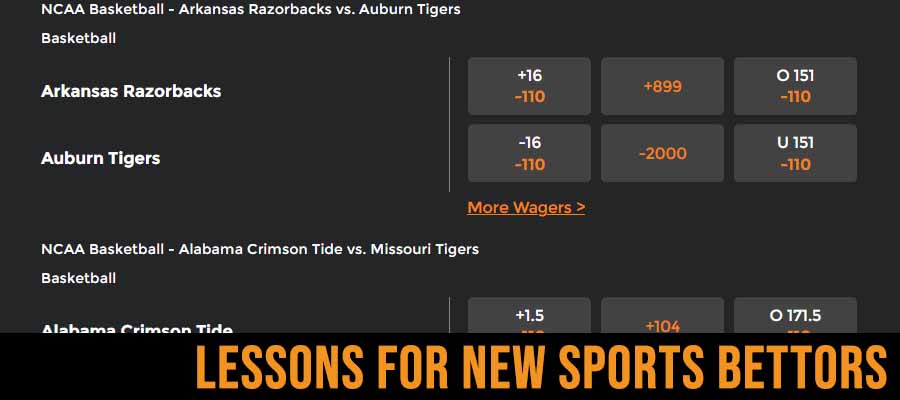
Odds show up in American, decimal, or fractional format. Worth knowing too is where the numbers come from: the difference between an oddsmaker and a bookie explains how lines get made, adjusted, and put in front of bettors.
Why sportsbook odds matter comes down to this: the price sets both potential return and break-even probability. It’s also worth understanding the bookmaker advantage and learning how to read lines and find value before treating any pick as a worthwhile bet.
| Format or Market | How to Read It | Beginner Takeaway |
|---|---|---|
| American odds | +150 returns $150 profit on a $100 stake; -150 requires a $150 stake to return $100 profit | Positive and negative numbers express price, not certainty |
| Decimal odds | 2.50 means the total return is 2.5 times the stake | The total return includes the original stake |
| Fractional odds | 3/2 means $3 of potential profit for every $2 staked | The fraction shows profit relative to stake |
| Point spread | A favorite at -4½ must win by at least 5 points for that spread ticket to cash | A spread measures margin, not just who wins |
Quick Answers About Sportsbook Lines
How do sports betting numbers work? They describe the market condition a selection must satisfy and the price paid if the wager wins.
Why do sportsbook lines change? Lines can react to news, injuries, confirmed lineups, market action, and changes in the book’s risk.
How Does a Point Spread Work in Sports Betting?
A point spread adds a handicap to the final score. The favorite has to win by more than the listed number, while the underdog covers by winning outright or losing by less than that margin.
A favorite at -4½ has to win by at least 5 points for the bet to cash. The half-point is there so the adjusted score can’t land exactly even, meaning the ticket can’t push on that number.
Spread bets make more sense once you understand the strategic differences between favorites and underdogs. That same discipline around price is behind when to stay away from favorites, why large spreads call for extra caution, and the golden rules of betting against the spread that can guide a pre-bet review.
Sports Betting Point Spread Explained
Favorite with a minus sign
The favorite must win by more than the posted handicap.
Underdog with a plus sign
The underdog may cover by winning or by losing within the listed margin.
Half-point line
The added half point removes the possibility of an exact tie against the spread.
What Is a Straight Bet, and Which Bet Types Should Beginners Learn First?
A straight bet is one wager on one outcome. For a beginner learning how to bet on sports, straight bets are easier to evaluate and track than combinations that require several outcomes to win.
Start by understanding moneylines, point spreads, and totals. Parlays, props, futures, and live markets can be studied later, after you are comfortable reading the price, potential payout, and settlement rules.
Once those foundations are clear, a guide to sports wagers beginners can explore can help you expand gradually without skipping the basics. Regardless of the market, the online wagering tips you should never ignore still apply: understand the rules, confirm the price, control the stake, and never bet solely because an option is available.
| Bet Type | What Must Happen | What the Beginner Is Evaluating |
|---|---|---|
| Moneyline | The selected side wins under the market’s rules | Winner and price |
| Point spread | The selected side covers the listed handicap | Expected margin of victory or defeat |
| Total | The combined score finishes over or under the posted number | Expected scoring environment |
| Parlay | Every included selection must satisfy the ticket rules | Several linked decisions and a higher chance of failure |
Beginner Principle
Learn one market at a time. Understanding why a straight bet won or lost is more useful than adding several unfamiliar selections to one ticket.
Why Is Research an Important Part of Sports Betting?
Consistently making strong sports betting decisions does not happen through pure luck or chance. Skilled bettors take time to examine the factors that could affect a game and then decide whether those factors are already reflected in the price.
If you are not prepared to put in the work, be prepared for inconsistent decisions. Research becomes even more important when markets move in real time, so live bettors should understand the best sportsbook features for live betting, including tools that help monitor odds changes and react as game conditions evolve.
Four-Part Research Process
1 Establish context
Review the matchup, venue, schedule, incentives, and current team situation.
2 Confirm availability
Check injury reports, projected lineups, official updates, and late changes.
3 Compare performance
Use recent and longer-term data without relying on one isolated statistic.
4 Evaluate the price
Decide whether the current odds compensate for the uncertainty and risk.
Useful research sources include ESPN, Sports Reference, Odds Shark, real-time social media updates, and advanced analytics platforms. The source is only the starting point; the bettor must still interpret what the information means for the market.
Research becomes more useful when it accounts for the specific circumstances surrounding an event. Learning what situational wagering means, choosing a strategy that fits the sport you know best, and understanding what point shaving is can help beginners recognize why context and market integrity matter alongside statistics.
Live markets add a timing decision to the research process. Before participating, study practical live wagering strategies and tips, learn how to evaluate changing live odds, and understand the advantages of live betting without assuming that faster information guarantees an edge.
The same discipline applies to live in-game betting decisions and the broader advantages of in-play wagering. Specialized situations such as halftime wagering, heated rivalry games, or teams with poor season starts require fresh analysis rather than an emotional reaction to what just happened.
BUILD THE ROUTINE
Research First, Choose the Market Second
Confirm the matchup information, compare the price with your assessment, set the stake from your bankroll plan, and place the wager only when the full decision makes sense.
How Should Beginners Use Sports Betting Statistics?
Sports betting statistics help describe performance, but they do not automatically identify a good wager. The useful question is whether a statistic is relevant to the matchup and whether the sportsbook has already accounted for it in the odds.
When learning how to use statistics in sports betting, combine data with context. A strong recent record may look persuasive, but opponent quality, injuries, schedule strength, venue, and sample size can change its meaning.
Statistics Quality Check
Relevance
Does the number describe the market or matchup you are actually betting?
Sample
Is the conclusion based on enough comparable events to be useful?
Context
Did opponents, injuries, venue, or game state influence the result?
Price
Does the data reveal an edge, or has the market already adjusted?
It is important to note: even relevant sports betting data describes what has happened; it cannot eliminate uncertainty about what happens next.
Statistics should support a transparent method, not a supposed shortcut. Claims about secret tips for beating the bookie or methods that supposedly tilt the odds in your favor still need to be tested against price, sample size, and risk. Even wagering myths that appear to contain some truth should never replace matchup-specific evidence.
When Should You Skip a Sports Bet?
On any given day, there may appear to be low-hanging fruit, but an obvious favorite is not automatically a worthwhile wager. The decision must account for the amount risked relative to the potential return.
A top NBA team facing a club on a massive losing skid might be priced at -1200. The favorite may appear highly likely to win, but risking $20 to earn only $1.67 in potential profit creates an unfavorable consequence if the upset occurs.
Relative Risk and Reward
These bars illustrate relative exposure rather than measured probability.
Upsets happen, so risk-and-reward evaluation is essential. Skip the game when the price does not compensate for the risk, even if you believe you know which team will win.
The opposite problem occurs when attractive payouts make unlikely outcomes appear more valuable than they are. Compare the logic behind betting huge underdogs, wagering on heavy underdogs, and an optimal longshot strategy before assuming that a large potential return creates value.
A disciplined bettor evaluates the market rather than the label. That includes learning how to identify potentially valuable underdogs and understanding the pricing logic behind betting on draws, where a less likely result can still be correctly or incorrectly priced.
Why Should Beginners Focus on One Sport or League Initially?
When you log in to a sports betting account, you will see an incredible number of betting options. Beginners may feel pressure to make selections across several sports simply because the markets are available.
The smarter approach is to block out the noise and focus on the sport you understand best. If you routinely watch the NHL, for instance, you may already know the teams, current form, and injuries, which gives your research a stronger starting point.
Why Specialization Helps
Familiar context
You can recognize when a statistic or headline is misleading.
Faster comparison
Repeated exposure makes teams, players, markets, and typical prices easier to compare.
Cleaner tracking
A focused record makes strengths and weaknesses easier to identify.
Specialization does not guarantee an edge, but it reduces the number of unfamiliar variables you are trying to evaluate at once.
Specialization also makes it easier to compare repeatable situations within one market. Over time, that focused evidence is more useful than jumping between unrelated sports or changing strategies after every short-term result.
How Do You Identify a Value Bet?
A value bet occurs when your estimated probability of an outcome is higher than the probability implied by the available odds. If you estimate that a team has a 60% chance of winning while the price implies only 50%, the difference may indicate value.
This does not mean the individual wager will win. Value is a price-based judgment that becomes meaningful over a large number of consistently evaluated decisions.
Beginners can deepen this concept by studying the principles of value betting and learning how to seek maximum value from a wager. Some bettors also compare their numbers with public sentiment through fading-the-public strategies or a contrarian betting approach, but neither method creates value unless the available price supports the decision.
Value-Betting Check
Your probability
Estimate the outcome using research rather than personal preference.
Market probability
Convert the posted odds into implied probability.
Price difference
Compare the two estimates and account for uncertainty in your analysis.
A sports betting calculator can make the price easier to interpret. Use the MyBookie betting odds calculator when you want to compare implied probability, potential profit, and total return before committing a stake.
Sports Betting Odds Calculator: Probability and Payout
Enter positive or negative American odds and a stake to estimate implied probability, potential profit, and total return.
How Do You Read and Compare Sportsbook Lines?
To read lines in sports betting, identify the market, the selection, the condition required to win, and the attached price. Comparing sportsbook lines means checking whether the same selection is available at a more favorable number or price before placing the wager.
A small pricing difference may not change your prediction, but it changes the potential return and the break-even requirement. Over time, accepting weaker betting odds makes profitability more difficult.
| Line Element | Question to Ask | Decision Impact |
|---|---|---|
| Market | Am I betting the winner, margin, total, or a specific event? | Defines what the ticket needs to win |
| Number | What line must the selection cover? | Changes the winning condition |
| Price | How much am I risking for the potential profit? | Changes implied probability and return |
| Timing | Has news or market action changed the original line? | May improve or weaken the available opportunity |
Quick Answer
What are sportsbook lines? They are the numbers and prices a sportsbook posts for each betting market.
Why compare odds for sports? A better line or price can reduce the required margin for winning or increase the return on the same successful selection.
Why Should You Keep a Log of Every Wager?
Keeping a detailed record of your wagers is essential for evaluating long-term performance. It allows you to analyze results, identify strengths and weaknesses, and adjust the process using evidence instead of memory.
Many bettors use spreadsheets or specialized apps. The format matters less than recording each bet consistently and reviewing the results by sport, market, price range, and decision type.
| Field | What to Record | What It Reveals |
|---|---|---|
| Date and market | Sport, event, and bet type | Where your activity is concentrated |
| Stake and odds | Unit size and accepted price | How much risk you took and at what cost |
| Result | Win, loss, push, void, profit, or loss | Your actual financial performance |
| Reasoning | The information and logic behind the selection | Whether the process was sound independent of one result |
Track the decision as well as the outcome. A winning bet can come from weak reasoning, while a losing bet can still reflect a disciplined decision made at a reasonable price.
This distinction is why bettors should compare winning percentage with units won. A record with many wins can still lose money when the prices are poor, while a lower win rate can be profitable if the average return compensates for the losses.
Why Is Chasing Sports Betting Losses Dangerous?
It is easy to become frustrated after a losing streak, but increasing bet sizes to recover losses quickly is a recipe for deeper problems. The new wager does not become more likely to win because the previous wager lost.
Stick to the established unit size and avoid making decisions from desperation. If emotion is affecting your judgment, take a couple of days away to re-evaluate your record and strategy.
A structured reset is more useful than forcing another wager. Review the questions to ask at the end of a streak, decide how to approach the next game after a bad result, and use a disciplined framework for dealing with sports betting losing streaks.
If the bankroll has already suffered major damage, attempting to dig out of a wagering hole with larger bets increases exposure rather than repairing the process. The safer lesson is to return to the keys to disciplined wagering, reduce or pause activity, and accept that recovery cannot be guaranteed.
How Chasing Changes Risk
The bar lengths show relative risk, not a measured probability of loss.
Why Must Bettors Accept That Losing Is Part of the Game?
A major part of sports betting is having the psychology to ride out losses. Even successful bettors experience periods where they cannot buy a win, but they respond by reviewing the process rather than panicking.
Getting caught up in losses often produces bad decisions that lengthen the streak. The long-term goal is not to win every wager; it is to make consistent decisions, manage exposure, and determine whether the approach produces acceptable results over time.
Productive Response to a Losing Streak
Protect the bankroll
Keep the unit stable and do not risk more to force a recovery.
Review the process
Check whether the research, price, and market choice supported the wager.
Separate variance from error
Do not assume every loss proves the analysis was wrong or every win proves it was right.
Pause when needed
Step away when frustration is influencing timing, selection, or stake size.
Accepting losses as part of the process helps you stay level-headed and avoid emotional decisions. Consistency and patience matter more than trying to repair one bad day immediately.
The same caution applies when results are positive. Understanding winning streaks in sports wagering helps prevent temporary success from encouraging reckless stake increases. Bettors asking whether sports betting can make money should evaluate long-term records, costs, and risk rather than one hot or cold run.
Outside advice must be evaluated with the same standard. Before subscribing to a service, consider whether paying for picks is worth it and whether the provider supplies transparent records, prices, methodology, and enough evidence to support its claims.
Can a Sports Betting System Guarantee Success?
No betting system can guarantee success, and beginners should distinguish a staking rule from an actual forecasting edge. Start with an evidence-based review of wagering systems that work and those that do not before evaluating claims about a monthly income system or methods intended to improve betting income.
Progressive staking approaches such as the Fibonacci system, Martingale system, reverse Martingale strategy, Oscar’s Grind, and Paroli system change stake size after results; they do not change the underlying probability that the next selection will win.
Condition-based approaches such as an underdog system, Allen Eastman’s 411 system, the worst pitchers system, or the Vendetta system still require independent testing, sufficient sample size, current pricing, and a defined risk limit. A memorable name is not evidence that a method will remain profitable.
How Does Online Sports Betting With Bitcoin and Crypto Work?
Online sports betting with bitcoin uses cryptocurrency as a funding or withdrawal method, while the core wagering process remains the same. You still select a market, review the betting odds, enter a stake, and submit the ticket under the sportsbook’s rules.
Bitcoin betting and crypto betting add payment considerations that do not exist in the line itself. Before transferring funds, confirm the supported asset, network, wallet address, account instructions, and any applicable transaction or sportsbook terms.
Crypto Sports Betting Explained
Funding method
Cryptocurrency changes how value enters or leaves the account, not how the bet is graded.
Network check
The selected asset and transfer network must match the sportsbook instructions.
Value movement
The market value of a cryptocurrency can change separately from the outcome of the wager.
Record keeping
Track the transferred amount, betting stake, result, and withdrawal separately.
Crypto does not make a wager more likely to win. Treat it as a payment choice and continue applying the same bankroll, value, and risk rules used for any other sports betting account.
How Do Free Bets Work in Sports Betting?
A free bet or bonus bet is promotional credit used to place an eligible wager under the offer’s terms. The qualifying markets, minimum odds, expiration, settlement, and treatment of the promotional stake can vary, so read the exact rules before using it.
Do not confuse promotional credit with cash bankroll. Evaluate the underlying selection and price first, then confirm that the wager meets every condition attached to the offer.
Free-Bet Review
Eligibility
Confirm which account, sport, market, and wager types qualify.
Minimum price
Check whether the promotion requires the wager to meet a specific odds threshold.
Settlement
Understand whether the promotional stake is included in the return.
Timing
Verify when the credit becomes available and when it expires.
A promotion may improve the value of a qualifying opportunity, but it does not turn an unsupported selection into a smart bet.
What Is the Step-by-Step Process for Placing Your First Sports Bet?
The first wager should be simple enough that you can explain exactly what must happen, how much is at risk, and what the potential return will be. Avoid adding complexity merely because more markets are available.
Before confirming the ticket, review the selection, line, price, stake, and event details one final time. Once the bet is accepted, record it in your betting log.
First-Bet Checklist
1 Fund responsibly
Deposit only the bankroll amount you already decided you can afford to lose.
2 Choose one market
Select a straightforward wager you understand, such as a moneyline, spread, or total.
3 Review the ticket
Confirm the event, selection, line, betting odds, and stake.
4 Record the decision
Save the reason for the bet and later add the graded result.
If you are wondering why this matters, it is because a repeatable process gives you something concrete to evaluate after the result.
How Can Beginners Build a Repeatable MyBookie Sports Betting Process?
A MyBookie sports betting process should connect account decisions, research, sportsbook lines, bankroll rules, and record keeping. The purpose is to reduce impulsive choices and make every wager answer the same essential questions.
Before you bet on sports, ask what the market requires, why the available price may be valuable, how much of the bankroll is exposed, and what information would cause you to pass.
The MyBookie Beginner Decision Loop
Understand
Know the sport, market, line, price, and ticket rules.
Research
Confirm the information that could materially change the matchup.
Evaluate
Compare your probability assessment with the market price.
Control
Use the planned unit, record the wager, and accept the result without chasing.
BEFORE YOU BET
Run the MyBookie Beginner Check
Understand the market, confirm the information, compare the betting line, calculate the stake, and be willing to pass when the price or risk does not fit your plan.
Frequently Asked Questions About Starting Sports Betting
How do I start sports betting successfully?
Start with a separate bankroll, a small fixed unit, one familiar sport, simple bet types, researched selections, and a record of every wager. Success means following a disciplined process, not expecting guaranteed profit.
How much money do I need to start sports betting?
There is no universal starting amount. Use only discretionary money you can afford to lose and calculate each stake as a small share of that bankroll.
What is the easiest sports bet for a beginner to understand?
A straight moneyline bet is often the simplest because it focuses on one selection winning under the market rules. Beginners should still evaluate the price rather than choosing a side only because it is likely to win.
What is a straight bet in sports betting?
A straight bet is a single wager on one outcome, such as one moneyline, point spread, or total. It is settled independently rather than depending on multiple selections.
How do betting odds work?
Betting odds express the potential return and the sportsbook’s implied probability for an outcome. The format may be American, decimal, or fractional.
What are sportsbook lines?
Sportsbook lines are the posted numbers and prices for betting markets, including moneylines, point spreads, and totals. The line defines the winning condition, while the price defines the potential return.
How do free bets work in sports betting?
Free bets are promotional credits that can be used on eligible wagers under specific terms. Always verify qualifying odds, markets, expiration, and whether the promotional stake is returned.
Can beginners use bitcoin for online sports betting?
Where supported, bitcoin can be used as a funding or withdrawal method. Confirm the correct asset, network, wallet address, and account instructions before transferring funds.
How much should a beginner risk on one sports bet?
This guide uses a conservative 1% to 2% starting unit. The correct amount still depends on the bankroll, risk tolerance, and the need to keep betting money separate from essential expenses.
Can sports betting guarantee a consistent profit?
No. Sports outcomes and betting markets remain uncertain, so even a disciplined, research-based strategy will experience losses.
What happens if a game is postponed or canceled?
Settlement depends on the sportsbook’s rules and the specific market. Check the ticket and house rules to determine whether the wager remains active, is voided, or is settled another way.
Summary: How to Start Sports Betting Successfully
- Create a separate bankroll using only money you can afford to lose.
- Begin with a consistent 1% to 2% unit rather than changing stakes emotionally.
- Learn sports betting basics, betting odds, sportsbook lines, and simple straight bets.
- Research one sport or league before expanding into unfamiliar markets.
- Compare the probability you estimate with the probability implied by the price.
- Track every wager, including the reasoning, odds, stake, and final result.
- Treat online betting, bitcoin betting, and crypto betting as different access or payment choices, not shortcuts to winning.
- Accept losses, avoid chasing, and pass whenever the price does not justify the risk.
Important: Sports betting involves financial risk. No model, betting system, research process, promotion, or payment method guarantees results, and managing exposure is essential.
It is important to note: injuries, lineup changes, officiating, weather, game events, and market movement introduce uncertainty that cannot be fully predicted.
What Is the Final Lesson for Starting Sports Betting Successfully?
Sports betting is a marathon, not a sprint. Mastering bankroll management, objective research, betting odds, value, specialization, and record keeping can improve the quality of your decisions while helping you enjoy the game responsibly.
The Final Decision Standard
Know the reason
You should be able to explain why the selection may offer value.
Know the risk
You should know exactly how much of the bankroll is exposed.
Know the price
You should understand the implied probability and potential return.
Know when to pass
You should be comfortable making no bet when the opportunity is unclear.
Discipline and patience are your greatest allies. If you want to start betting on sports, take your time, keep learning, protect the bankroll, and judge the process over many decisions rather than one result.
The key takeaway is that sustainable betting behavior comes from positioning and process, not prediction alone. Strong bettors wait for useful information, understand how timing affects the available line, accept uncertainty, and act only when the price, evidence, and bankroll plan align.
A winning ticket does not automatically prove the decision was sharp, and a losing ticket does not automatically prove it was poor. Authority in sports betting comes from understanding the market well enough to explain the wager before it starts, measure it after it ends, and improve the next decision without chasing the last result.
MyBookie: Bet On Anything. Anywhere. Anytime.
About the Author
Henry Watkins is a Sports Writer at MyBookie. Originally from Scotland and currently residing in Metro Atlanta with his wife Penny, Henry covers a range of topics, including competitive and professional sports as well as sports business. In addition to his sports writing, he is also an author of horror fiction, with works such as Karaoke Night, Crueller, and Off The Grid.