English


Last updated: August 2026
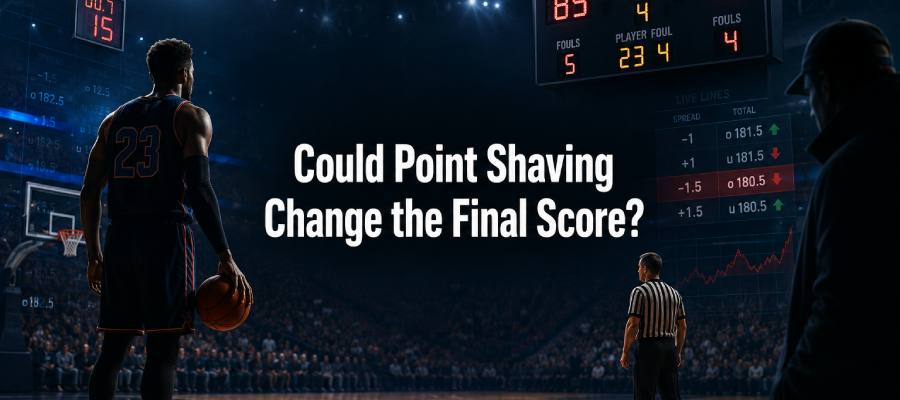
In sports betting, point shaving is the illegal practice of intentionally influencing a team’s scoring margin so the team doesn’t cover the published point spread. Unlike match fixing, it doesn’t require a team to lose. A team can win the game outright and still fail to cover the spread, which is easier to understand once you know how sportsbooks work and how betting lines get priced.
Point shaving usually involves a player or other participant deliberately affecting their team’s performance after receiving money or another benefit from someone tied to illegal gambling. The goal is to influence the margin of victory, not the outright winner. For beginners, these lessons on how to start sports betting cover odds, betting markets, point spreads, and responsible wagering before you get into fraud and integrity issues.
Editorial Note
This article explains what point shaving is, how point shaving works in sports betting, how it relates to point spreads, and why it threatens the integrity of sporting events. It is intended for educational purposes only and does not promote or condone match fixing, sports betting fraud, bribery or any other illegal activity.
Quick Answer
Point shaving is the illegal practice of intentionally influencing the scoring margin in a sporting event so a team fails to cover the betting spread. It can involve players or other participants deliberately affecting performance in exchange for money or another benefit. Point shaving is different from match fixing because the objective may be to influence the margin of victory rather than determine which team wins.
Table of Contents
- Editorial Note
- What Is Point Shaving?
- How Does a Point-Shaving Scheme Work?
- How Does Point Shaving Relate to the Point Spread?
- Can a Team Win and Still Be Involved in Point Shaving?
- What Is the Difference Between Point Shaving and Match Fixing?
- What Is the Difference Between Point Shaving and Spot Fixing?
- Examples of Point Shaving in Sports Betting
- Why Is Point Shaving Illegal?
- How Do Sportsbooks Detect Point Shaving?
- What Happens to Athletes Involved in Point Shaving?
- Why Is College Basketball Often Associated With Point Shaving?
- Can Point Shaving Happen in Other Sports?
- How Does Point Shaving Affect Sports Bettors?
- Point Shaving vs. Match Fixing vs. Spot Fixing
- FAQ
What Is Point Shaving?
Point shaving is the illegal practice of intentionally influencing a team’s scoring margin so it fails to cover a betting spread. The key distinction is that point shaving does not necessarily mean fixing which team wins. A favored team can win the game while deliberately winning by fewer points than expected.
For example, if Team A is a 10-point favorite, a point-shaving scheme could involve intentionally reducing the team’s margin so it wins by fewer than 10 points. The team wins, but a bet on Team A -10 loses because the team did not cover the spread.
Quick Answer
What does point shaving mean? It means deliberately manipulating a team’s scoring margin to influence a betting outcome, usually by preventing the team from covering the point spread.
Can a team win and still be involved in point shaving? Yes. Point shaving can involve a team winning the game but failing to cover the spread because its margin of victory was intentionally reduced.
This is why point shaving and point spreads are closely connected. A sportsbook’s point spread creates a betting market around the expected margin between two teams. Bettors wagering against the spread are not simply predicting which team will win; they are predicting whether the team will outperform or fall short of that number.
How Does a Point-Shaving Scheme Work?
A point-shaving scheme generally involves a player or another participant deliberately affecting performance after being approached by someone attempting to profit from a betting scheme. In basketball, for example, manipulated performance could involve missed shots, unnecessary turnovers, poor passes or other actions that reduce a team’s scoring efficiency.
The objective is generally to influence the final margin rather than necessarily lose the game. A gambler involved in the scheme may place a wager based on the expected result of the manipulated spread.
How Point Shaving Works
Because this type of betting-related manipulation intentionally influences a sporting event, it is a serious sports integrity issue. Players, coaches, officials and other participants can face significant disciplinary, financial and legal consequences if they become involved in such schemes.
How Does Point Shaving Relate to the Point Spread?
The point spread is central to understanding point shaving. A sportsbook assigns a spread to represent the expected difference between two teams. The favorite must win by more than that number for a standard spread wager on the favorite to cover.
Consider a team listed as a 7.5-point favorite:
| Final Score | Margin | Favorite -7.5 |
|---|---|---|
| 100-90 | 10 points | Covers |
| 100-95 | 5 points | Does not cover |
In the first example, the favorite wins by 10 and covers a -7.5 spread. In the second, the favorite still wins but falls short of the required margin. That difference between winning the game and covering the spread explains why point shaving can affect a betting market without changing the outright winner.
Key Insight
⚙ Winning:
The team finishes with more points than its opponent.
Covering:
The team wins or loses by enough points to beat the published spread.
Can a Team Win and Still Be Involved in Point Shaving?
Yes. A team can win a game and still be involved in a spread-manipulation scheme. The defining issue is the intentional manipulation of the scoring margin, not necessarily which team wins.
For example, imagine a heavily favored team is expected to win by 12 points but deliberately plays poorly enough to win by only four. The team wins the game, but it fails to cover a -12 spread. That is one of the clearest ways to understand the difference between point shaving and match fixing.
Winning vs. Covering the Spread
What Is the Difference Between Point Shaving and Match Fixing?
Point shaving generally involves manipulating the scoring margin or another aspect of a contest connected to a betting line. Match fixing is a broader term that typically refers to deliberately manipulating the outcome or a specific result of a sporting event for an improper purpose.
The distinction matters because a point-shaving scheme may allow the favored team to win while ensuring it does not cover the spread. Match fixing can instead involve manipulating which team wins or loses.
Another related term is spot fixing, which involves manipulating a specific event or action during a game rather than necessarily controlling the final result. These concepts can overlap, but they are not interchangeable.
| Term | What Is Manipulated? | Typical Betting Connection |
|---|---|---|
| Point shaving | Scoring margin or spread-related result | Point spread |
| Match fixing | Game outcome or predetermined result | Winner, loser or other market |
| Spot fixing | Specific event or action | Player or game-specific market |
What Is the Difference Between Point Shaving and Spot Fixing?
Point shaving focuses primarily on influencing the scoring margin or another outcome tied to the betting spread. Spot fixing involves deliberately manipulating a specific event within a game, such as a particular play, action or statistical occurrence.
Both can undermine sports integrity and may be connected to illegal betting activity, but they describe different forms of game manipulation. Understanding the difference between point shaving, match fixing and spot fixing helps put sports betting corruption into context.
Examples of Point Shaving in Sports Betting
Some of the most well-known point-shaving scandals have occurred in college basketball. The 1951 CCNY basketball scandal involved players from the City College of New York and became one of the most infamous sports betting scandals in American history.
The investigation eventually involved players and individuals connected to several schools, including NYU, Long Island University, Kentucky, Manhattan College, Bradley and Toledo. The case demonstrated how gambling networks could attempt to influence college basketball games.
Other notable cases include the Dixie Classic scandal of 1961 and the Boston College basketball point-shaving scandal of 1978–79. These cases are frequently discussed in connection with the history of point shaving scandals in college basketball.
Key Insight
⚙ Historical pattern:
Many high-profile American point-shaving cases have involved college basketball.
Important distinction:
Historical scandals do not mean modern sporting events are generally manipulated. Most games are played competitively and fairly.
Why Is Point Shaving Illegal?
Point shaving can involve intentionally manipulating a sporting event for financial gain and may involve bribery, fraud, illegal gambling or other criminal conduct. It also undermines the integrity of the betting market by creating a result that is influenced by factors outside legitimate athletic competition.
For sportsbooks and leagues, protecting the integrity of games is critical. Suspicious betting patterns, unusual wagering activity and information from integrity-monitoring organizations can contribute to investigations into potential sports betting fraud.
How Do Sportsbooks Detect Point Shaving?
Sportsbooks and sports integrity organizations can monitor betting markets for unusual activity that may indicate potential manipulation. Examples include unexpected betting patterns, unusual changes in betting volume, suspicious wagers and activity that appears inconsistent with normal market behavior.
Unusual betting activity does not automatically prove point shaving. Legitimate factors can also cause betting markets to move, so suspected cases generally require further investigation by sportsbooks, leagues, regulators or law enforcement.
Potential Integrity Signals
What Happens to Athletes Involved in Point Shaving?
Athletes involved in point shaving can face serious consequences depending on the circumstances and applicable laws. Potential consequences can include suspension, expulsion from a league or school, loss of eligibility, financial penalties and criminal prosecution.
The consequences can extend beyond the athlete. Coaches, officials, gamblers and other individuals involved in a point-shaving or game-fixing scheme may also face disciplinary or legal action.
Why Is College Basketball Often Associated With Point Shaving?
College basketball has a long history of high-profile point-shaving cases, which is one reason the sport is frequently associated with the term. Basketball also provides many individual possessions and scoring opportunities, meaning small changes in shooting, turnovers, fouls and late-game decisions can affect the final margin.
That historical association does not mean point shaving is common in legitimate college basketball or that basketball games should be assumed to be manipulated. The vast majority of sporting events are played competitively and fairly.
Can Point Shaving Happen in Other Sports?
Point shaving is most commonly discussed in basketball and other sports where a point spread or scoring margin is an important betting market. Similar forms of performance or outcome manipulation can occur in football and other sports, although the terminology may differ.
In football, intentionally poor performance could potentially affect the margin of victory and whether a team covers the spread. In soccer, cricket and other sports, betting-related manipulation may instead involve match fixing or spot fixing because their betting markets and scoring structures differ from those of point-spread sports.
How the Concept Varies by Sport
How Does Point Shaving Affect Sports Bettors?
Point shaving undermines the basic assumption that bettors are wagering on a legitimate sporting contest. If a player or other participant intentionally influences performance, the final result may no longer reflect normal competitive play, while bettors who are unaware of the manipulation are left at a disadvantage.
Key Insight
⚙ Betting impact:
Scoring-margin manipulation can affect whether a team covers the point spread even when that team still wins the game.
Integrity impact:
Manipulating a sporting event compromises fair competition and can undermine confidence in the betting market.
This is why sports betting fraud, game manipulation and point shaving are serious sports integrity concerns. Legitimate sports betting depends on competitive events and participants acting independently of illegal gambling interests.
Understanding point spreads, margin of victory and betting odds can help bettors see why a team’s outright result is not always the same as its spread result. For example, a favorite can win by five points but fail to cover a -7.5 spread.
For help converting betting odds and understanding implied probabilities, use the betting odds calculator.
Why the Spread Matters
Point Shaving vs. Match Fixing vs. Spot Fixing
Point shaving, match fixing and spot fixing are related forms of sports manipulation, but they do not mean exactly the same thing. Point shaving generally focuses on influencing the scoring margin or spread-related result. Match fixing is broader and can involve manipulating which team wins, loses or produces a predetermined result. Spot fixing focuses on a specific event or action within a game.
| Type | What Is Manipulated? | Example Betting Connection |
|---|---|---|
| Point shaving | Scoring margin | Team fails to cover the point spread |
| Match fixing | Game outcome or predetermined result | Winner, loser or specific result |
| Spot fixing | Specific event or action | Player or game-specific market |
The Key Difference
Knowing these distinctions can help bettors better understand news reports involving sports corruption, betting scandals, sports betting fraud, game fixing and integrity investigations. It also reinforces why legitimate betting markets depend on sporting events being conducted fairly and without improper influence.
FAQ
What does point shaving mean?
It means intentionally influencing a team’s scoring margin to affect a betting outcome, usually by preventing the team from covering the point spread.
Is point shaving the same as match fixing?
No. Point shaving generally focuses on the scoring margin or spread-related result, while match fixing can involve manipulating the outcome of an entire sporting event.
Can a team win and still be involved in a point-shaving scheme?
Yes. A team can win the game but fail to cover the spread if its scoring margin has been deliberately reduced.
Why is point shaving associated with sports betting?
The practice is closely connected to sports betting because the objective is often to influence a wager based on the point spread or margin of victory.
What sports have had point-shaving scandals?
Basketball, particularly college basketball, has been associated with many high-profile betting scandals involving manipulation of scoring margins.
How can sportsbooks detect betting manipulation?
Sportsbooks and integrity organizations can monitor unusual betting patterns, suspicious wagers and unexpected market activity. Suspicious activity alone does not prove that a game has been manipulated.
What happens if a player is caught shaving points?
Depending on the circumstances, an athlete can face suspension, loss of eligibility, financial penalties, disciplinary action or criminal prosecution.
NEXT STEP
Build a Stronger Understanding of Sports Betting
Now that you understand point shaving, take the next step by learning how to start sports betting and how odds, spreads and betting markets work.
Learn Sports Betting BasicsMyBookie: Bet On Anything. Anywhere. Anytime.

About the Author

Henry Watkins is a Sports Writer at MyBookie. Originally from Scotland and currently residing in Metro Atlanta with his wife, Penny, Henry covers competitive and professional sports as well as the business of sports. In addition to his sports writing, he is an author of horror fiction, including Karaoke Night, Crueller, and Off The Grid.
Sportsbook Bonuses
Read requirements in the Bonus page. However, if you want to take a deep knowledge, go to MyBookie Bonus Rules and How to